Department of Cardiology, National Centre for Global Health and Medicine, Tokyo, Japan.
Biostatistics Section, Centre for Clinical Sciences, National Centre for Global Health and Medicine, Tokyo, Japan.
Int J Infect Dis. 2021 Nov;112:111-116. doi: 10.1016/j.ijid.2021.09.014. Epub 2021 Sep 10.
To determine whether anticoagulation therapy improves outcomes in patients with coronavirus disease 2019 (COVID-19) in Japan given their lower risk of thrombosis compared with Western cohorts.
The efficacy of anticoagulation therapy in hospitalized patients with COVID-19 was evaluated using a nationwide registry: the COVID-19 Registry Japan. The inverse probability of weight treatment method was used to adjust for baseline confounders in the anticoagulation and non-anticoagulation groups.
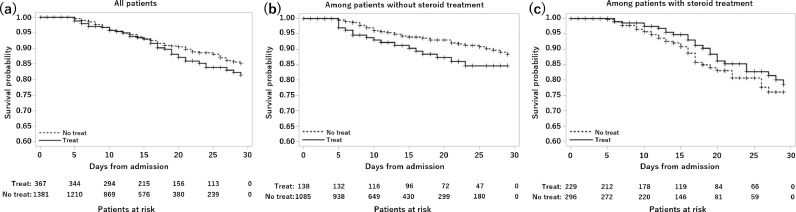
Of the 1748 patients included, anticoagulants were used in 367 patients (treatment group). The patients in the anticoagulant group were older, predominantly male, and often presented with obesity, hyperlipidaemia, hypertension, diabetes and elevated D-dimer levels. Twenty-nine-day mortality was 7.6% in the whole cohort (treatment group, 11.2%; no treatment group, 6.6%), 6% in patients who were not treated with steroids (treatment group, 12.3%; no treatment group, 5.2%), and 11.2% in patients treated with steroids (treatment group, 10.5%; no treatment group, 11.8%). Mortality in the whole cohort was similar between the treatment and no treatment groups (P=0.99), and an insignificant decreasing trend in mortality was observed in patients treated with steroids (P=0.075).
Anticoagulants may be beneficial in Asians, in whom comorbidities and risk of thrombosis may differ from other ethnic groups.
与西方队列相比,日本的 2019 年冠状病毒病(COVID-19)患者的血栓形成风险较低,确定抗凝治疗是否改善 COVID-19 住院患者的结局。
使用全国登记处 COVID-19 登记日本对 COVID-19 住院患者的抗凝治疗效果进行评估。使用逆概率加权治疗方法(inverse probability of weight treatment method)调整抗凝和非抗凝组的基线混杂因素。
在纳入的 1748 例患者中,367 例(治疗组)使用了抗凝剂。抗凝剂组患者年龄较大,主要为男性,常伴有肥胖、高脂血症、高血压、糖尿病和 D-二聚体水平升高。全队列 29 天死亡率为 7.6%(治疗组 11.2%;未治疗组 6.6%),未使用类固醇的患者为 6%(治疗组 12.3%;未治疗组 5.2%),使用类固醇的患者为 11.2%(治疗组 10.5%;未治疗组 11.8%)。全队列治疗组和未治疗组之间的死亡率无差异(P=0.99),使用类固醇的患者死亡率呈下降趋势,但无统计学意义(P=0.075)。
抗凝剂可能对亚洲人有益,亚洲人的合并症和血栓形成风险可能与其他种族不同。