Department of Medical Sciences, Uppsala University, Uppsala, Sweden
Department of Public Health and Caring Sciences/Geriatrics, Uppsala University, Uppsala, Sweden.
Open Heart. 2021 Sep;8(2). doi: 10.1136/openhrt-2021-001735.
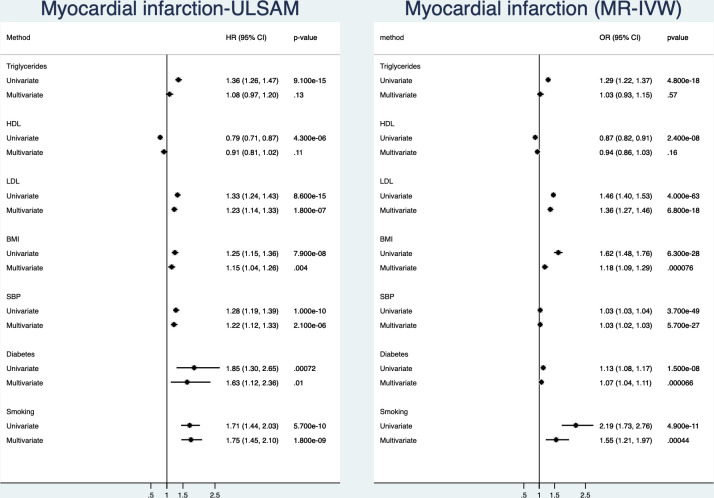
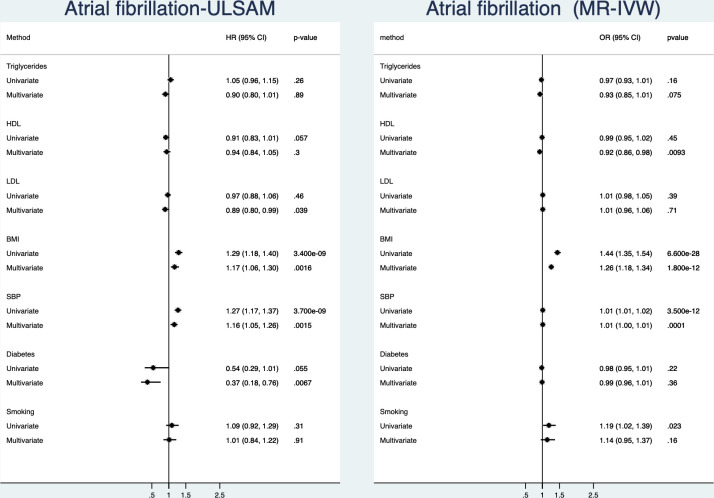
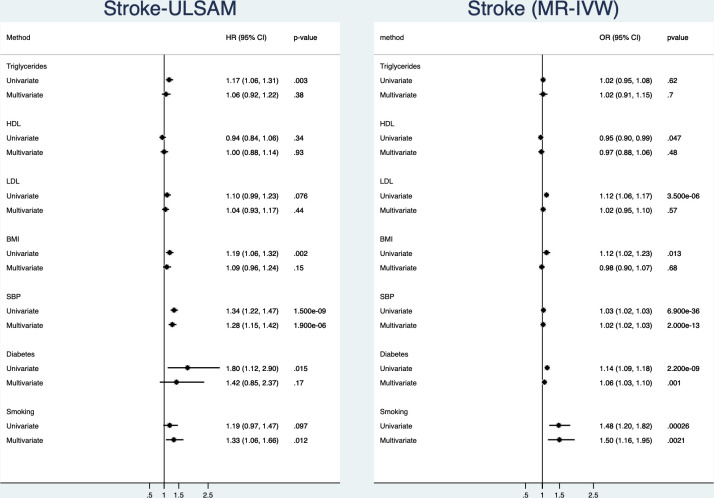
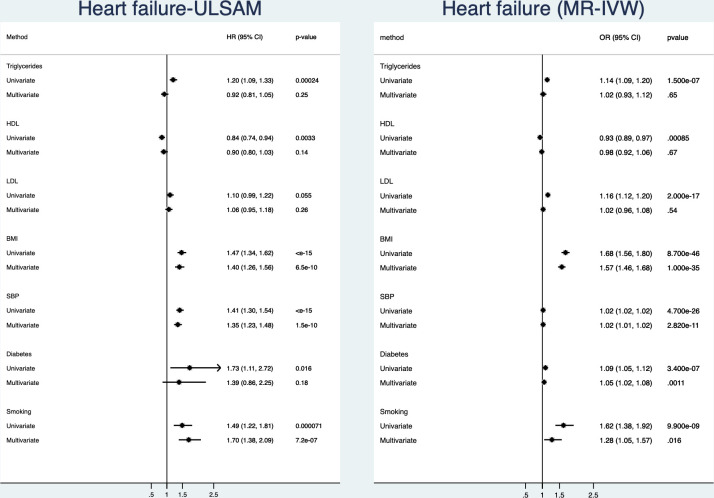
This study compared the strength and causality of associations between major risk factors for cardiovascular disease (CVD) and the four major CVDs: myocardial infarction, ischaemic stroke, heart failure and atrial fibrillation. Both a long-term follow-up in an observational cohort and Mendelian randomisation (MR) were used for this aim.
In the Uppsala Longitudinal Study of Adult Men study, 2322 men, all aged 50 years, were assessed for CVD risk factors and then followed for four decades regarding incident CVDs. The two-sample MR part used public available Genome-Wide Association Study (GWAS) data.
In multivariate analyses, systolic blood pressure was overall by far the most important risk factor, since it was related to all four CVDs, both in observational and MR analyses. Body mass index was the second most overall important risk factor, being linked to all four CVDs, except ischaemic stroke, both in observational and MR analyses. Smoking was an important risk factor for ischaemic stroke and heart failure, both in observational and MR analyses, while low-density lipoprotein-cholesterol mainly was related to myocardial infarction. Diabetes was mainly a causal risk factor for incident myocardial infarction and heart failure. Neither HDL-cholesterol nor triglycerides were of major importance as risk factors in these multivariable models.
By combining long-term observational data with genetic data, we show that the impact and causal role of specific established cardiovascular risk factors varies between different major CVDs. Systolic blood pressure was causally related to all four cardiovascular outcomes and was therefore, overall, the most important risk factor.
本研究比较了心血管疾病(CVD)的主要危险因素与四大 CVD 之间的关联强度和因果关系:心肌梗死、缺血性卒、心力衰竭和心房颤动。本研究旨在使用长期观察队列研究和孟德尔随机化(MR)两种方法实现这一目标。
在乌普萨拉男性成人纵向研究中,对 2322 名年龄均为 50 岁的男性进行了 CVD 风险因素评估,然后对他们进行了长达四十年的 CVD 发病情况随访。两样本 MR 部分使用了公开的全基因组关联研究(GWAS)数据。
在多变量分析中,收缩压是迄今为止最重要的危险因素,因为它与所有四种 CVD 均相关,无论是在观察性研究还是 MR 分析中。体重指数是第二重要的总体危险因素,与除缺血性卒中之外的所有四种 CVD 均相关,无论是在观察性研究还是 MR 分析中。吸烟是缺血性卒中和心力衰竭的重要危险因素,无论是在观察性研究还是 MR 分析中,而 LDL-胆固醇主要与心肌梗死相关。糖尿病是心肌梗死和心力衰竭发病的主要因果危险因素。高密度脂蛋白胆固醇和甘油三酯在这些多变量模型中均不是主要的危险因素。
通过将长期观察性数据与遗传数据相结合,我们表明特定的已建立的心血管危险因素对不同的主要 CVD 的影响和因果作用是不同的。收缩压与所有四种心血管结局均存在因果关系,因此总体而言,它是最重要的危险因素。