Xie Puguang, Li Yuyao, Deng Bo, Du Chenzhen, Rui Shunli, Deng Wu, Wang Min, Boey Johnson, Armstrong David G, Ma Yu, Deng Wuquan
Department of Endocrinology and Metabolism, Chongqing Emergency Medical Center, Chongqing Key Laboratory of Emergency Medicine, Chongqing University Central Hospital, Chongqing University, Chongqing, China.
College of Bioengineering, Chongqing University of China, Chongqing, China.
Int Wound J. 2022 May;19(4):910-918. doi: 10.1111/iwj.13691. Epub 2021 Sep 14.
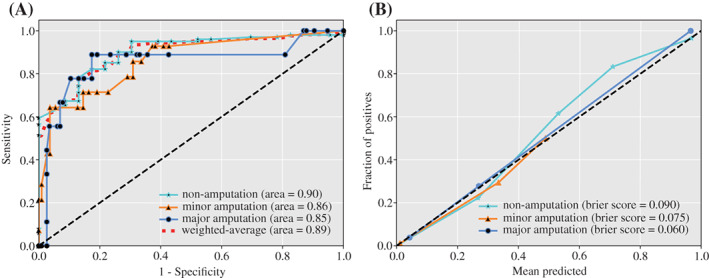
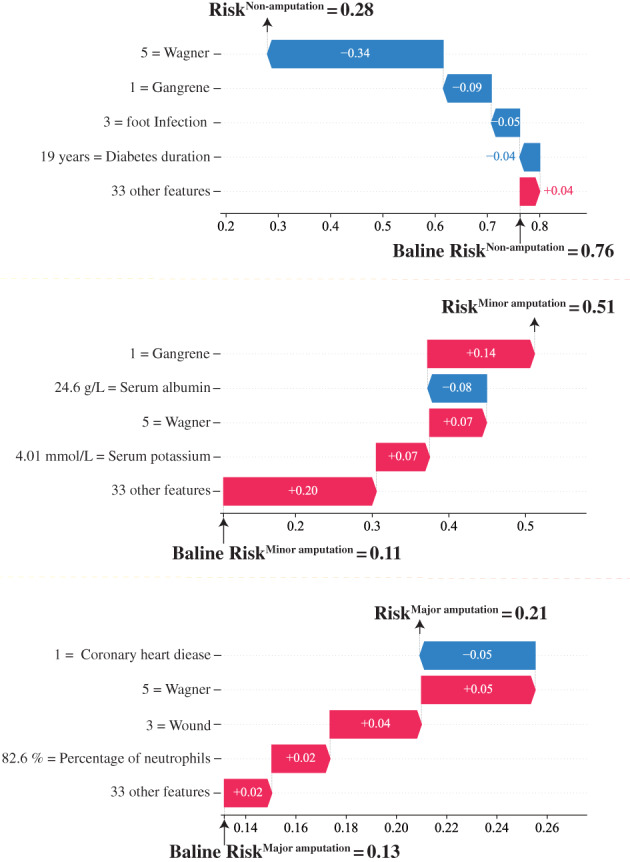
Diabetic foot ulcer (DFU) is one of the most serious and alarming diabetic complications, which often leads to high amputation rates in diabetic patients. Machine learning is a part of the field of artificial intelligence, which can automatically learn models from data and better inform clinical decision-making. We aimed to develop an accurate and explainable prediction model to estimate the risk of in-hospital amputation in patients with DFU. A total of 618 hospitalised patients with DFU were included in this study. The patients were divided into non-amputation, minor amputation or major amputation group. Light Gradient Boosting Machine (LightGBM) and 5-fold cross-validation tools were used to construct a multi-class classification model to predict the three outcomes of interest. In addition, we used the SHapley Additive exPlanations (SHAP) algorithm to interpret the predictions of the model. Our area under the receiver-operating-characteristic curve (AUC) demonstrated a 0.90, 0.85 and 0.86 predictive ability for non-amputation, minor amputation and major amputation outcomes, respectively. Taken together, our data demonstrated that the developed explainable machine learning model provided accurate estimates of the amputation rate in patients with DFU during hospitalisation. Besides, the model could inform individualised analyses of the patients' risk factors.
糖尿病足溃疡(DFU)是最严重且令人担忧的糖尿病并发症之一,常导致糖尿病患者的高截肢率。机器学习是人工智能领域的一部分,它可以从数据中自动学习模型,并更好地为临床决策提供依据。我们旨在开发一种准确且可解释的预测模型,以估计DFU患者的院内截肢风险。本研究共纳入618例住院DFU患者。这些患者被分为非截肢、小截肢或大截肢组。使用轻量级梯度提升机(LightGBM)和五折交叉验证工具构建多类分类模型,以预测三个感兴趣的结果。此外,我们使用SHapley值加法解释(SHAP)算法来解释模型的预测结果。我们的受试者工作特征曲线(AUC)下面积分别显示出对非截肢、小截肢和大截肢结果的预测能力为0.90、0.85和0.86。综上所述,我们的数据表明,所开发的可解释机器学习模型能够准确估计住院DFU患者的截肢率。此外,该模型可为患者风险因素的个体化分析提供依据。