Sam Napoleon Bellua, Guan Shi-Yang, Wang Peng, Li Xiao-Mei, Wang De-Guang, Pan Hai-Feng, Ye Dong-Qing
Department of Epidemiology and Biostatistics, School of Public Health and Anhui Province Key Laboratory of Major Autoimmune Diseases, Anhui Medical University, Hefei, Anhui, China.
Department of Rheumatology and Immunology, Anhui Provincial Hospital, Hefei, Anhui, China.
Arch Med Sci. 2019 May 31;17(5):1232-1240. doi: 10.5114/aoms.2019.85459. eCollection 2021.
Several published results have established variations in respect to plasma/serum macrophage migration inhibitory factor (MIF) levels and gene polymorphisms with systemic lupus erythematosus (SLE). This study gave a more concise estimation on the MIF levels for SLE patients and established the association between MIF polymorphisms and SLE.
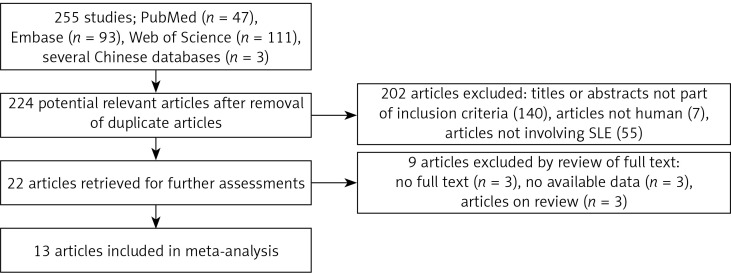
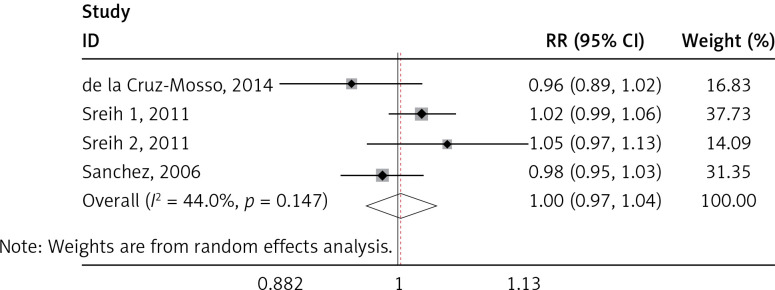
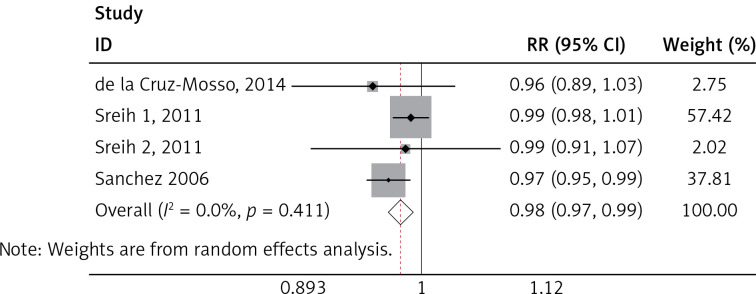
All articles were searched from PubMed, Embase, Web of Science, Wan-Fang, Chinese Biological Medical Literature, and China National Knowledge Infrastructure up to 6 October 2017, with no language restriction. Pooled standard mean difference with 95% confidence interval was evaluated using random effect model. Thirteen articles were used for this meta-analysis, with 620 SLE patients and 779 healthy controls assessed for MIF levels, and 2,159 SLE patients and 2,574 healthy controls considered for MIF-173 C/G and MIF-794 CATT polymorphisms.
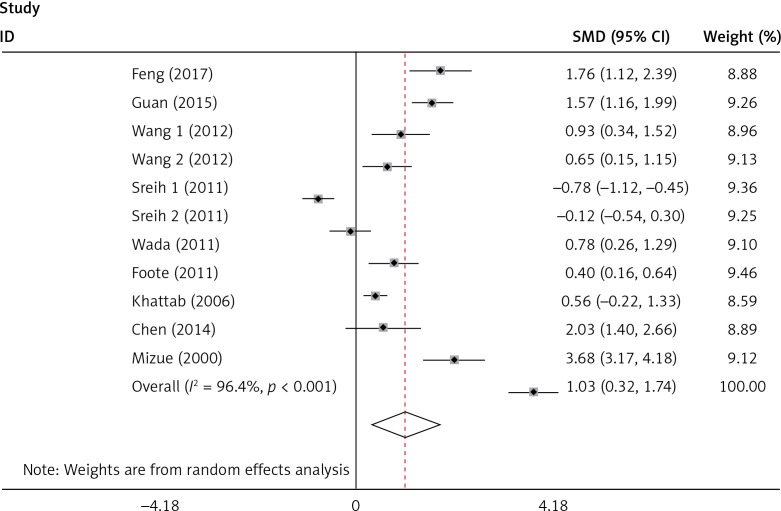
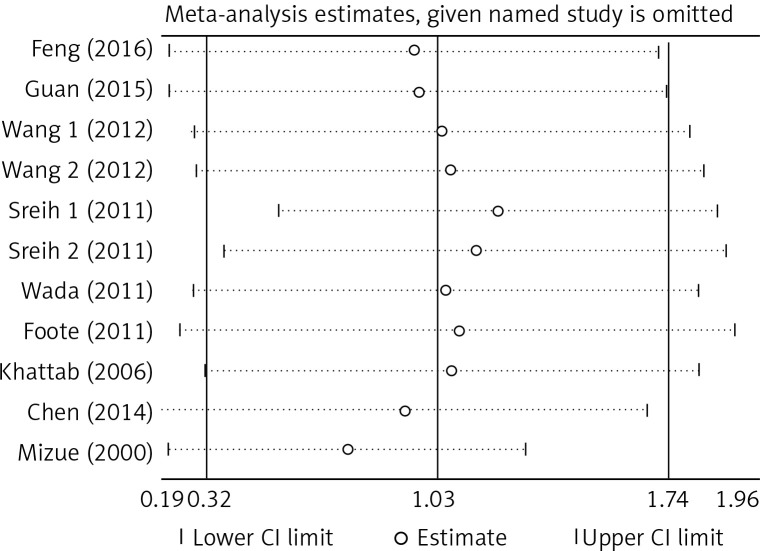
There was a significant higher MIF levels in SLE patients than in healthy controls ( = 0.004). The subgroup analysis showed Asians and ages < 30 had higher MIF levels in SLE patients than in healthy controls. It was evident that patients with systemic lupus erythematosus diseases activity index scores < 8 and ≥ 8, and disease duration for both year < 5 and ≥ 5 of SLE had higher MIF levels when compared to healthy controls. We found a significant association between SLE and MIF-173 C/G, but not MIF-794 CATT.
This study provided evidence of significant higher MIF levels in SLE patients and supported the association of MIF-173 C/G and SLE. However, we were not able to establish an association between MIF-794 CATT and SLE.
多项已发表的研究结果证实,系统性红斑狼疮(SLE)患者的血浆/血清巨噬细胞移动抑制因子(MIF)水平及基因多态性存在差异。本研究对SLE患者的MIF水平进行了更精确的评估,并确定了MIF基因多态性与SLE之间的关联。
检索了截至2017年10月6日的PubMed、Embase、Web of Science、万方、中国生物医学文献数据库和中国知网,不限语言。采用随机效应模型评估合并标准均数差及95%置信区间。本荟萃分析纳入13篇文章,共620例SLE患者和779例健康对照者的MIF水平数据,以及2159例SLE患者和2574例健康对照者的MIF - 173 C/G和MIF - 794 CATT基因多态性数据。
SLE患者的MIF水平显著高于健康对照者(P = 0.004)。亚组分析显示,亚洲人和年龄<30岁的SLE患者的MIF水平高于健康对照者。显然,系统性红斑狼疮疾病活动指数评分<8和≥8的患者,以及病程<5年和≥5年的SLE患者,其MIF水平均高于健康对照者。我们发现SLE与MIF - 173 C/G存在显著关联,但与MIF - 794 CATT无关联。
本研究证实SLE患者的MIF水平显著升高,并支持MIF - 173 C/G与SLE的关联。然而,我们未能确定MIF - 794 CATT与SLE之间的关联。