Dickens Jonathan Vivian, DeMarco Andrew T, van der Stelt Candace M, Snider Sarah F, Lacey Elizabeth H, Medaglia John D, Friedman Rhonda B, Turkeltaub Peter E
Department of Neurology, Georgetown University Medical Center, Washington, DC 20007, USA.
Center for Brain Plasticity and Recovery, Georgetown University Medical Center, Washington, DC 20007, USA.
Brain Commun. 2021 Aug 30;3(3):fcab194. doi: 10.1093/braincomms/fcab194. eCollection 2021.
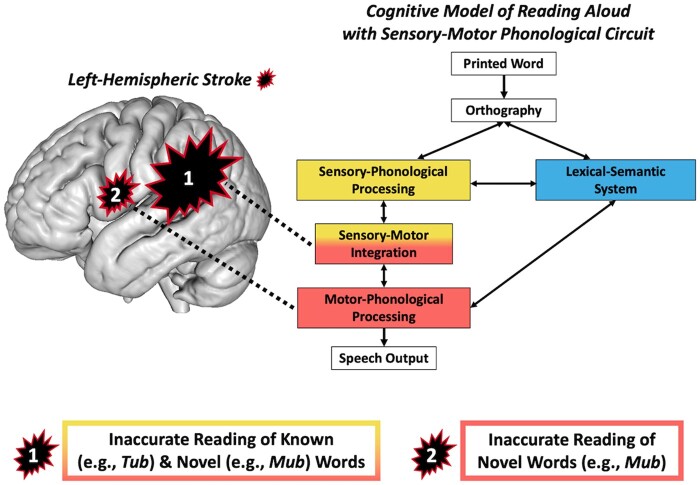
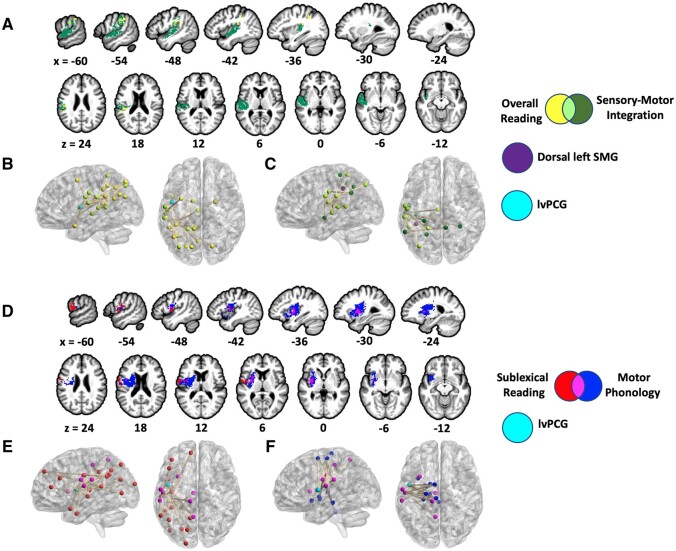
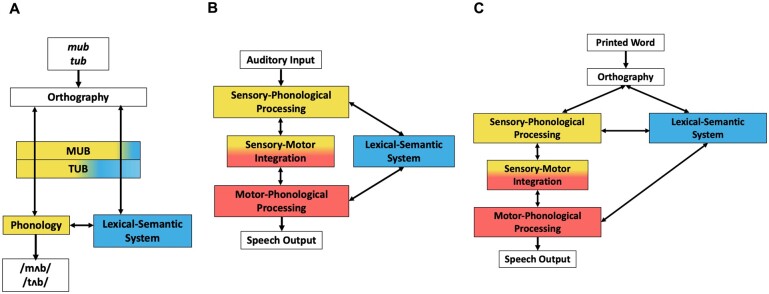
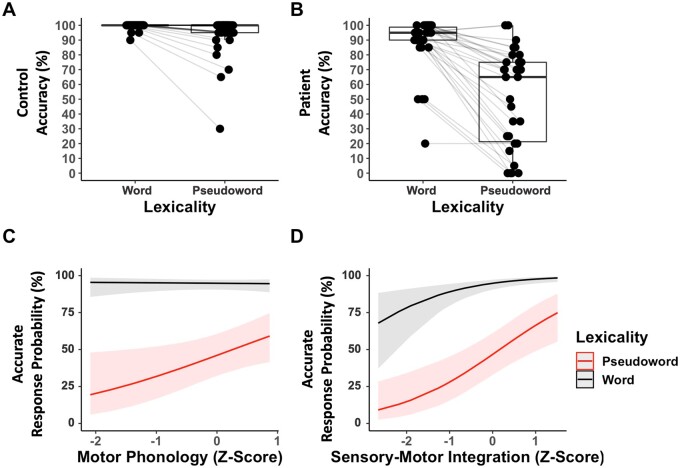
Alexia is common in the context of aphasia. It is widely agreed that damage to phonological and semantic systems not specific to reading causes co-morbid alexia and aphasia. Studies of alexia to date have only examined phonology and semantics as singular processes or axes of impairment, typically in the context of stereotyped alexia syndromes. However, phonology, in particular, is known to rely on subprocesses, including sensory-phonological processing, motor-phonological processing, and sensory-motor integration. Moreover, many people with stroke aphasia demonstrate mild or mixed patterns of reading impairment that do not fit neatly with one syndrome. This cross-sectional study tested whether the hallmark symptom of phonological reading impairment, the lexicality effect, emerges from damage to a specific subprocess of phonology in stroke patients not selected for alexia syndromes. Participants were 30 subjects with left-hemispheric stroke and 37 age- and education-matched controls. A logistic mixed-effects model tested whether post-stroke impairments in sensory phonology, motor phonology, or sensory-motor integration modulated the effect of item lexicality on patient accuracy in reading aloud. Support vector regression voxel-based lesion-symptom mapping localized brain regions necessary for reading and non-orthographic phonological processing. Additionally, a novel support vector regression structural connectome-symptom mapping method identified the contribution of both lesioned and spared but disconnected, brain regions to reading accuracy and non-orthographic phonological processing. Specifically, we derived whole-brain structural connectomes using constrained spherical deconvolution-based probabilistic tractography and identified lesioned connections based on comparisons between patients and controls. Logistic mixed-effects regression revealed that only greater motor-phonological impairment related to lower accuracy reading aloud pseudowords versus words. Impaired sensory-motor integration was related to lower overall accuracy in reading aloud. No relationship was identified between sensory-phonological impairment and reading accuracy. Voxel-based and structural connectome lesion-symptom mapping revealed that lesioned and disconnected left ventral precentral gyrus related to both greater motor-phonological impairment and lower sublexical reading accuracy. In contrast, lesioned and disconnected left temporoparietal cortex is related to both impaired sensory-motor integration and reduced overall reading accuracy. These results clarify that at least two dissociable phonological processes contribute to the pattern of reading impairment in aphasia. First, impaired sensory-motor integration, caused by lesions disrupting the left temporoparietal cortex and its structural connections, non-selectively reduces accuracy in reading aloud. Second, impaired motor-phonological processing, caused at least partially by lesions disrupting left ventral premotor cortex and structural connections, selectively reduces sublexical reading accuracy. These results motivate a revised cognitive model of reading aloud that incorporates a sensory-motor phonological circuit.
失读症在失语症背景下很常见。人们普遍认为,对非特定于阅读的语音和语义系统的损害会导致共病性失读症和失语症。迄今为止,关于失读症的研究仅将语音和语义作为单一过程或损伤轴进行考察,通常是在刻板的失读症综合征背景下。然而,众所周知,语音尤其依赖于子过程,包括感觉语音处理、运动语音处理和感觉运动整合。此外,许多中风失语症患者表现出轻度或混合性阅读障碍模式,并不完全符合某一种综合征。这项横断面研究测试了语音阅读障碍的标志性症状——词汇性效应,是否源于未被选入失读症综合征的中风患者语音特定子过程的损伤。参与者为30名左半球中风患者和37名年龄及教育程度匹配的对照组。一个逻辑混合效应模型测试了中风后感觉语音、运动语音或感觉运动整合方面的损伤是否调节了项目词汇性对患者大声朗读准确性的影响。基于支持向量回归的体素损伤-症状映射定位了阅读和非正字法语音处理所需的脑区。此外,一种新的支持向量回归结构连接组-症状映射方法确定了受损和未受损但断开连接的脑区对阅读准确性和非正字法语音处理的贡献。具体而言,我们使用基于约束球面反卷积的概率纤维束成像得出全脑结构连接组,并根据患者与对照组的比较确定受损连接。逻辑混合效应回归显示,只有更大的运动语音损伤与朗读假词与真词相比准确性较低相关。感觉运动整合受损与大声朗读的总体准确性较低相关。未发现感觉语音损伤与阅读准确性之间的关系。基于体素和结构连接组的损伤-症状映射显示,受损和断开连接的左侧腹侧中央前回与更大的运动语音损伤和更低的次词汇阅读准确性均相关。相比之下,受损和断开连接的左侧颞顶叶皮层与感觉运动整合受损和总体阅读准确性降低均相关。这些结果表明,至少有两个可分离的语音过程导致了失语症患者的阅读障碍模式。首先,由破坏左侧颞顶叶皮层及其结构连接的损伤引起的感觉运动整合受损,非选择性地降低了大声朗读的准确性。其次,至少部分由破坏左侧腹侧运动前皮层及其结构连接的损伤引起的运动语音处理受损,选择性地降低了次词汇阅读准确性。这些结果促使人们对大声朗读的认知模型进行修订,纳入感觉运动语音回路。