Martin Kelly C, DeMarco Andrew T, Dyslin Sara M, Turkeltaub Peter E
Georgetown University Medical Center.
Georgetown University Medical Center, MedStar National Rehabilitation Hospital.
Res Sq. 2024 Apr 1:rs.3.rs-4189759. doi: 10.21203/rs.3.rs-4189759/v1.
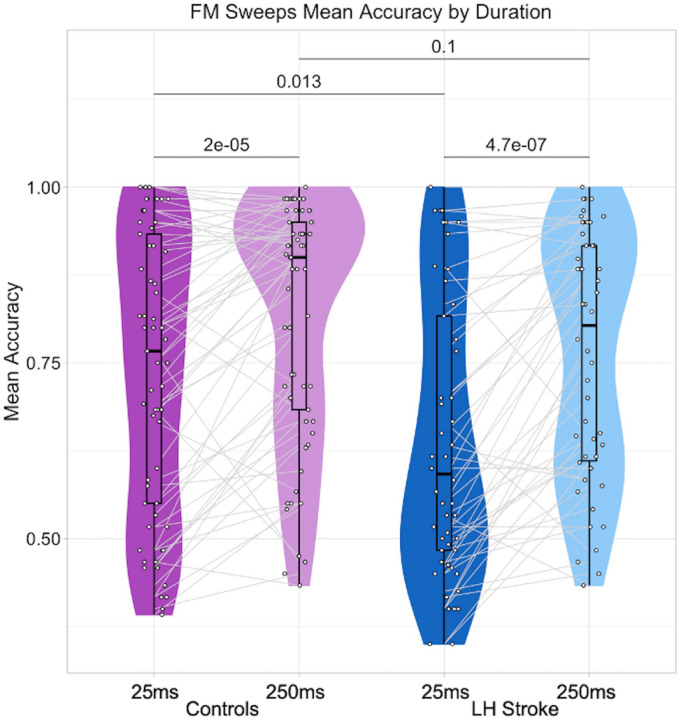
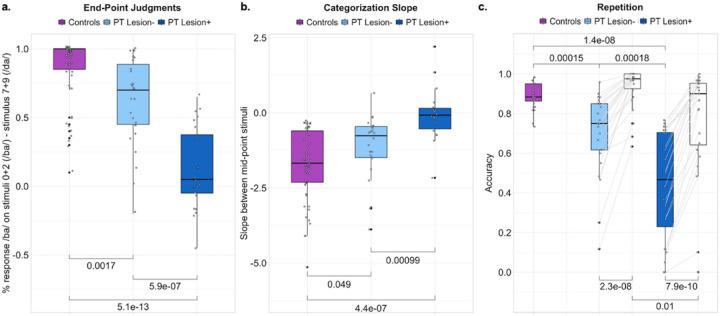
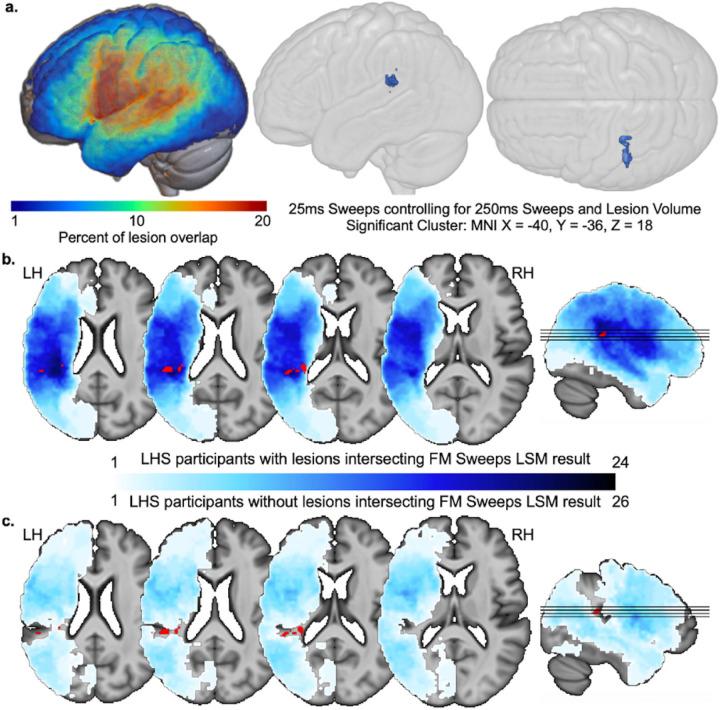
After initial bilateral acoustic processing of the speech signal, much of the subsequent language processing is left-lateralized. The reason for this lateralization remains an open question. Prevailing hypotheses describe a left hemisphere (LH) advantage for rapidly unfolding information-such as the segmental (e.g., phonetic and phonemic) components of speech. Here we investigated whether and where damage to the LH predicted impaired performance on judging the directionality of frequency modulated (FM) sweep stimuli that changed within short (25ms) or longer (250ms) temporal windows. Performance was significantly lower for stroke survivors (n = 50; 18 female) than controls (n = 61; 34 female) on FM Sweeps judgments, particularly on the short sweeps. Support vector regression lesion-symptom mapping (SVR-LSM) revealed that part of the left planum temporale (PT) was related to worse performance on judging the short FM sweeps, controlling for performance on the long sweeps. We then investigated whether damage to this particular area related to diminished performance on two levels of linguistic processing that theoretically depend on rapid auditory processing: stop consonant identification and pseudoword repetition. We separated stroke participants into subgroups based on whether their LH lesion included the part of the left PT that related to diminished short sweeps judgments. Participants with PT lesions (PT lesion+, n = 24) performed significantly worse than those without (PT lesion-, n = 26) on stop consonant identification and pseudoword repetition, controlling for lesion size and hearing ability. Interestingly, PT lesions impacted pseudoword repetition more than real word repetition (PT lesion-by-repetition trial type interaction), which is of interest because pseudowords rely solely on sound perception and sequencing, whereas words can also rely on lexical-semantic knowledge. We conclude that the left PT is a critical region for processing auditory information in short temporal windows, and it may also be an essential transfer point in auditory-to-linguistic processing.
在对语音信号进行初始的双侧声学处理之后,大部分后续的语言处理都偏向左侧化。这种侧化的原因仍然是一个悬而未决的问题。流行的假说认为左半球(LH)在快速展开信息方面具有优势,例如语音的片段性(如语音和音素)成分。在这里,我们研究了LH损伤是否以及在何处预示着在判断在短(25毫秒)或长(250毫秒)时间窗口内变化的调频(FM)扫描刺激的方向性时表现受损。在FM扫描判断中,中风幸存者(n = 50;18名女性)的表现明显低于对照组(n = 61;34名女性),尤其是在短扫描中。支持向量回归损伤-症状映射(SVR-LSM)显示,左颞平面(PT)的一部分与判断短FM扫描时较差的表现有关,同时控制长扫描的表现。然后,我们研究了这个特定区域的损伤是否与理论上依赖快速听觉处理的两个语言处理水平上的表现下降有关:塞音识别和假词重复。我们根据中风参与者的LH损伤是否包括与短扫描判断能力下降相关的左PT部分,将他们分为亚组。在控制损伤大小和听力能力的情况下,PT损伤组(PT损伤+,n = 24)在塞音识别和假词重复方面的表现明显比无PT损伤组(PT损伤-,n = 26)差。有趣的是,PT损伤对假词重复的影响比对真词重复更大(PT损伤×重复试验类型交互作用),这很有意思,因为假词仅依赖于声音感知和序列,而单词还可以依赖词汇语义知识。我们得出结论,左PT是在短时间窗口内处理听觉信息的关键区域,它也可能是听觉到语言处理的重要转换点。