Division of Foodborne, Waterborne, and Environmental Diseases, Centers for Disease Control and Prevention, Atlanta, Georgia.
Now with One Health Office, Centers for Disease Control and Prevention, Atlanta, Georgia.
JAMA Netw Open. 2021 Sep 1;4(9):e2125203. doi: 10.1001/jamanetworkopen.2021.25203.
Extensively drug-resistant Campylobacter jejuni infections cannot be treated with any commonly recommended antibiotics and pose an increasing public health threat.
To investigate cases of extensively drug-resistant C jejuni associated with pet store puppies and describe the epidemiologic and laboratory characteristics of these infections.
DESIGN, SETTING, AND PARTICIPANTS: In August 2017, health officials identified, via survey, patients with C jejuni infections who reported contact with puppies sold by pet stores. In conjunction with state and federal partners, the Centers for Disease Control and Prevention investigated cases of culture-confirmed C jejuni infections in US patients with an epidemiologic or molecular association with pet store puppies between January 1, 2016, and February 29, 2020. Available records from cases occurring before 2016 with genetically related isolates were also obtained.
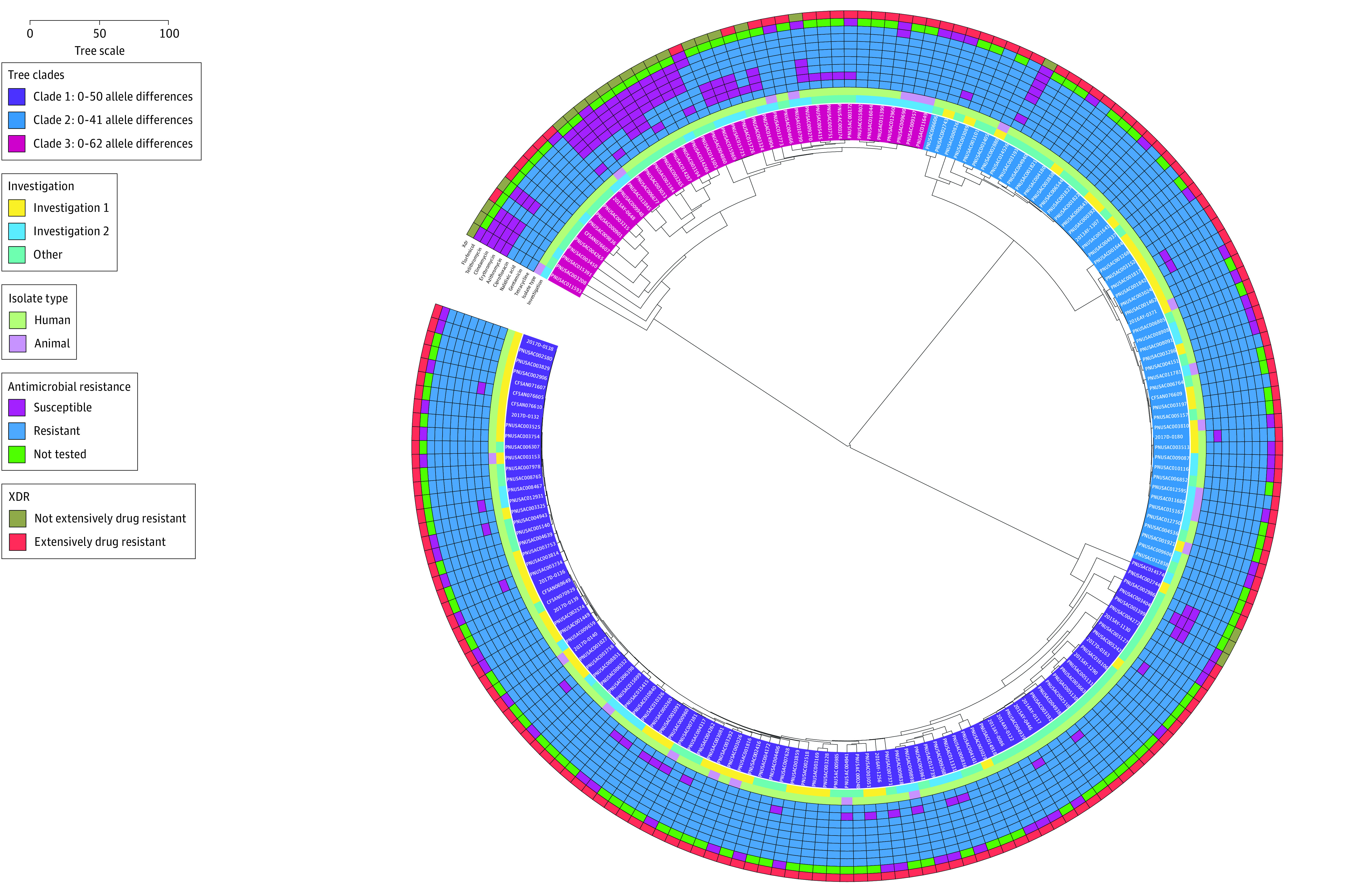
Patients were interviewed about demographic characteristics, health outcomes, and dog exposure during the 7 days before illness onset. Core genome multilocus sequence typing was used to assess isolate relatedness, and genomes were screened for resistance determinants to predict antibiotic resistance. Isolates resistant to fluoroquinolones, macrolides, and 3 or more additional antibiotic classes were considered to be extensively drug resistant. Cases before 2016 were identified by screening all sequenced isolates submitted for surveillance using core genome multilocus sequence typing.
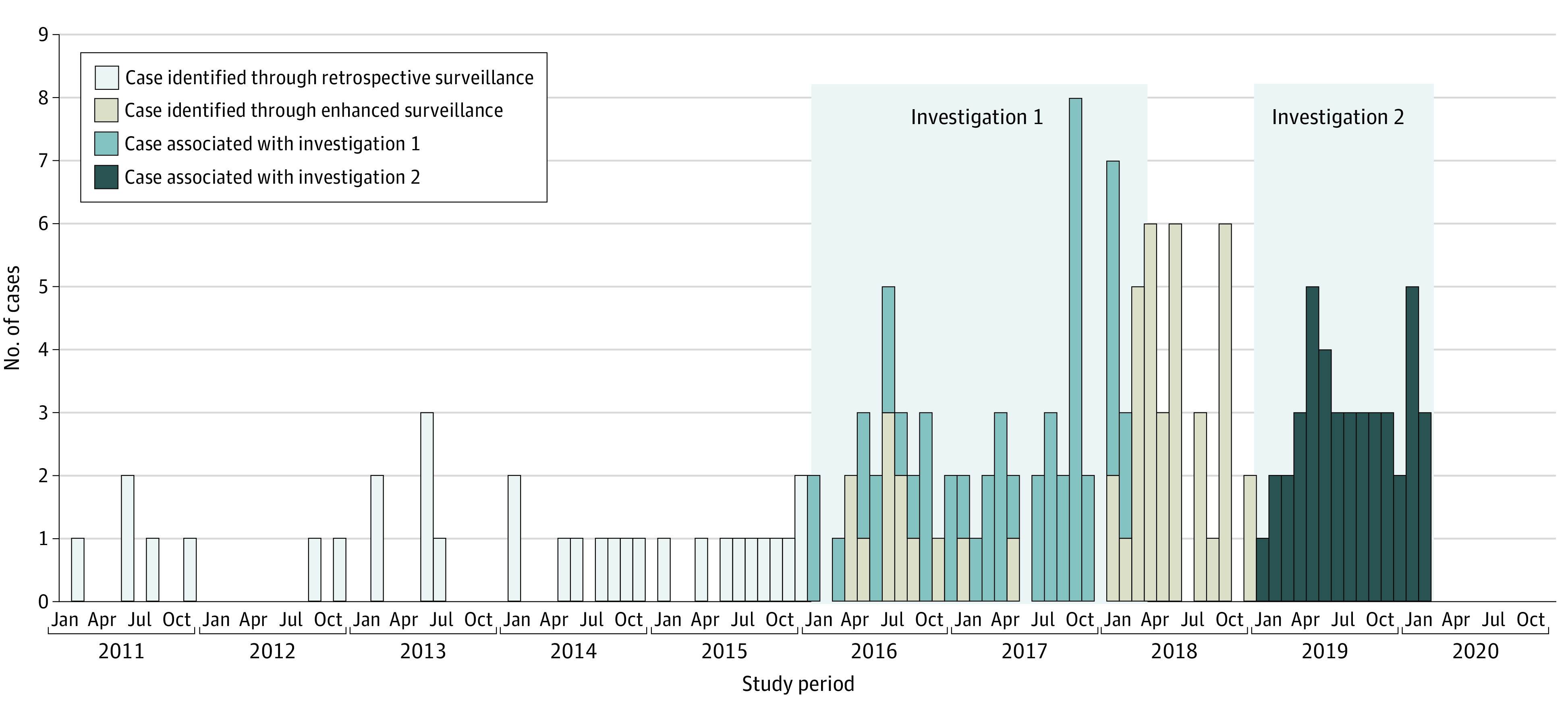
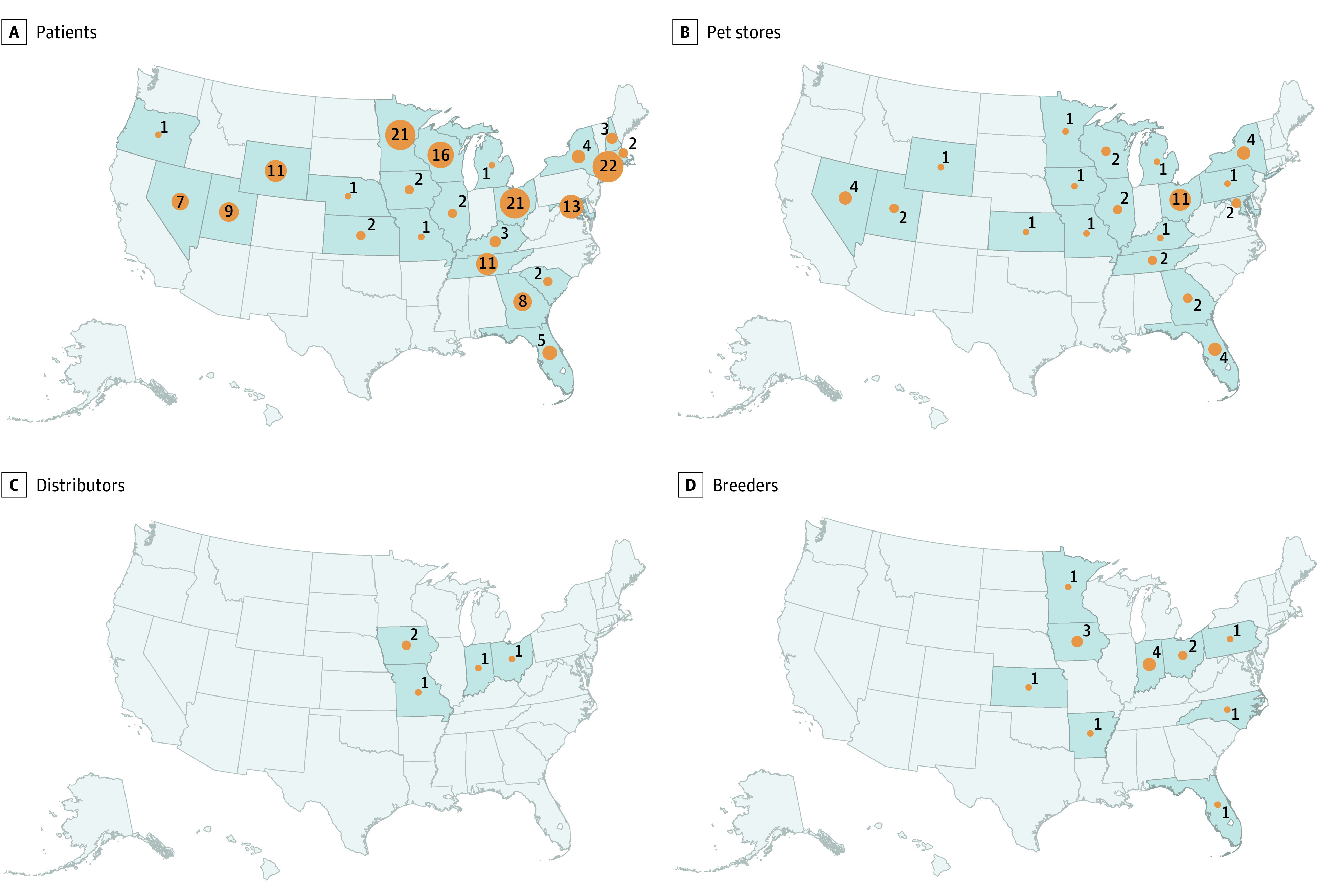
A total of 168 patients (median [interquartile range] age, 37 [19.5-51.0] years; 105 of 163 female [64%]) with an epidemiologic or molecular association with pet store puppies were studied. A total of 137 cases occurred from January 1, 2016, to February 29, 2020, with 31 additional cases dating back to 2011. Overall, 117 of 121 patients (97%) reported contact with a dog in the week before symptom onset, of whom 69 of 78 (88%) with additional information reported contact with a pet store puppy; 168 isolates (88%) were extensively drug resistant. Traceback investigation did not implicate any particular breeder, transporter, distributer, store, or chain.
Strains of extensively drug-resistant C jejuni have been circulating since at least 2011 and are associated with illness among pet store customers, employees, and others who come into contact with pet store puppies. The results of this study suggest that practitioners should ask about puppy exposure when treating patients with Campylobacter infection, especially when they do not improve with routine antibiotics, and that the commercial dog industry should take action to help prevent the spread of extensively drug-resistant C jejuni from pet store puppies to people.
对所有常见推荐抗生素均具有耐药性的广泛耐药性空肠弯曲菌感染无法得到治疗,对公共健康构成日益严重的威胁。
调查与宠物店小狗相关的广泛耐药性空肠弯曲菌感染病例,并描述这些感染的流行病学和实验室特征。
设计、地点和参与者:2017 年 8 月,通过调查,卫生官员确定了报告接触过宠物店出售的小狗的空肠弯曲菌感染患者。与州和联邦合作伙伴一起,美国疾病控制与预防中心调查了在 2016 年 1 月 1 日至 2020 年 2 月 29 日期间,与宠物店小狗具有流行病学或分子关联的美国患者中经培养确认的空肠弯曲菌感染病例。还获得了 2016 年之前发生的具有遗传相关分离株的病例的可用记录。
对患者进行了访谈,询问了他们在发病前 7 天的人口统计学特征、健康结果和狗接触情况。使用核心基因组多位点序列分型评估分离株的相关性,并对基因组进行筛选以预测抗生素耐药性。对氟喹诺酮类、大环内酯类和 3 种或 3 种以上其他抗生素类别的耐药分离株被认为是广泛耐药的。2016 年之前的病例是通过使用核心基因组多位点序列分型对提交监测的所有测序分离株进行筛选来确定的。
共研究了 168 名(中位数[四分位距]年龄,37 [19.5-51.0]岁;163 名女性[64%]中有 105 名)与宠物店小狗具有流行病学或分子关联的患者。从 2016 年 1 月 1 日至 2020 年 2 月 29 日共发生 137 例,另有 31 例回溯至 2011 年。总体而言,121 例患者中有 117 例(97%)在症状出现前一周报告与狗有接触,其中 78 例(88%)有其他信息的患者报告与宠物店小狗有接触;168 株(88%)分离株为广泛耐药。追溯调查未牵连任何特定的饲养员、运输者、经销商、商店或连锁店。
自 2011 年以来,广泛耐药性空肠弯曲菌已在传播,并与宠物店顾客、员工和其他接触宠物店小狗的人的疾病有关。本研究结果表明,医生在治疗空肠弯曲菌感染患者时应询问有关小狗暴露的情况,尤其是当他们没有用常规抗生素改善时,并且商业犬业应采取行动,帮助防止广泛耐药性空肠弯曲菌从宠物店小狗传播给人类。