Chemical Injuries Center, Systems Biology and Poisoning Institute, Baqiyatallah University of Medical Sciences, MollaSadra St., Tehran, Iran.
Minimally Invasive Surgery Research Center, Hazrat-e-Rasool Hospital, Iran University of Medical Science, Tehran, Iran.
Respir Res. 2021 Sep 15;22(1):245. doi: 10.1186/s12931-021-01833-6.
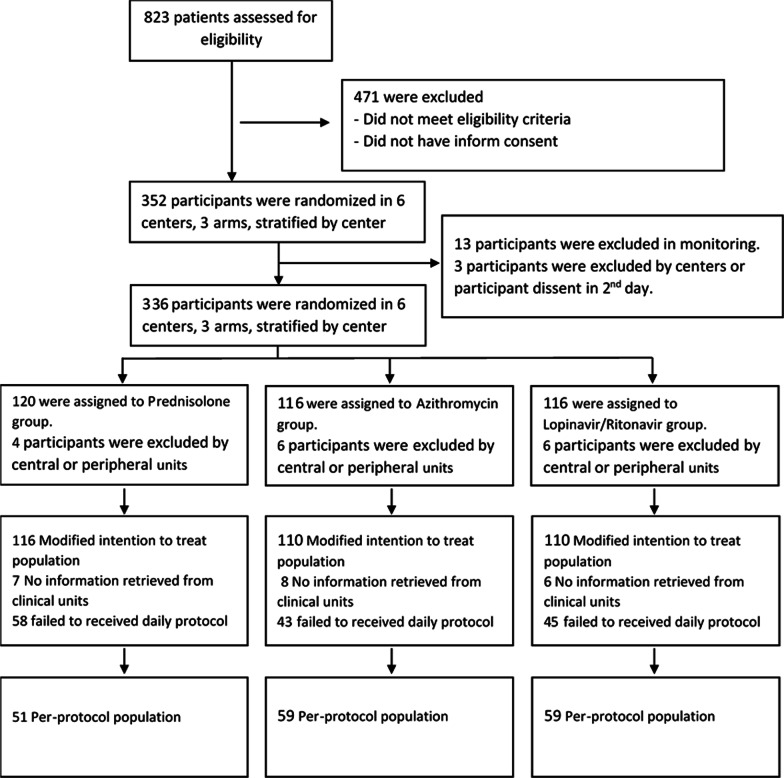
We performed a multicenter, randomized open-label trial in patients with moderate to severe Covid-19 treated with a range of possible treatment regimens.
Patients were randomly assigned to one of three regimen groups at a ratio of 1:1:1. The primary outcome of this study was admission to the intensive care unit. Secondary outcomes were intubation, in-hospital mortality, time to clinical recovery, and length of hospital stay (LOS). Between April 13 and August 9, 2020, a total of 336 patients were randomly assigned to receive one of the 3 treatment regimens including group I (hydroxychloroquine stat, prednisolone, azithromycin and naproxen; 120 patients), group II (hydroxychloroquine stat, azithromycin and naproxen; 116 patients), and group III (hydroxychloroquine and lopinavir/ritonavir (116 patients). The mean LOS in patients receiving prednisolone was 5.5 in the modified intention-to-treat (mITT) population and 4.4 days in the per-protocol (PP) population compared with 6.4 days (mITT population) and 5.8 days (PP population) in patients treated with Lopinavir/Ritonavir.
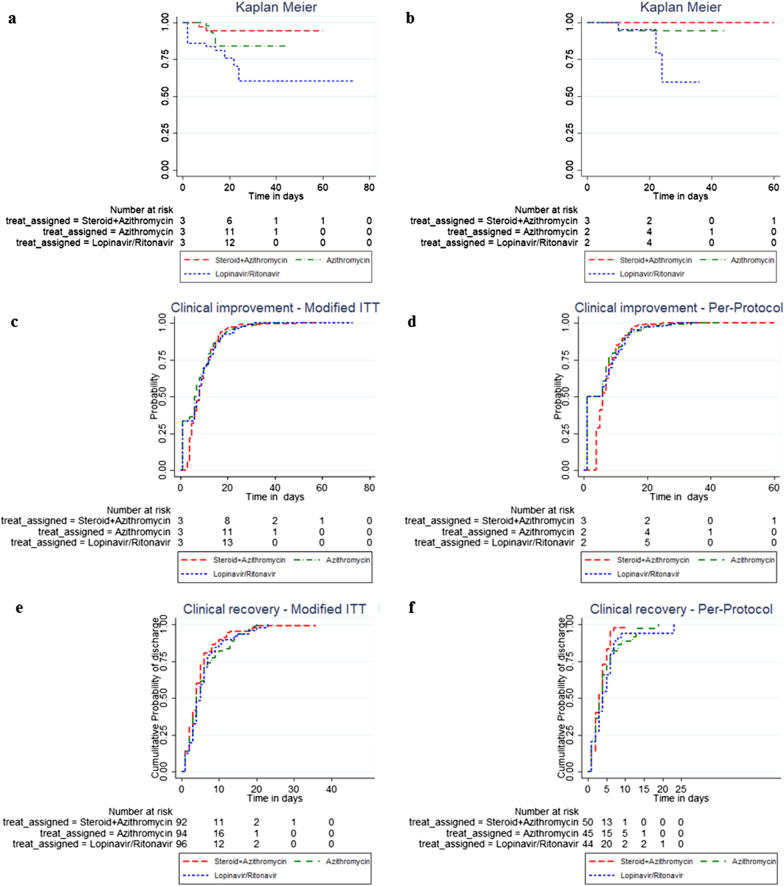
The mean LOS was significantly lower in the mITT and PP populations who received prednisolone compared with populations treated with Lopinavir/Ritonavir (p = 0.028; p = 0.0007). We observed no significant differences in the number of deaths, ICU admission, and need for mechanical ventilation between the Modified ITT and per-protocol populations treated with prednisolone and Lopinavir/Ritonavir, although these outcomes were better in the arm treated with prednisolone. The time to clinical recovery was similar in the modified ITT and per-protocol populations treated with prednisolone, lopinavir/ritonavir, and azithromycin (P = 0.335; P = 0.055; p = 0.291; p = 0.098).
The results of the present study show that therapeutic regimen (regimen I) with low dose prednisolone was superior to other regimens in shortening the length of hospital stay in patients with moderate to severe COVID-19. The steroid sparing effect may be utilized to increase the effectiveness of corticosteroids in the management of diabetic patients by decreasing the dosage.
我们在接受多种可能治疗方案治疗的中重度新冠患者中开展了一项多中心、随机、开放标签试验。
患者以 1:1:1 的比例随机分配至三个方案组之一。该研究的主要结局为入住重症监护病房。次要结局为插管、院内死亡率、临床恢复时间和住院时间(LOS)。2020 年 4 月 13 日至 8 月 9 日,共 336 例患者随机分配至接受三种治疗方案之一,包括 I 组(羟氯喹起始治疗,泼尼松龙、阿奇霉素和萘普生;120 例)、II 组(羟氯喹起始治疗,阿奇霉素和萘普生;116 例)和 III 组(羟氯喹和洛匹那韦/利托那韦;116 例)。泼尼松龙组的 LOS 均值在改良意向治疗人群(mITT)中为 5.5 天,在符合方案人群(PP)中为 4.4 天,而洛匹那韦/利托那韦组在 mITT 人群中为 6.4 天,在 PP 人群中为 5.8 天。
泼尼松龙组 mITT 和 PP 人群的 LOS 均值显著低于洛匹那韦/利托那韦组(p=0.028;p=0.0007)。尽管泼尼松龙组的结局更好,但在泼尼松龙和洛匹那韦/利托那韦治疗的 mITT 和 PP 人群中,死亡率、入住 ICU 和机械通气需求无显著差异。临床恢复时间在 mITT 和 PP 人群中接受泼尼松龙、洛匹那韦/利托那韦和阿奇霉素治疗的时间相似(P=0.335;P=0.055;p=0.291;p=0.098)。
本研究结果表明,在中重度 COVID-19 患者中,低剂量泼尼松龙治疗方案(方案 I)在缩短住院时间方面优于其他方案。通过减少剂量,类固醇节省效应可能被用于增加糖皮质激素在糖尿病患者管理中的疗效。