Department of Internal Medicine, Lyon University Hospital, Lyon, France; Centre International de Recherche en Infectiologie (CIRI), Inserm U1111, CNRS, UMR5308, Ecole Normale Supérieure de Lyon, Université Claude Bernard-Lyon 1, Lyon, France.
Centre International de Recherche en Infectiologie (CIRI), Inserm U1111, CNRS, UMR5308, Ecole Normale Supérieure de Lyon, Université Claude Bernard-Lyon 1, Lyon, France.
Autoimmun Rev. 2020 Jul;19(7):102567. doi: 10.1016/j.autrev.2020.102567. Epub 2020 May 4.
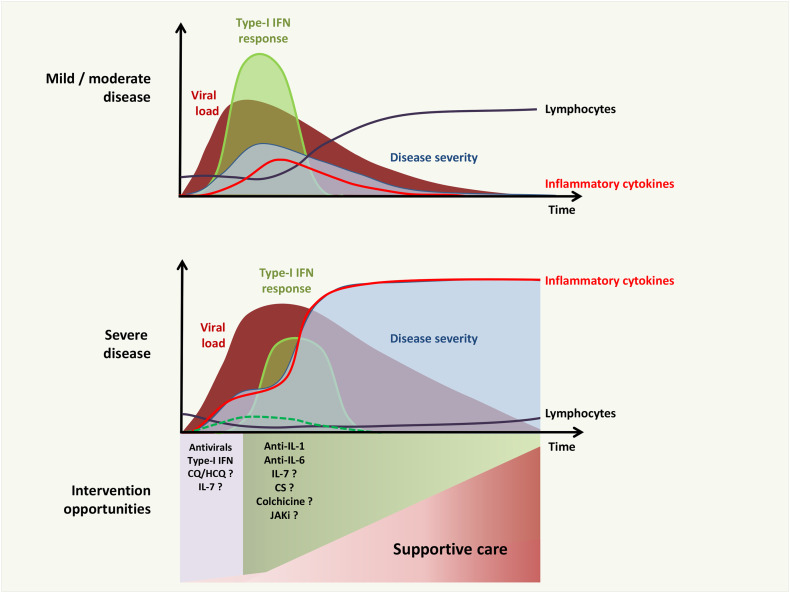
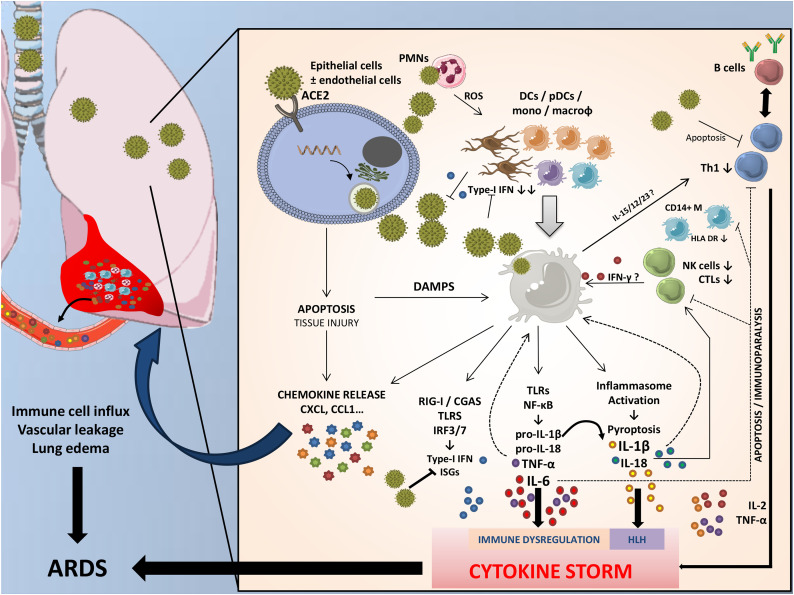
The coronavirus disease-19 pandemic (COVID-19), which appeared in China in December 2019 and rapidly spread throughout the world, has forced clinicians and scientists to take up extraordinary challenges. This unprecedented situation led to the inception of numerous fundamental research protocols and many clinical trials. It quickly became apparent that although COVID-19, in the vast majority of cases, was a benign disease, it could also develop a severe form with sometimes fatal outcomes. Cytokines are central to the pathophysiology of COVID-19; while some of them are beneficial (type-I interferon, interleukin-7), others appear detrimental (interleukin-1β, -6, and TNF-α) particularly in the context of the so-called cytokine storm. Yet another characteristic of the disease has emerged: concomitant immunodeficiency, notably involving impaired type-I interferon response, and lymphopenia. This review provides an overview of current knowledge on COVID-19 immunopathology. We discuss the defective type-I IFN response, the theoretical role of IL-7 to restore lymphocyte repertoire, as well as we mention the two patterns observed in severe COVID-19 (i.e. interleukin-1β-driven macrophage activation syndrome vs. interleukin-6-driven immune dysregulation). Next, reviewing current evidence drawn from clinical trials, we examine a number of cytokine and anti-cytokine therapies, including interleukin-1, -6, and TNF inhibitors, as well as less targeted therapies, such as corticosteroids, chloroquine, or JAK inhibitors.
新型冠状病毒病(COVID-19)于 2019 年 12 月在中国出现,并迅速在全球蔓延,迫使临床医生和科学家面临前所未有的挑战。这种情况导致了许多基础研究方案和许多临床试验的启动。很快就发现,虽然 COVID-19 在绝大多数情况下是一种良性疾病,但它也可能发展为严重形式,有时导致致命后果。细胞因子是 COVID-19 病理生理学的核心;虽然其中一些是有益的(I 型干扰素、白细胞介素-7),但另一些则是有害的(白细胞介素-1β、-6 和 TNF-α),特别是在所谓的细胞因子风暴的情况下。该疾病的另一个特征是同时存在免疫缺陷,特别是涉及 I 型干扰素反应受损和淋巴细胞减少。这篇综述概述了目前对 COVID-19 免疫病理学的认识。我们讨论了有缺陷的 I 型 IFN 反应、IL-7 恢复淋巴细胞库的理论作用,以及我们提到了在严重 COVID-19 中观察到的两种模式(即白细胞介素-1β驱动的巨噬细胞活化综合征与白细胞介素-6 驱动的免疫失调)。接下来,我们回顾了从临床试验中得出的当前证据,研究了几种细胞因子和抗细胞因子疗法,包括白细胞介素-1、-6 和 TNF 抑制剂,以及不太靶向的疗法,如皮质类固醇、氯喹或 JAK 抑制剂。