• 文献检索
  • 文档翻译
  • 深度研究
  • 学术资讯
  • Suppr Zotero 插件Zotero 插件
  • 邀请有礼
  • 套餐&价格
  • 历史记录
应用&插件
Suppr Zotero 插件Zotero 插件浏览器插件Mac 客户端Windows 客户端微信小程序
定价
高级版会员购买积分包购买API积分包
服务
文献检索文档翻译深度研究API 文档MCP 服务
关于我们
关于 Suppr公司介绍联系我们用户协议隐私条款
关注我们

Suppr 超能文献

核心技术专利:CN118964589B侵权必究
粤ICP备2023148730 号-1Suppr @ 2026

文献检索

告别复杂PubMed语法,用中文像聊天一样搜索,搜遍4000万医学文献。AI智能推荐,让科研检索更轻松。

立即免费搜索

文件翻译

保留排版,准确专业,支持PDF/Word/PPT等文件格式,支持 12+语言互译。

免费翻译文档

深度研究

AI帮你快速写综述,25分钟生成高质量综述,智能提取关键信息,辅助科研写作。

立即免费体验

深度学习确定治疗 COVID-19 的协同药物组合。

Deep learning identifies synergistic drug combinations for treating COVID-19.

机构信息

Computer Science and Artificial Intelligence Laboratory, Massachusetts Institute of Technology, Cambridge, MA 02139;

Department of Biological Engineering, Synthetic Biology Center, Institute for Medical Engineering and Science, Massachusetts Institute of Technology, Cambridge, MA 02139.

出版信息

Proc Natl Acad Sci U S A. 2021 Sep 28;118(39). doi: 10.1073/pnas.2105070118.

DOI:10.1073/pnas.2105070118
PMID:34526388
原文链接:https://pmc.ncbi.nlm.nih.gov/articles/PMC8488647/
Abstract

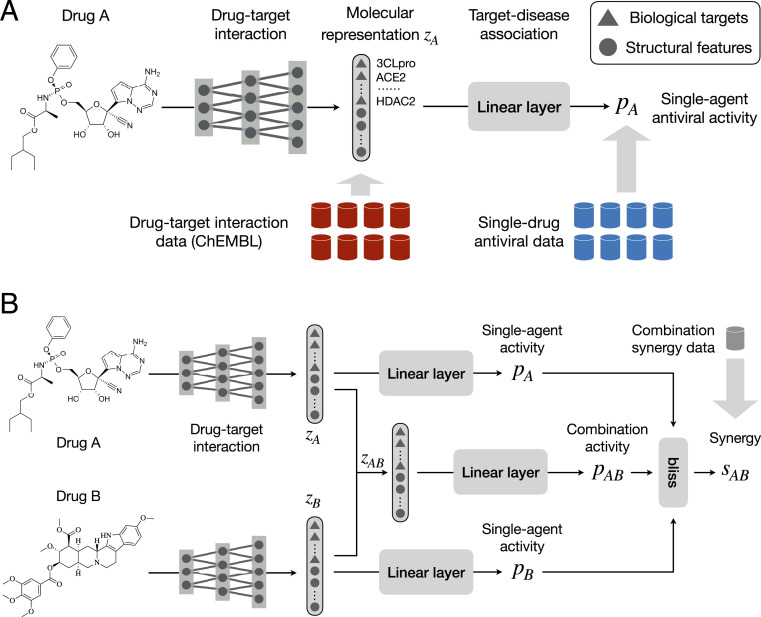
Effective treatments for COVID-19 are urgently needed. However, discovering single-agent therapies with activity against severe acute respiratory syndrome coronavirus 2 (SARS-CoV-2) has been challenging. Combination therapies play an important role in antiviral therapies, due to their improved efficacy and reduced toxicity. Recent approaches have applied deep learning to identify synergistic drug combinations for diseases with vast preexisting datasets, but these are not applicable to new diseases with limited combination data, such as COVID-19. Given that drug synergy often occurs through inhibition of discrete biological targets, here we propose a neural network architecture that jointly learns drug-target interaction and drug-drug synergy. The model consists of two parts: a drug-target interaction module and a target-disease association module. This design enables the model to utilize drug-target interaction data and single-agent antiviral activity data, in addition to available drug-drug combination datasets, which may be small in nature. By incorporating additional biological information, our model performs significantly better in synergy prediction accuracy than previous methods with limited drug combination training data. We empirically validated our model predictions and discovered two drug combinations, remdesivir and reserpine as well as remdesivir and IQ-1S, which display strong antiviral SARS-CoV-2 synergy in vitro. Our approach, which was applied here to address the urgent threat of COVID-19, can be readily extended to other diseases for which a dearth of chemical-chemical combination data exists.

摘要

目前急需针对 COVID-19 的有效疗法。然而,发现对严重急性呼吸综合征冠状病毒 2(SARS-CoV-2)具有活性的单一药物疗法极具挑战性。联合疗法在抗病毒治疗中发挥着重要作用,因为它们提高了疗效并降低了毒性。最近的方法应用深度学习来识别具有大量预先存在数据集的疾病的协同药物组合,但这些方法不适用于 COVID-19 等新出现的疾病,因为这些疾病的组合数据有限。鉴于药物协同作用通常通过抑制离散的生物靶标发生,在这里我们提出了一种神经网络架构,该架构联合学习药物-靶标相互作用和药物-药物协同作用。该模型由两部分组成:药物-靶标相互作用模块和靶标-疾病关联模块。这种设计使模型能够利用药物-靶标相互作用数据和单一药物抗病毒活性数据,以及可用的药物-药物组合数据集,尽管这些数据集可能性质较小。通过纳入额外的生物学信息,我们的模型在协同作用预测准确性方面的表现明显优于具有有限药物组合训练数据的先前方法。我们对模型预测进行了实证验证,并发现了两种药物组合,即瑞德西韦和利血平以及瑞德西韦和 IQ-1S,它们在体外对 SARS-CoV-2 表现出强烈的抗病毒协同作用。我们在这里应用的方法来应对 COVID-19 的紧迫威胁,可以很容易地扩展到其他化学-化学组合数据稀缺的疾病。
https://cdn.ncbi.nlm.nih.gov/pmc/blobs/f31c/8488647/99b308737f69/pnas.2105070118fig03.jpg
https://cdn.ncbi.nlm.nih.gov/pmc/blobs/f31c/8488647/ca86ef2d2964/pnas.2105070118fig01.jpg
https://cdn.ncbi.nlm.nih.gov/pmc/blobs/f31c/8488647/069006e49fb8/pnas.2105070118fig02.jpg
https://cdn.ncbi.nlm.nih.gov/pmc/blobs/f31c/8488647/99b308737f69/pnas.2105070118fig03.jpg
https://cdn.ncbi.nlm.nih.gov/pmc/blobs/f31c/8488647/ca86ef2d2964/pnas.2105070118fig01.jpg
https://cdn.ncbi.nlm.nih.gov/pmc/blobs/f31c/8488647/069006e49fb8/pnas.2105070118fig02.jpg
https://cdn.ncbi.nlm.nih.gov/pmc/blobs/f31c/8488647/99b308737f69/pnas.2105070118fig03.jpg

相似文献

1
Deep learning identifies synergistic drug combinations for treating COVID-19.深度学习确定治疗 COVID-19 的协同药物组合。
Proc Natl Acad Sci U S A. 2021 Sep 28;118(39). doi: 10.1073/pnas.2105070118.
2
Synergistic and Antagonistic Drug Combinations against SARS-CoV-2.协同与拮抗作用的新冠病毒药物组合。
Mol Ther. 2021 Feb 3;29(2):873-885. doi: 10.1016/j.ymthe.2020.12.016. Epub 2020 Dec 15.
3
The FDA-Approved Drug Cobicistat Synergizes with Remdesivir To Inhibit SARS-CoV-2 Replication and Decreases Viral Titers and Disease Progression in Syrian Hamsters.美国食品和药物管理局批准的药物考比司他与瑞德西韦协同抑制 SARS-CoV-2 复制,降低叙利亚仓鼠的病毒滴度和疾病进展。
mBio. 2022 Apr 26;13(2):e0370521. doi: 10.1128/mbio.03705-21. Epub 2022 Mar 1.
4
Synergism between remdesivir and ribavirin leads to SARS-CoV-2 extinction in cell culture.瑞德西韦和利巴韦林的协同作用导致细胞培养中的 SARS-CoV-2 灭绝。
Br J Pharmacol. 2024 Aug;181(15):2636-2654. doi: 10.1111/bph.16344. Epub 2024 Apr 14.
5
Remdesivir-ivermectin combination displays synergistic interaction with improved in vitro activity against SARS-CoV-2.瑞德西韦-伊维菌素联合用药显示出协同作用,体外对 SARS-CoV-2 的活性增强。
Int J Antimicrob Agents. 2022 Mar;59(3):106542. doi: 10.1016/j.ijantimicag.2022.106542. Epub 2022 Jan 31.
6
Drug synergy of combinatory treatment with remdesivir and the repurposed drugs fluoxetine and itraconazole effectively impairs SARS-CoV-2 infection in vitro.瑞德西韦联合氟西汀和伊曲康唑治疗药物协同作用可有效抑制 SARS-CoV-2 体外感染。
Br J Pharmacol. 2021 Jun;178(11):2339-2350. doi: 10.1111/bph.15418. Epub 2021 Apr 6.
7
In vitro evaluation of antiviral activity of single and combined repurposable drugs against SARS-CoV-2.体外评估单药和联合再利用药物抗 SARS-CoV-2 的抗病毒活性。
Antiviral Res. 2020 Sep;181:104878. doi: 10.1016/j.antiviral.2020.104878. Epub 2020 Jul 15.
8
Beneficial effect of combinational methylprednisolone and remdesivir in hamster model of SARS-CoV-2 infection.联合使用甲基强的松龙和瑞德西韦对 SARS-CoV-2 感染仓鼠模型的有益作用。
Emerg Microbes Infect. 2021 Dec;10(1):291-304. doi: 10.1080/22221751.2021.1885998.
9
Hepatitis C Virus Protease Inhibitors Show Differential Efficacy and Interactions with Remdesivir for Treatment of SARS-CoV-2 .丙型肝炎病毒蛋白酶抑制剂对 SARS-CoV-2 治疗的疗效和与瑞德西韦的相互作用存在差异。
Antimicrob Agents Chemother. 2021 Aug 17;65(9):e0268020. doi: 10.1128/AAC.02680-20.
10
Remdesivir against COVID-19 and Other Viral Diseases.瑞德西韦治疗 COVID-19 及其他病毒性疾病。
Clin Microbiol Rev. 2020 Oct 14;34(1). doi: 10.1128/CMR.00162-20. Print 2020 Dec 16.

引用本文的文献

1
A deep learning and digital archaeology approach for mosquito repellent discovery.一种用于驱蚊剂发现的深度学习与数字考古学方法。
Chem Senses. 2025 Jan 22;50. doi: 10.1093/chemse/bjaf021.
2
DrugPipe: Generative artificial intelligence-assisted virtual screening pipeline for generalizable and efficient drug repurposing.DrugPipe:用于通用且高效药物再利用的生成式人工智能辅助虚拟筛选流程
Biol Methods Protoc. 2025 May 30;10(1):bpaf038. doi: 10.1093/biomethods/bpaf038. eCollection 2025.
3
CEBIT screening for inhibitors of the interaction between SARS-CoV-2 spike and ACE2.

本文引用的文献

1
Network medicine framework for identifying drug-repurposing opportunities for COVID-19.用于识别新冠病毒药物再利用机会的网络医学框架。
Proc Natl Acad Sci U S A. 2021 May 11;118(19). doi: 10.1073/pnas.2025581118.
2
Drug Repurposing Screen for Compounds Inhibiting the Cytopathic Effect of SARS-CoV-2.用于筛选抑制新型冠状病毒细胞病变效应化合物的药物再利用筛选
Front Pharmacol. 2021 Jan 25;11:592737. doi: 10.3389/fphar.2020.592737. eCollection 2020.
3
Biological activity-based modeling identifies antiviral leads against SARS-CoV-2.基于生物活性的建模方法鉴定出抗 SARS-CoV-2 的抗病毒先导化合物。
针对严重急性呼吸综合征冠状病毒2(SARS-CoV-2)刺突蛋白与血管紧张素转换酶2(ACE2)之间相互作用的抑制剂进行汉诺威国际信息及通信技术博览会(CEBIT)筛选。
Fundam Res. 2022 Mar 3;2(4):562-569. doi: 10.1016/j.fmre.2022.01.034. eCollection 2022 Jul.
4
MADSP: predicting anti-cancer drug synergy through multi-source integration and attention-based representation learning.MADSP:通过多源整合和基于注意力的表征学习预测抗癌药物协同作用
Bioinformatics. 2025 Jun 2;41(6). doi: 10.1093/bioinformatics/btaf326.
5
AI-driven discovery of synergistic drug combinations against pancreatic cancer.人工智能驱动的抗胰腺癌协同药物组合的发现。
Nat Commun. 2025 Apr 29;16(1):4020. doi: 10.1038/s41467-025-56818-6.
6
A new paradigm for drug discovery in the treatment of complex diseases: drug discovery and optimization.治疗复杂疾病的药物研发新范式:药物发现与优化。
Chin Med. 2025 Mar 24;20(1):40. doi: 10.1186/s13020-025-01075-4.
7
Computational drug repurposing: approaches, evaluation of in silico resources and case studies.计算性药物重新利用:方法、虚拟资源评估及案例研究
Nat Rev Drug Discov. 2025 Mar 18. doi: 10.1038/s41573-025-01164-x.
8
Restoring Homeostasis: Treating Amyotrophic Lateral Sclerosis by Resolving Dynamic Regulatory Instability.恢复体内平衡:通过解决动态调节不稳定来治疗肌萎缩侧索硬化症
Int J Mol Sci. 2025 Jan 21;26(3):872. doi: 10.3390/ijms26030872.
9
Interpretable adenylation domain specificity prediction using protein language models.使用蛋白质语言模型进行可解释的腺苷化结构域特异性预测。
bioRxiv. 2025 Jan 18:2025.01.13.632878. doi: 10.1101/2025.01.13.632878.
10
Machine learning for antimicrobial peptide identification and design.用于抗菌肽鉴定与设计的机器学习
Nat Rev Bioeng. 2024 May;2(5):392-407. doi: 10.1038/s44222-024-00152-x. Epub 2024 Feb 26.
Nat Biotechnol. 2021 Jun;39(6):747-753. doi: 10.1038/s41587-021-00839-1. Epub 2021 Feb 23.
4
Synergistic and Antagonistic Drug Combinations against SARS-CoV-2.协同与拮抗作用的新冠病毒药物组合。
Mol Ther. 2021 Feb 3;29(2):873-885. doi: 10.1016/j.ymthe.2020.12.016. Epub 2020 Dec 15.
5
Targeting ACE2-RBD Interaction as a Platform for COVID-19 Therapeutics: Development and Drug-Repurposing Screen of an AlphaLISA Proximity Assay.以ACE2-RBD相互作用为靶点开发COVID-19治疗药物:AlphaLISA邻近分析法的开发与药物再利用筛选
ACS Pharmacol Transl Sci. 2020 Nov 17;3(6):1352-1360. doi: 10.1021/acsptsci.0c00161. eCollection 2020 Dec 11.
6
Identification of SARS-CoV-2 3CL Protease Inhibitors by a Quantitative High-Throughput Screening.通过定量高通量筛选鉴定新型冠状病毒3CL蛋白酶抑制剂
ACS Pharmacol Transl Sci. 2020 Sep 4;3(5):1008-1016. doi: 10.1021/acsptsci.0c00108. eCollection 2020 Oct 9.
7
Discovery of SARS-CoV-2 antiviral drugs through large-scale compound repurposing.通过大规模化合物重新利用发现抗 SARS-CoV-2 病毒药物。
Nature. 2020 Oct;586(7827):113-119. doi: 10.1038/s41586-020-2577-1. Epub 2020 Jul 24.
8
A SARS-CoV-2 protein interaction map reveals targets for drug repurposing.一种 SARS-CoV-2 蛋白相互作用图谱揭示了药物再利用的靶标。
Nature. 2020 Jul;583(7816):459-468. doi: 10.1038/s41586-020-2286-9. Epub 2020 Apr 30.
9
SARS-CoV-2 Cell Entry Depends on ACE2 and TMPRSS2 and Is Blocked by a Clinically Proven Protease Inhibitor.严重急性呼吸综合征冠状病毒 2 型(SARS-CoV-2)进入细胞依赖于 ACE2 和 TMPRSS2,可被一种临床验证的蛋白酶抑制剂所阻断。
Cell. 2020 Apr 16;181(2):271-280.e8. doi: 10.1016/j.cell.2020.02.052. Epub 2020 Mar 5.
10
A Deep Learning Approach to Antibiotic Discovery.深度学习在抗生素发现中的应用。
Cell. 2020 Feb 20;180(4):688-702.e13. doi: 10.1016/j.cell.2020.01.021.