Gaggiano Carla, Rigante Donato, Hernández-Rodríguez José, Vitale Antonio, Tarsia Maria, Soriano Alessandra, Lopalco Giuseppe, Iannone Florenzo, Abdel Jaber Masen, Giacomelli Roberto, Wiȩsik-Szewczyk Ewa, Cattalini Marco, Frassi Micol, Piga Matteo, Ragab Gaafar, Sota Jurgen, Zunica Fiammetta, Floris Alberto, Sabato Vito, Hegazy Mohamed Tharwat, Araújo Olga, Pelegrín Laura, Fabbiani Alessandra, Renieri Alessandra, Grosso Salvatore, Fabiani Claudia, Frediani Bruno, Cantarini Luca
Research Center of Systemic Autoinflammatory Diseases and Behçet's Disease, and Rheumatology-Ophthalmology Collaborative Uveitis Center, Department of Medical Sciences, Surgery and Neurosciences, University of Siena, Siena, Italy; Clinical Pediatrics, Department of Molecular Medicine and Development, University of Siena, Siena, Italy.
Department of Life Sciences and Global Health, Fondazione Policlinico Universitario A. Gemelli IRCCS, Rome, Italy; Rare Diseases and Periodic Fevers Research Centre, Università Cattolica del Sacro Cuore, Rome, Italy.
Ther Adv Musculoskelet Dis. 2021 Sep 9;13:1759720X211037178. doi: 10.1177/1759720X211037178. eCollection 2021.
This study aims at describing the therapeutic outcome of patients carrying the R92Q variant in the gene treated with anakinra (ANA) or canakinumab (CAN) and identifying any factors predictive of complete response to IL-1 inhibition.
Clinical data of patients treated with ANA or CAN for recurrent inflammatory attacks due to the presence of the R92Q variant were retrospectively collected and analysed.
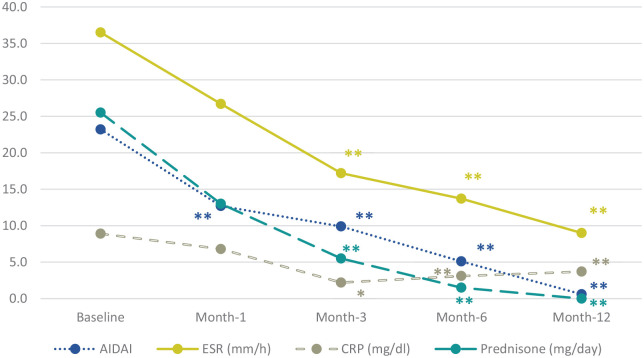
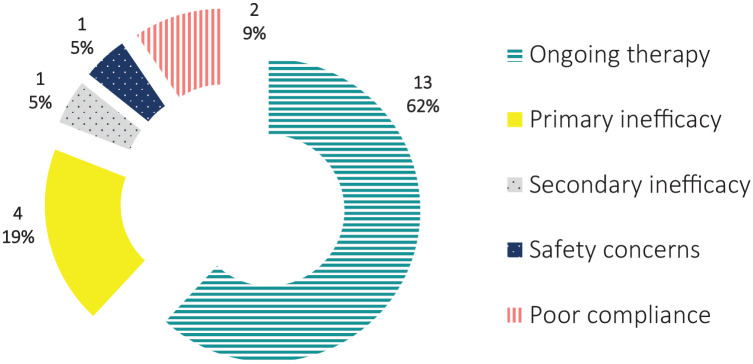
Data about 20 treatment courses with IL-1 inhibitors (16 with ANA and 4 with CAN) from 19 patients were collected. Mean age at disease onset was 20.2 ± 14.8 years. In 5 cases (26%) the R92Q variant was found in a family member affected by recurrent fever. The therapeutic response was complete in 13(68%) and partial in 2 patients (11%); treatment failure was observed in 4 cases (21%). Median AIDAI decreased from 10 (interquartile range [IQR] = 28) to 0 (IQR = 1) at the 12-month follow-up visit ( < 0.001). Mean ESR and median CRP dropped respectively from 40.8 ± 24.8 to 9.1 ± 4.5 mm/h ( < 0.001) and from 3.0 (IQR = 1.9) to 0.3 (IQR = 0.3) mg/dl ( < 0.001) after 12 months of treatment. A steroid-sparing effect was observed from the third month of treatment ( < 0.01). Thirteen patients (65%) were still on treatment at the last follow-up visit (median duration of treatment 17 (IQR = 38) months). The presence of R92Q mutation in a symptomatic relative ( = 0.022), the relapsing remitting disease course ( < 0.001) and the presence of migratory erythematous skin rashes during fever attacks ( = 0.005) were associated with complete efficacy of IL-1 inhibitors.
R92Q patients showed a favourable response to ANA and CAN, particularly when the mutation segregated in a family member and when a relapsing-remitting disease course or TNF-α receptor-associated periodic syndrome (TRAPS) typical skin rash were observed. In the subgroup of patients not taking advantage of IL-1 blockage different molecular mechanisms underlying the autoinflammatory picture are likely to exist.
本研究旨在描述携带该基因R92Q变异的患者接受阿那白滞素(ANA)或卡那单抗(CAN)治疗的疗效,并确定任何可预测对IL-1抑制完全反应的因素。
回顾性收集并分析因存在R92Q变异而接受ANA或CAN治疗复发性炎症发作患者的临床数据。
收集了19例患者20个使用IL-1抑制剂治疗疗程的数据(16个使用ANA,4个使用CAN)。疾病发病时的平均年龄为20.2±14.8岁。在5例(26%)患者中,R92Q变异在一名受复发性发热影响的家庭成员中被发现。13例(68%)患者治疗反应完全,2例(11%)部分缓解;4例(21%)观察到治疗失败。在12个月随访时,中位AIDAI从10(四分位间距[IQR]=28)降至0(IQR=1)(P<0.001)。治疗12个月后,平均ESR和中位CRP分别从40.8±24.8降至9.1±4.5mm/h(P<0.001),从3.0(IQR=1.9)降至0.3(IQR=0.3)mg/dl(P<0.001)。从治疗第三个月起观察到激素节省效应(P<0.01)。在最后一次随访时,13例(65%)患者仍在接受治疗(中位治疗持续时间17(IQR=38)个月)。有症状亲属中存在R92Q突变(P=0.022)、复发缓解病程(P<0.001)以及发热发作期间出现游走性红斑皮疹(P=0.005)与IL-1抑制剂的完全疗效相关。
R92Q患者对ANA和CAN显示出良好反应,特别是当突变在家庭成员中分离,以及观察到复发缓解病程或TNF-α受体相关周期性综合征(TRAPS)典型皮疹时。在未从IL-1阻断中获益的患者亚组中,可能存在自身炎症表现背后不同的分子机制。