Kim Taehee, Lee Hyun, Sim Yun Su, Yang Bumhee, Park Hye Yun, Ra Seung Won, Jang Hyo Jun, Yoo Seung-Jin, Kim Sang-Heon, Sohn Jang Won, Yoon Ho Joo, Oh Yeon-Mok, Kwon Yong-Soo, Choi Hayoung
Division of Pulmonary, Allergy, and Critical Care Medicine, Department of Internal Medicine, Hallym University Kangnam Sacred Heart Hospital, Hallym University College of Medicine, Seoul, Korea.
Lung Research Institute, Hallym University College of Medicine, Chuncheon, Korea.
J Thorac Dis. 2021 Aug;13(8):4894-4902. doi: 10.21037/jtd-20-3028.
Prevalence, respiratory symptoms, and quality of life (QoL) in post-tuberculosis (TB) subjects with bronchiectasis are not well elucidated.
Subjects who participated in the Korea National Health and Nutritional Examination Survey 2007-2009 were enrolled in this cross-sectional study. We evaluated the prevalence of physician-diagnosed bronchiectasis among post-TB subjects. We compared respiratory symptoms, physical activity limitations, and QoL between post-TB subjects with and without bronchiectasis.
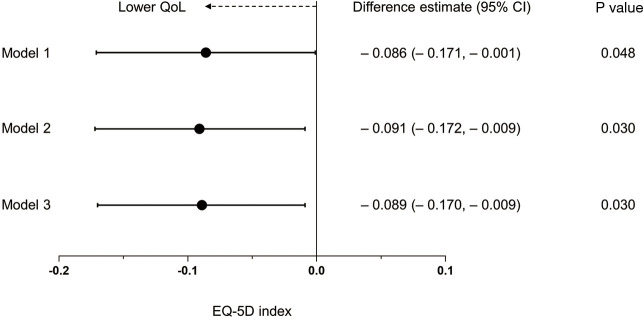
The prevalence of bronchiectasis was 3.3% among 963 post-TB subjects. Post-TB subjects with bronchiectasis showed a higher rate of asthma (29.6% 4.9%, P<0.001) than those without bronchiectasis. Post-TB subjects with bronchiectasis showed more cough (23.9% 6.7%, P=0.033) and physical activity limitations due to respiratory diseases (35.0% 8.9%, P=0.033) than those without bronchiectasis. Furthermore, compared with post-TB subjects without bronchiectasis, those with bronchiectasis had lower QoL measured by the EuroQoL five-dimension (EQ-5D) index (0.84 0.93, P=0.048). Linear regression analysis found that the EQ-5D index in post-TB subjects with bronchiectasis was significantly lower than in those without bronchiectasis (difference estimate =-0.089, P=0.030), especially in the anxiety/depression component.
Post-TB subjects with bronchiectasis had more cough and physical activity limitations and lower health-related QoL than those without bronchiectasis.
支气管扩张症在肺结核(TB)治愈患者中的患病率、呼吸道症状及生活质量(QoL)尚未得到充分阐明。
本横断面研究纳入了参加2007 - 2009年韩国国家健康与营养检查调查的受试者。我们评估了肺结核治愈患者中经医生诊断的支气管扩张症的患病率。我们比较了有和没有支气管扩张症的肺结核治愈患者的呼吸道症状、身体活动受限情况及生活质量。
在963名肺结核治愈患者中,支气管扩张症的患病率为3.3%。有支气管扩张症的肺结核治愈患者哮喘发生率(29.6% 对4.9%,P<0.001)高于无支气管扩张症的患者。有支气管扩张症的肺结核治愈患者咳嗽(23.9% 对6.7%,P = 0.033)及因呼吸道疾病导致的身体活动受限(35.0% 对8.9%,P = 0.033)比无支气管扩张症的患者更多。此外,与无支气管扩张症的肺结核治愈患者相比,有支气管扩张症的患者用欧洲五维健康量表(EQ - 5D)指数衡量的生活质量更低(0.84对0.93,P = 0.048)。线性回归分析发现,有支气管扩张症的肺结核治愈患者的EQ - 5D指数显著低于无支气管扩张症的患者(差异估计=-0.089,P = 0.030),尤其是在焦虑/抑郁维度。
与无支气管扩张症的肺结核治愈患者相比,有支气管扩张症的患者咳嗽更多、身体活动受限更多,且与健康相关的生活质量更低。