King Tania, Singh Ankur, Disney George
Centre for Health Equity, Melbourne School of Population and Global Health, University of Melbourne, Victoria 3010, Australia.
Centre for Epidemiology and Biostatistics, Melbourne School of Population and Global Health, University of Melbourne, Victoria 3010, Australia.
Lancet Reg Health West Pac. 2021 Aug 20;15:100257. doi: 10.1016/j.lanwpc.2021.100257. eCollection 2021 Oct.
Across the world, many young people are supplying unpaid, informal care. There is growing evidence of the impact of this caring role on the lives of young informal carers, however there has been little quantitative analysis of the mental health impacts. This research aimed to estimate the effect of informal caring at age 14/15 years on mental health at age 18/19 years.
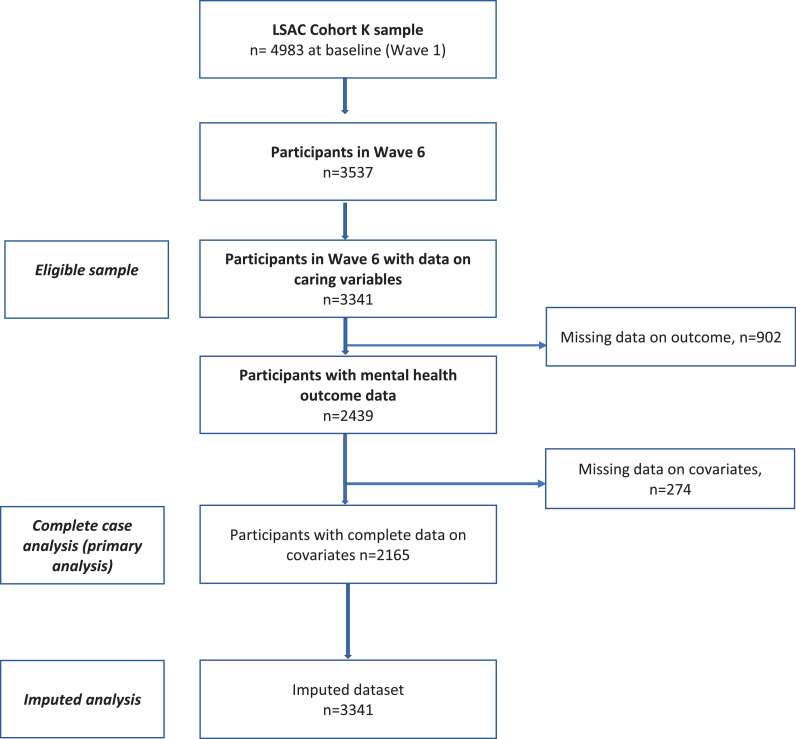
Data was drawn from Waves 5, 6, 8 (2012-2018) of the Longitudinal Study of Australian Children. Effects of caring on mental health were assessed using augmented inverse probability weighting, with adjustment for potential confounders, and using the Kessler-10 measure of mental health. Caring was assessed with both a binary (any caring vs none), and a three category variable (no caring, less than daily caring, daily caring). Multiple imputation was carried out using chained equations, and analysis was conducted on both complete case (n=2165) and the imputed dataset (n=3341).
In complete case models, any caring at age 14/15 years was associated with poorer mental health at age 18/19 years compared to those reporting no caring, with an average treatment effect (ATE) of 1.10 (95%CI 0.37, 1.83). The ATE of daily caring compared to no caring at age 14/15 years of age was 1.94 (95%CI 0.48, 3.39), and caring less than daily (compared to no caring) was associated with a treatment effect of 0.83(95%CI 0.06, 1.61). Associations were robust to several sensitivity analyses.
These results suggest there is a mental health impact of caring in adolescence on mental health four years later. This highlights the need for support for young informal carers, particularly for those providing more intensive caring.
This study was supported by an Australian Research Council Discovery Early Career Award (TK, DE200100607).
在全球范围内,许多年轻人都在提供无偿的非正式照料。越来越多的证据表明这种照料角色对年轻非正式照料者的生活产生了影响,然而,对于其对心理健康的影响却鲜有定量分析。本研究旨在估计14/15岁时的非正式照料对18/19岁时心理健康的影响。
数据取自澳大利亚儿童纵向研究的第5、6、8轮(2012 - 2018年)。使用增强逆概率加权法评估照料对心理健康的影响,并对潜在混杂因素进行调整,同时使用凯斯勒10项心理健康量表。照料情况通过二元变量(有照料与无照料)和三分类变量(无照料、非每日照料、每日照料)进行评估。使用链式方程进行多重填补,并对完整病例(n = 2165)和填补数据集(n = 3341)进行分析。
在完整病例模型中,与报告无照料的人相比,14/15岁时有任何照料行为与18/19岁时较差的心理健康相关,平均治疗效果(ATE)为1.10(95%CI 0.37,1.83)。14/15岁时每日照料与无照料相比的ATE为1.94(95%CI 0.48,3.39),非每日照料(与无照料相比)的治疗效果为0.83(95%CI 0.06,1.61)。这些关联在多项敏感性分析中均具有稳健性。
这些结果表明,青少年时期的照料对四年后的心理健康有影响。这凸显了为年轻非正式照料者提供支持的必要性,特别是对于那些提供更密集照料的人。
本研究得到了澳大利亚研究理事会发现早期职业奖(TK,DE200100607)的支持。