Fleitas Alfonzo Ludmila, Singh Ankur, Disney George, King Tania
Centre for Health Equity, Melbourne School of Population and Global Health, The University of Melbourne, Parkville, 3010, Victoria, Australia.
Centre of Epidemiology and Biostatistics, Melbourne School of Population and Global Health, The University of Melbourne, Parkville, 3010, Victoria, Australia.
SSM Popul Health. 2023 Jul 31;23:101479. doi: 10.1016/j.ssmph.2023.101479. eCollection 2023 Sep.
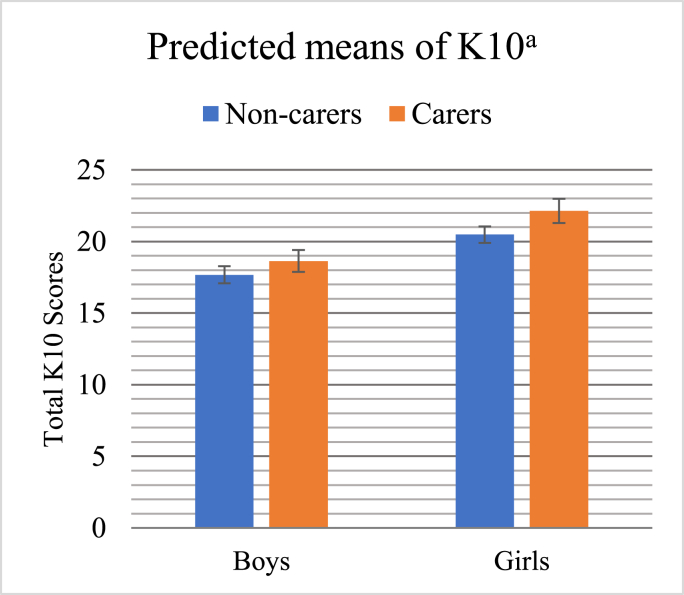
Young carers are people aged 25 years or less who deliver unpaid informal care to a family or a friend living with a physical or mental illness, a disability, problems related to alcohol/substance use or an elderly relative. Young caring has negative impacts on the mental health of adolescents. Gender patterns underpinning this association have not been explored. We examined gender differences in the mental health effect of informal care among Australian adolescents. We used data from the Longitudinal Study of Australian Children (LSAC). Participants were categorised as non-carers or young carers at 14/15 years old. Although we acknowledge that gender is non-binary, information about gender identity was not collected in LSAC during adolescence. We used the study child's sex as reported at age 14/15 years to categorise adolescents as boys or girls. Mental health was measured using the Kessler Psychological Distress scale (K10) at ages 18/19. We conducted multivariable linear regression models and assessed effect modification by fitting an interaction term between gender and informal care. Informal care was associated with poorer mental health among boys (β: 0.97, 95%CI: -0.01, 1.95), and girls (β: 1.66, 95%CI: 0.63, 2.69). Overall, in comparison to boy non-carers, girl carers had the highest level of distress (β: 4.47; 95%CI: 3.44, 5.51), yielding high predicted scores of K10. While the mental health effects of young care were stronger for girls, there was limited evidence of effect modification as the difference in mental health disparities due to informal care between girls and boys was small (β: 0.69) with high uncertainty levels (95%CI: -0.72, 2.11). Psychological distress scores were higher for girls than boys in both caring categories. Support strategies should focus on identifying and supporting boy and girl carers to reduce the adverse mental health impact of young informal care.
年轻照料者是指年龄在25岁及以下,为患有身体或精神疾病、残疾、酒精/药物使用相关问题的家庭成员或朋友,或老年亲属提供无偿非正式照料的人。年轻照料对青少年的心理健康有负面影响。尚未探究支撑这种关联的性别模式。我们研究了澳大利亚青少年中非正式照料对心理健康影响的性别差异。我们使用了澳大利亚儿童纵向研究(LSAC)的数据。参与者在14/15岁时被分类为非照料者或年轻照料者。尽管我们承认性别并非二元对立,但LSAC在青少年时期并未收集有关性别认同的信息。我们使用研究儿童在14/15岁时报告的性别,将青少年分类为男孩或女孩。在18/19岁时使用凯斯勒心理困扰量表(K10)测量心理健康状况。我们进行了多变量线性回归模型,并通过拟合性别与非正式照料之间的交互项来评估效应修正。非正式照料与男孩(β:0.97,95%CI:-0.01,1.95)和女孩(β:1.66,95%CI:0.63,2.69)较差的心理健康状况相关。总体而言,与男孩非照料者相比,女孩照料者的困扰程度最高(β:4.47;95%CI:3.44,5.51),K10预测得分较高。虽然年轻照料对女孩的心理健康影响更强,但效应修正的证据有限,因为女孩和男孩之间因非正式照料导致的心理健康差异较小(β:0.69),不确定性水平较高(95%CI:-0.72,2.11)。在两个照料类别中,女孩的心理困扰得分均高于男孩。支持策略应侧重于识别和支持男孩和女孩照料者,以减少年轻非正式照料对心理健康的不利影响。