Department of Earth System Science, Stanford University, Stanford, CA, 94305, USA.
Exobiology Branch, NASA Ames Research Center, Moffett Field, CA, 94035, USA.
Arch Microbiol. 2021 Dec;203(10):6041-6052. doi: 10.1007/s00203-021-02561-7. Epub 2021 Sep 16.
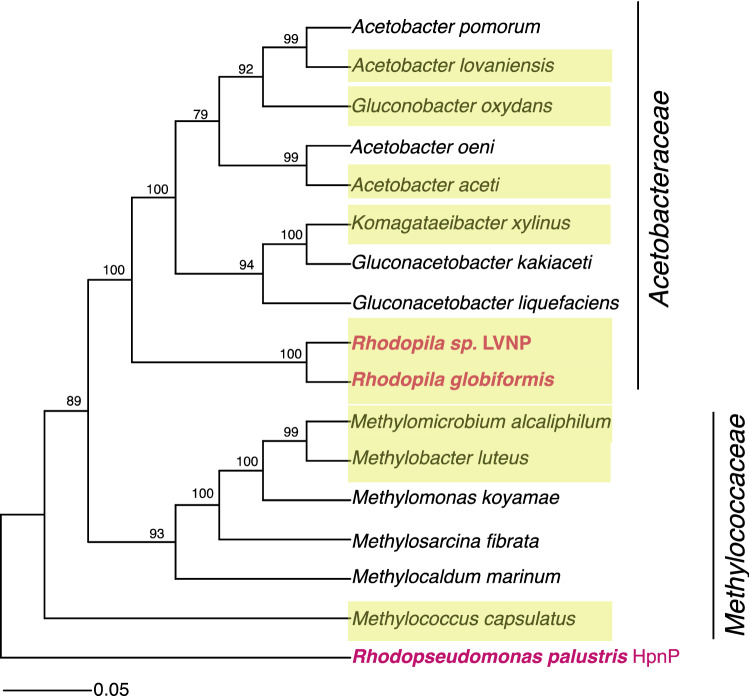
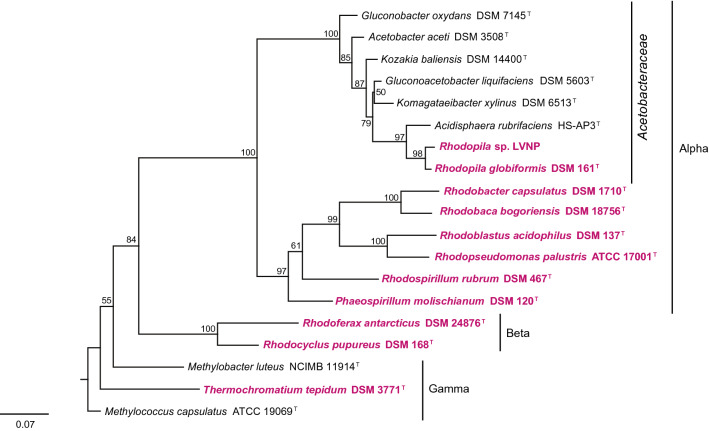
Bacterial lipids are well-preserved in ancient rocks and certain ones have been used as indicators of specific bacterial metabolisms or environmental conditions existing at the time of rock deposition. Here we show that an anaerobic bacterium produces 3-methylhopanoids, pentacyclic lipids previously detected only in aerobic bacteria and widely used as biomarkers for methane-oxidizing bacteria. Both Rhodopila globiformis, a phototrophic purple nonsulfur bacterium isolated from an acidic warm spring in Yellowstone, and a newly isolated Rhodopila species from a geochemically similar spring in Lassen Volcanic National Park (USA), synthesized 3-methylhopanoids and a suite of related hopanoids and contained the genes encoding the necessary biosynthetic enzymes. Our results show that 3-methylhopanoids can be produced under anoxic conditions and challenges the use of 3-methylhopanoids as biomarkers of oxic conditions in ancient rocks and as prima facie evidence that methanotrophic bacteria were active when the rocks were deposited.
细菌脂质在古老的岩石中保存完好,某些脂质已被用作指示特定细菌代谢或岩石沉积时存在的环境条件的指标。在这里,我们表明一种厌氧菌产生 3-甲基藿烷,这是一种以前仅在好氧菌中检测到的五环脂质,被广泛用作甲烷氧化菌的生物标志物。从黄石酸性温泉中分离出的光养紫色无硫细菌 Rhodopila globiformis 和从拉森火山国家公园(美国)具有相似地球化学特征的温泉中分离出的一种新的 Rhodopila 物种都合成了 3-甲基藿烷和一系列相关的藿烷,并含有编码必要生物合成酶的基因。我们的结果表明,3-甲基藿烷可以在缺氧条件下产生,这对将 3-甲基藿烷用作古代岩石中好氧条件的生物标志物以及作为岩石沉积时甲烷氧化菌活跃的初步证据提出了挑战。