Division of Epidemiology, Dalla Lana School of Public Health, University of Toronto, Toronto, Canada.
Department of Epidemiology and Medical Statistics, School of Public Health, College of Health Sciences, Moi University, Eldoret, Kenya.
JAMA Netw Open. 2021 Sep 1;4(9):e2125365. doi: 10.1001/jamanetworkopen.2021.25365.
In 2015, there were nearly 140 million orphaned children globally, particularly in low- and middle-income regions, and millions more for whom the street is central to their everyday lives. A total of 16.6 million children were orphaned because of deaths associated with HIV/AIDS, of whom 90% live in sub-Saharan Africa. Although most orphaned and separated children and adolescents in this region are cared for by extended family, the large number of children requiring care has produced a proliferation of institutional care. Few studies have investigated the association between care environment and physical health among orphaned and separated youths in sub-Saharan Africa.
To examine the association of care environment with incident HIV and death among orphaned and separated children and adolescents who were living in charitable children's institutions, family-based settings, and street settings in western Kenya over almost 10 years.
DESIGN, SETTING, AND PARTICIPANTS: The Orphaned and Separated Children's Assessments Related to Their Health and Well-Being (OSCAR) project was an observational prospective cohort study conducted in Uasin Gishu County, Kenya. The cohort comprised 2551 orphaned, separated, and street-connected children from communities within 8 administrative locations, which included 300 randomly selected households (family-based settings) caring for children who were orphaned from all causes, 19 charitable children's institutions (institutional settings), and a convenience sample of 100 children who were practicing self-care on the streets (street settings). Participants were enrolled from May 31, 2010, to April 24, 2013, and were followed up until November 30, 2019.
Care environment (family-based, institutional, or street setting).
Survival regression models were used to investigate the association between care environment and incident HIV, death, and time to incident HIV or death.
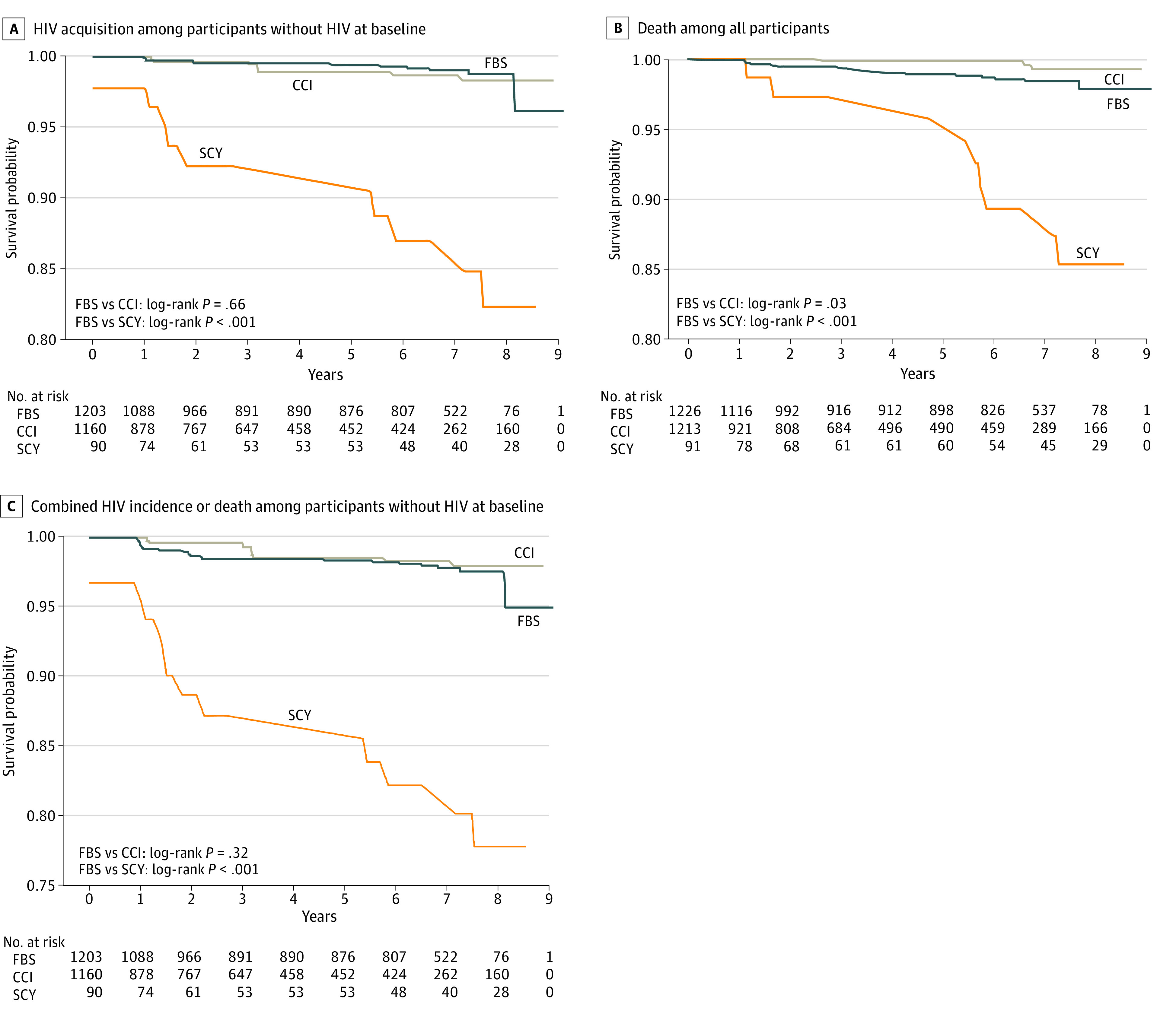
Among 2551 participants, 1230 youths were living in family-based settings, 1230 were living in institutional settings, and 91 were living in street settings. Overall, 1321 participants (51.8%) were male, with a mean (SD) age at baseline of 10.4 (4.8) years. Most participants who were living in institutional (1047 of 1230 youths [85.1%]) or street (71 of 91 youths [78.0%]) settings were double orphaned (ie, both parents had died). A total of 59 participants acquired HIV infection or died during the study period. After adjusting for sex, age, and baseline HIV status, living in a charitable children's institution was not associated with death (adjusted hazard ratio [AHR], 0.26; 95% CI, 0.07-1.02) or incident HIV (AHR, 1.49; 95% CI, 0.46-4.83). Compared with living in a family-based setting, living in a street setting was associated with death (AHR, 5.46; 95% CI, 2.30-12.94), incident HIV (AHR, 17.31; 95% CI, 5.85-51.25), and time to incident HIV or death (AHR, 7.82; 95% CI, 3.48-17.55).
In this study, after adjusting for potential confounders, no association was found between care environment and HIV incidence or death among youths living in institutional vs family-based settings. However, living in a street setting vs a family-based setting was associated with both HIV incidence and death. This study's findings suggest that strengthening of child protection systems and greater investment in evidence-based family support systems that improve child and adolescent health and prevent youth migration to the street are needed for safe and beneficial deinstitutionalization to be implemented at scale.
2015 年,全球有近 1.4 亿孤儿,特别是在低收入和中等收入地区,还有数百万儿童以街头为日常生活的中心。共有 1660 万名儿童因与艾滋病毒/艾滋病相关的死亡而成为孤儿,其中 90%生活在撒哈拉以南非洲。尽管该地区大多数孤儿和失散儿童和青少年由大家庭照顾,但需要照顾的儿童人数众多,导致机构照顾泛滥。很少有研究调查孤儿和失散在撒哈拉以南非洲的青少年的关怀环境与身体健康之间的关系。
研究在肯尼亚西部,慈善儿童机构、家庭为基础的环境和街头环境中生活的孤儿和失散儿童和青少年的关怀环境与艾滋病毒感染和死亡之间的关联,时间跨度近 10 年。
设计、地点和参与者:孤儿和失散儿童健康与福祉评估(OSCAR)项目是一项观察性前瞻性队列研究,在肯尼亚乌辛古苏县进行。该队列包括来自 8 个行政地点社区的 2551 名孤儿、失散和街头儿童,包括 300 个随机选择的家庭(家庭环境),照顾因各种原因成为孤儿的儿童,19 家慈善儿童机构(机构环境),以及 100 名在街头自我照顾的便利样本(街头环境)。参与者于 2010 年 5 月 31 日至 2013 年 4 月 24 日入组,并随访至 2019 年 11 月 30 日。
关怀环境(家庭、机构或街头环境)。
生存回归模型用于研究关怀环境与艾滋病毒感染、死亡以及感染艾滋病毒或死亡的时间之间的关联。
在 2551 名参与者中,1230 名年轻人生活在家庭环境中,1230 名生活在机构环境中,91 名生活在街头环境中。总体而言,1321 名参与者(51.8%)为男性,基线时的平均(SD)年龄为 10.4(4.8)岁。大多数生活在机构(1230 名青少年中有 1047 名[85.1%])或街头(91 名青少年中有 71 名[78.0%])环境中的青少年都是双重孤儿(即父母双亡)。在研究期间,共有 59 名参与者感染了艾滋病毒或死亡。在校正性别、年龄和基线艾滋病毒状况后,生活在慈善儿童机构与死亡(调整后的危险比[AHR],0.26;95%CI,0.07-1.02)或艾滋病毒感染(AHR,1.49;95%CI,0.46-4.83)无关。与生活在家庭环境相比,生活在街头环境与死亡(AHR,5.46;95%CI,2.30-12.94)、艾滋病毒感染(AHR,17.31;95%CI,5.85-51.25)和艾滋病毒感染或死亡的时间(AHR,7.82;95%CI,3.48-17.55)有关。
在这项研究中,在校正潜在混杂因素后,在机构和家庭环境中生活的青少年的关怀环境与艾滋病毒感染率或死亡率之间没有关联。然而,与生活在家庭环境相比,生活在街头环境与艾滋病毒感染和死亡都有关。这项研究的结果表明,需要加强儿童保护系统,并加大对基于证据的家庭支持系统的投资,以改善儿童和青少年的健康,并防止青年移民到街头,以便在大规模实施有益的去机构化时实现安全和有益。