Immunology Program, Stanford University School of Medicine, Stanford, California, USA.
Institute for Immunity, Transplantation and Infection, Stanford University School of Medicine, Stanford, California, USA.
J Am Med Inform Assoc. 2021 Oct 12;28(11):2325-2335. doi: 10.1093/jamia/ocab165.
Ulcerative colitis (UC) is a chronic inflammatory disorder with limited effective therapeutic options for long-term treatment and disease maintenance. We hypothesized that a multi-cohort analysis of independent cohorts representing real-world heterogeneity of UC would identify a robust transcriptomic signature to improve identification of FDA-approved drugs that can be repurposed to treat patients with UC.
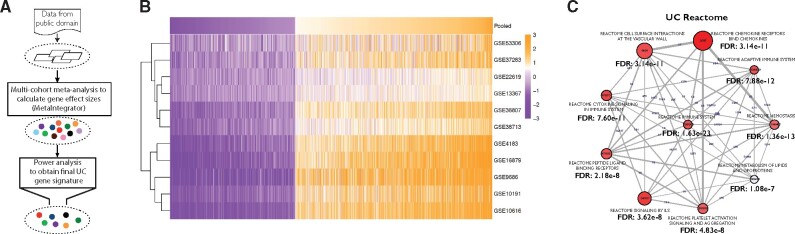
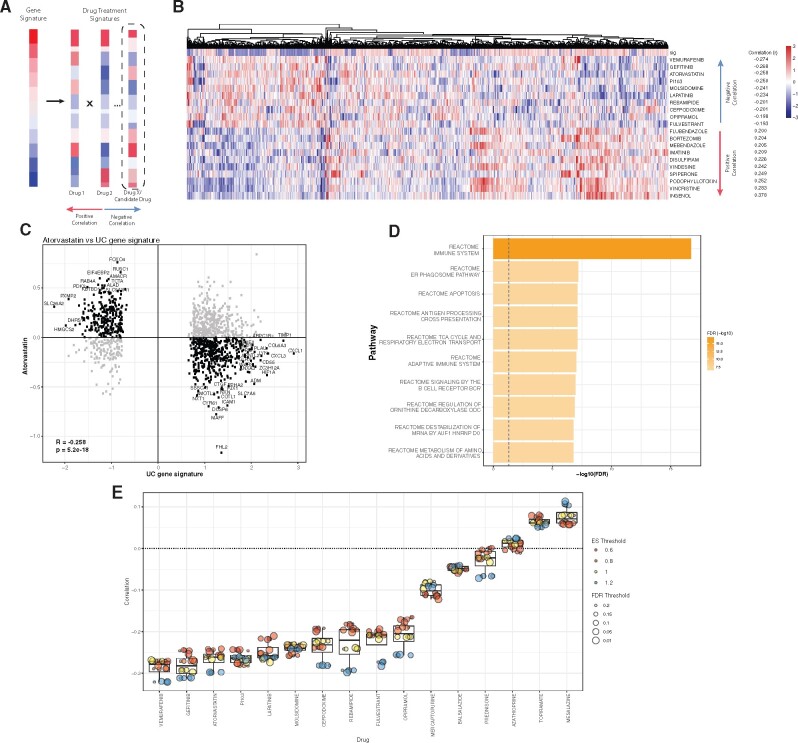
We performed a multi-cohort analysis of 272 colon biopsy transcriptome samples across 11 publicly available datasets to identify a robust UC disease gene signature. We compared the gene signature to in vitro transcriptomic profiles induced by 781 FDA-approved drugs to identify potential drug targets. We used a retrospective cohort study design modeled after a target trial to evaluate the protective effect of predicted drugs on colectomy risk in patients with UC from the Stanford Research Repository (STARR) database and Optum Clinformatics DataMart.
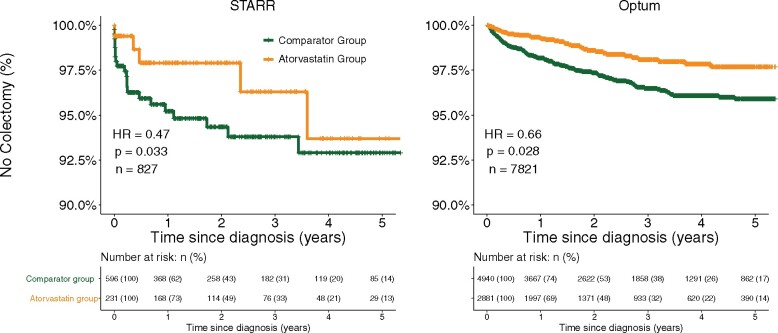
Atorvastatin treatment had the highest inverse-correlation with the UC gene signature among non-oncolytic FDA-approved therapies. In both STARR (n = 827) and Optum (n = 7821), atorvastatin intake was significantly associated with a decreased risk of colectomy, a marker of treatment-refractory disease, compared to patients prescribed a comparator drug (STARR: HR = 0.47, P = .03; Optum: HR = 0.66, P = .03), irrespective of age and length of atorvastatin treatment.
DISCUSSION & CONCLUSION: These findings suggest that atorvastatin may serve as a novel therapeutic option for ameliorating disease in patients with UC. Importantly, we provide a systematic framework for integrating publicly available heterogeneous molecular data with clinical data at a large scale to repurpose existing FDA-approved drugs for a wide range of human diseases.
溃疡性结肠炎(UC)是一种慢性炎症性疾病,长期治疗和疾病维持的有效治疗选择有限。我们假设,对代表 UC 真实世界异质性的独立队列进行多队列分析,将确定一个稳健的转录组特征,以提高鉴定可重新用于治疗 UC 患者的 FDA 批准药物的能力。
我们对 11 个公开可用数据集的 272 个结肠活检转录组样本进行了多队列分析,以确定一个稳健的 UC 疾病基因特征。我们将该基因特征与 781 种 FDA 批准药物的体外转录组谱进行了比较,以确定潜在的药物靶点。我们使用类似于目标试验的回顾性队列研究设计,评估预测药物对斯坦福研究档案(STARR)数据库和 Optum Clinformatics DataMart 中 UC 患者结肠切除术风险的保护作用。
在非肿瘤治疗性 FDA 批准疗法中,阿托伐他汀治疗与 UC 基因特征的相关性最高。在 STARR(n=827)和 Optum(n=7821)中,与服用对照药物的患者相比,阿托伐他汀的摄入与结肠切除术风险降低显著相关,结肠切除术是治疗抵抗疾病的标志物(STARR:HR=0.47,P=0.03;Optum:HR=0.66,P=0.03),与年龄和阿托伐他汀治疗的时间无关。
这些发现表明,阿托伐他汀可能成为改善 UC 患者疾病的一种新的治疗选择。重要的是,我们提供了一个系统的框架,用于在大规模上整合公开可用的异质分子数据和临床数据,以重新利用现有的 FDA 批准药物治疗广泛的人类疾病。