Department of Biomedical Engineering and Imaging Medicine, Army Medical University, Chongqing, 400038, China.
Department of Emergency, Chongqing Emergency Medical Center, Chongqing, 400014, China.
BMC Cardiovasc Disord. 2021 Sep 16;21(1):441. doi: 10.1186/s12872-021-02262-5.
Previous clinical studies have suggested an effect of gender on outcome after out-of-hospital cardiac arrest, but the results are conflicting and there is no uniform agreement regarding gender differences in survival and prognosis. The present study was aimed to investigate the interaction between gender and post resuscitation interventions on neurological outcome in an asphyxial rat model of cardiac arrest.
Asphyxia was induced by blocking the endotracheal tube in 120 adult Sprague-Dawley rats (60 males and 60 females) at the same age. Cardiopulmonary resuscitation (CPR) was started after 5 min of untreated cardiac arrest. Animals were randomized into one of the three post resuscitation care intervention groups (n = 40, 20 males) immediately after resuscitation: (1) normothermic control (NC): ventilated with 2% N/98% O for 1 h under normothermia; (2) targeted temperature management (TTM): ventilated with 2% N/98% O for 1 h under hypothermia; (3) hydrogen inhalation (HI): ventilated with 2% H/98% O for 1 h under normothermia. Physiological variables were recorded during the 5 h post resuscitation monitoring period. Neurological deficit score (NDS) and accumulative survival were used to assess 96 h outcomes. Mutual independence analysis and Mantel-Haenszel stratified analysis were used to explore the associations among gender, intervention and survival.
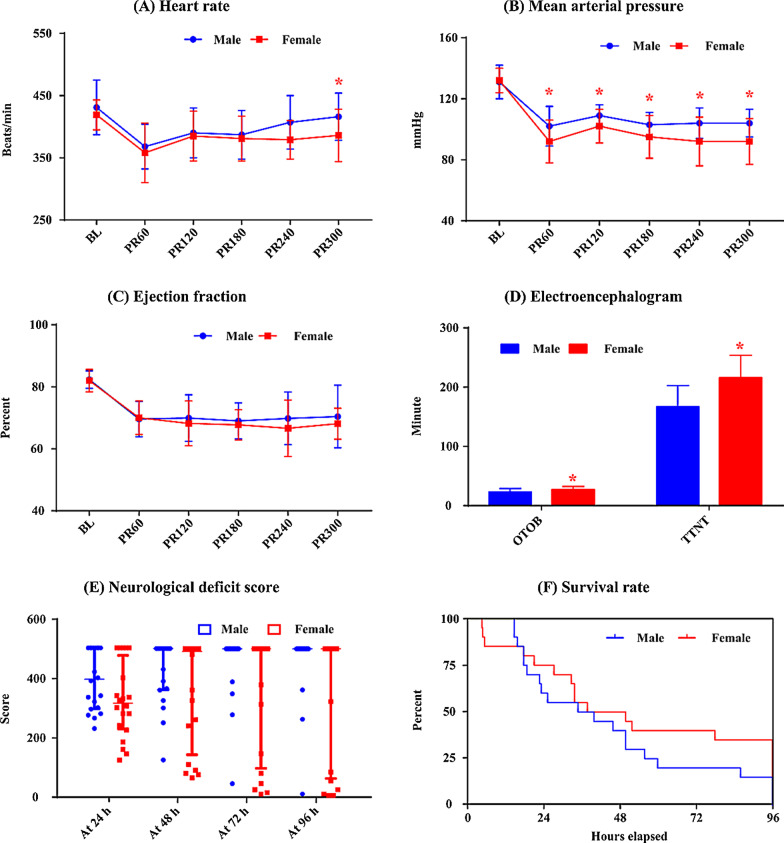
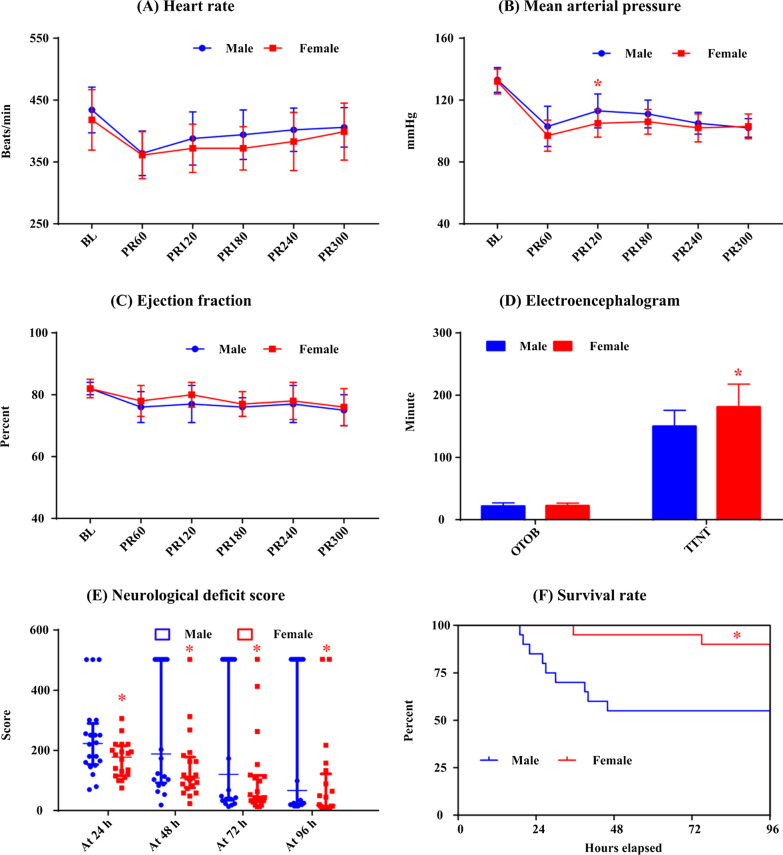
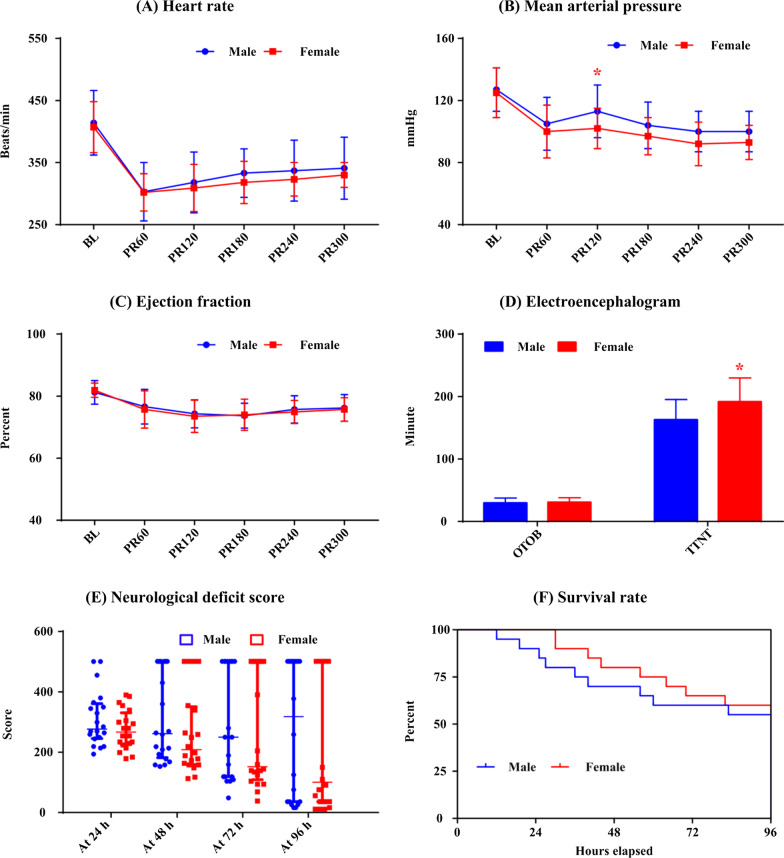
The body weights of female rats were significantly lighter than males, but CPR characteristics did not differ between genders. Compared with male rats, females had significantly lower mean arterial pressure, longer onset time of the electroencephalogram (EEG) burst and time to normal EEG trace (TTNT) in the NC group; relatively longer TTNT in the TTM group; and substantially longer TTNT, lower NDSs, and higher survival in the HI group. Mutual independence analysis revealed that both gender and intervention were associated with neurological outcome. Mantel-Haenszel stratified analysis demonstrated that female rats had significantly higher survival rate than males when adjusted for the confounder intervention.
In this rat model cardiac arrest and CPR, gender did not affect resuscitation but associated with neurological outcome. The superiority of female rats in neurological recovery was affected by post resuscitation interventions and female rats were more likely to benefit from hydrogen therapy.
先前的临床研究表明,性别对院外心脏骤停后的结局有影响,但结果相互矛盾,对于生存和预后方面的性别差异尚无统一共识。本研究旨在探讨在窒息性心脏骤停大鼠模型中,性别与复苏后干预措施之间的相互作用对神经结局的影响。
通过在相同年龄的 120 只成年 Sprague-Dawley 大鼠(60 只雄性和 60 只雌性)的气管内管上阻塞来诱导窒息。在未经治疗的心脏骤停 5 分钟后开始心肺复苏(CPR)。动物在复苏后立即随机分为三个复苏后护理干预组(每组 40 只,20 只雄性):(1)常温对照(NC):在常温下用 2%N/98%O 通气 1 小时;(2)目标温度管理(TTM):在低温下用 2%N/98%O 通气 1 小时;(3)氢气吸入(HI):在常温下用 2%H/98%O 通气 1 小时。在复苏后 5 小时监测期间记录生理变量。神经功能缺损评分(NDS)和累积存活率用于评估 96 小时的结果。采用互不相容性分析和 Mantel-Haenszel 分层分析来探讨性别、干预措施与存活率之间的关系。
雌性大鼠的体重明显轻于雄性,但两性之间的 CPR 特征没有差异。与雄性大鼠相比,NC 组雌性大鼠的平均动脉压明显较低,脑电图(EEG)爆发的起始时间较长,脑电图正常跟踪时间(TTNT)较长;TTNT 在 TTM 组相对较长;HI 组 TTNT 较长,NDS 评分较低,存活率较高。互不相容性分析表明,性别和干预均与神经结局相关。Mantel-Haenszel 分层分析表明,调整混杂因素干预后,雌性大鼠的存活率明显高于雄性。
在该大鼠模型心脏骤停和 CPR 中,性别不影响复苏,但与神经结局相关。雌性大鼠在神经恢复方面的优势受复苏后干预措施的影响,雌性大鼠更有可能受益于氢气治疗。