School of Public Health, Division of Epidemiology and Biostatistics, University of California, Berkeley, 2121 Berkeley Way # 5302, Berkeley, CA, 94720, USA.
Facente Consulting, Richmond, CA, USA.
BMC Public Health. 2021 Sep 16;21(1):1693. doi: 10.1186/s12889-021-11697-6.
Many persons with active SARS-CoV-2 infection experience mild or no symptoms, presenting barriers to COVID-19 prevention. Regular temperature screening is nonetheless used in some settings, including university campuses, to reduce transmission potential. We evaluated the potential impact of this strategy using a prospective university-affiliated cohort.
Between June and August 2020, 2912 participants were enrolled and tested for SARS-CoV-2 by PCR at least once (median: 3, range: 1-9). Participants reported temperature and symptoms daily via electronic survey using a previously owned or study-provided thermometer. We assessed feasibility and acceptability of daily temperature monitoring, calculated sensitivity and specificity of various fever-based strategies for restricting campus access to reduce transmission, and estimated the association between measured temperature and SARS-CoV-2 test positivity using a longitudinal binomial mixed model.
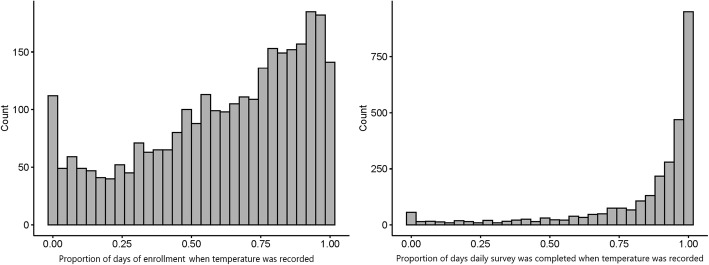
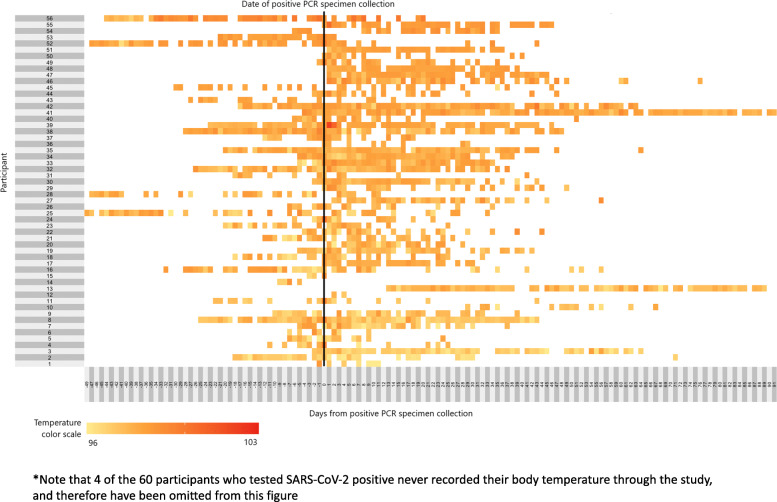
Most participants (70.2%) did not initially have a thermometer for taking their temperature daily. Across 5481 total person months, the average daily completion rate of temperature values was 61.6% (median: 67.6%, IQR: 41.8-86.2%). Sensitivity for SARS-CoV-2 ranged from 0% (95% CI 0-9.7%) to 40.5% (95% CI 25.6-56.7%) across all strategies for self-report of possible COVID-19 symptoms on day of specimen collection, with corresponding specificity of 99.9% (95% CI 99.8-100%) to 95.3% (95% CI 94.7-95.9%). An increase of 0.1 °F in individual mean body temperature on the same day as specimen collection was associated with 1.11 increased odds of SARS-CoV-2 positivity (95% CI 1.06-1.17).
Our study is the first, to our knowledge, that examines the feasibility, acceptability, and effectiveness of daily temperature screening in a prospective cohort during an infectious disease outbreak, and the only study to assess these strategies in a university population. Daily temperature monitoring was feasible and acceptable; however, the majority of potentially infectious individuals were not detected by temperature monitoring, suggesting that temperature screening is insufficient as a primary means of detection to reduce transmission of SARS-CoV-2.
许多患有 SARS-CoV-2 活跃感染的人症状轻微或无症状,这给 COVID-19 预防带来了障碍。然而,在某些情况下,包括大学校园在内,仍会定期进行体温筛查,以降低传播的可能性。我们使用前瞻性大学附属队列评估了这种策略的潜在影响。
在 2020 年 6 月至 8 月期间,共招募了 2912 名参与者,并通过 PCR 至少检测了一次 SARS-CoV-2(中位数:3,范围:1-9)。参与者通过之前拥有或研究提供的温度计,每天通过电子调查报告体温和症状。我们评估了每日体温监测的可行性和可接受性,计算了各种基于发热的策略限制校园进入以减少传播的敏感性和特异性,并使用纵向二项式混合模型估计了测量体温与 SARS-CoV-2 检测阳性之间的关联。
大多数参与者(70.2%)最初没有温度计来每天测量体温。在 5481 总人月中,平均每天完成体温值的比例为 61.6%(中位数:67.6%,IQR:41.8-86.2%)。对于在采集标本当天自我报告可能 COVID-19 症状的所有策略,SARS-CoV-2 的敏感性从 0%(95%CI 0-9.7%)到 40.5%(95%CI 25.6-56.7%)不等,相应的特异性为 99.9%(95%CI 99.8-100%)至 95.3%(95%CI 94.7-95.9%)。在采集标本当天个体平均体温升高 0.1°F,与 SARS-CoV-2 阳性的几率增加 1.11 倍(95%CI 1.06-1.17)相关。
我们的研究是第一个,据我们所知,在传染病爆发期间,在前瞻性队列中检查每日体温筛查的可行性、可接受性和有效性的研究,也是唯一一项在大学人群中评估这些策略的研究。每日体温监测是可行和可接受的;然而,大多数潜在的传染性个体并未通过体温监测检测到,这表明体温筛查不足以作为降低 SARS-CoV-2 传播的主要检测手段。