Department of Public Health Sciences, Clemson University, Clemson, SC, USA.
School of Mathematical and Statistical Sciences, Clemson University, Clemson, SC, USA.
Lancet Child Adolesc Health. 2021 Jun;5(6):428-436. doi: 10.1016/S2352-4642(21)00060-2. Epub 2021 Mar 19.
Despite severe outbreaks of COVID-19 among colleges and universities across the USA during the Fall 2020 semester, the majority of institutions did not routinely test students. While high-frequency repeated testing is considered the most effective strategy for disease mitigation, most institutions do not have the necessary infrastructure or funding for implementation. Therefore, alternative strategies for testing the student population are needed. Our study detailed the implementation and results of testing strategies to mitigate SARS-CoV-2 spread on a university campus, and we aimed to assess the relative effectiveness of the different testing strategies.
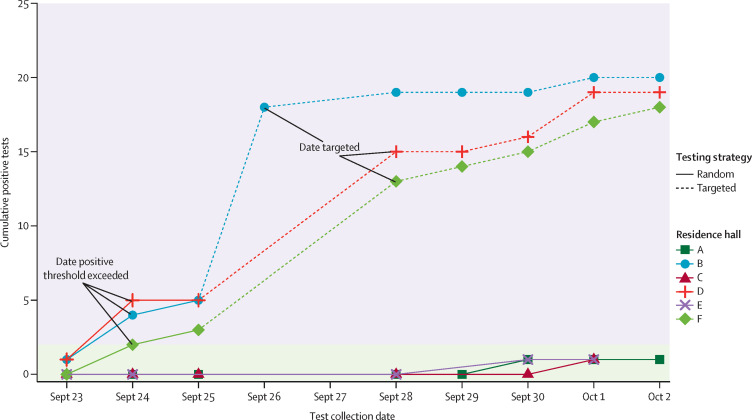
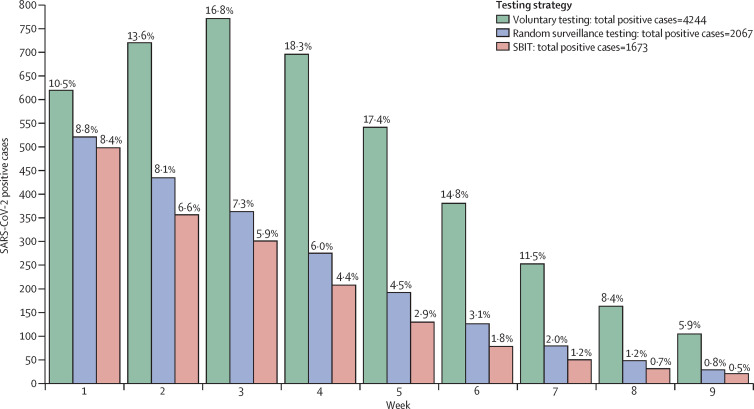
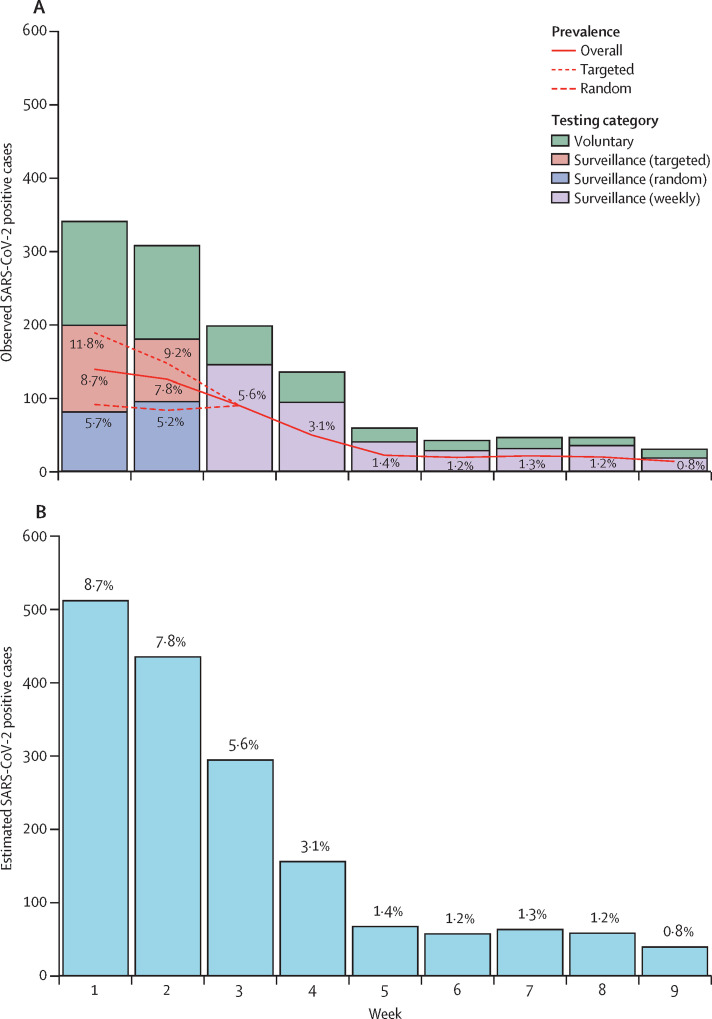
For this retrospective cohort study, we included 6273 on-campus students arriving to a large public university in the rural USA (Clemson, SC, USA) for in-person instruction in the Fall 2020 semester (Sept 21 to Nov 25). Individuals arriving after Sept 23, those who tested positive for SARS-CoV-2 before Aug 19, and student athletes and band members were not included in this study. We implemented two testing strategies to mitigate SARS-CoV-2 spread during this period: a novel surveillance-based informative testing (SBIT) strategy, consisting of random surveillance testing to identify outbreaks in residence hall buildings or floors and target them for follow-up testing (Sept 23 to Oct 5); followed by a repeated weekly surveillance testing (Oct 6 to Nov 22). Relative changes in estimated weekly prevalence were examined. We developed SARS-CoV-2 transmission models to compare the relative effectiveness of weekly testing (900 daily surveillance tests), SBIT (450 daily surveillance tests), random surveillance testing (450 daily surveillance tests), and voluntary testing (0 daily surveillance tests) on disease mitigation. Model parameters were based on our empirical surveillance data in conjunction with published sources.
SBIT was implemented from Sept 23 to Oct 5, and identified outbreaks in eight residence hall buildings and 45 residence hall floors. Targeted testing of residence halls was 2·03 times more likely to detect a positive case than random testing (95% CI 1·67-2·46). Weekly prevalence was reduced from a peak of 8·7% to 5·6% during this 2-week period, a relative reduction of 36% (95% CI 27-44). Prevalence continued to decrease after implementation of weekly testing, reaching 0·8% at the end of in-person instruction (week 9). SARS-CoV-2 transmission models concluded that, in the absence of SBIT (ie, voluntary testing only), the total number of COVID-19 cases would have increased by 154% throughout the semester. Compared with SBIT, random surveillance testing alone would have resulted in a 24% increase in COVID-19 cases. Implementation of weekly testing at the start of the semester would have resulted in 36% fewer COVID-19 cases throughout the semester compared with SBIT, but it would require twice the number of daily tests.
It is imperative that institutions rigorously test students during the 2021 academic year. When high-frequency testing (eg, weekly) is not possible, SBIT is an effective strategy to mitigate disease spread among the student population that can be feasibly implemented across colleges and universities.
Clemson University, USA.
尽管美国高校在 2020 年秋季学期爆发了严重的 COVID-19 疫情,但大多数高校并未对学生进行常规检测。虽然高频重复检测被认为是减轻疾病的最有效策略,但大多数机构没有实施该策略所需的基础设施或资金。因此,需要寻找替代的学生群体检测策略。我们的研究详细介绍了在大学校园实施和评估减轻 SARS-CoV-2 传播的检测策略的结果,并旨在评估不同检测策略的相对有效性。
本回顾性队列研究纳入了 6273 名在美国农村的大型公立大学(美国克莱姆森)报到进行面对面教学的在校学生(2020 年秋季学期,9 月 21 日至 11 月 25 日)。本研究不包括 9 月 23 日后到校的学生、8 月 19 日前检测出 SARS-CoV-2 阳性的学生,以及学生运动员和乐队成员。我们实施了两种检测策略来减轻 SARS-CoV-2 在这期间的传播:一种是新型基于监测的信息性检测(SBIT)策略,包括随机监测检测以识别宿舍大楼或楼层的疫情,并对其进行后续检测(9 月 23 日至 10 月 5 日);随后进行每周重复监测检测(10 月 6 日至 11 月 22 日)。我们检查了每周估计患病率的变化。我们开发了 SARS-CoV-2 传播模型,以比较每周检测(900 次日常监测检测)、SBIT(450 次日常监测检测)、随机监测检测(450 次日常监测检测)和自愿检测(0 次日常监测检测)在疾病缓解方面的相对效果。模型参数基于我们的经验监测数据以及已发表的资料。
SBIT 于 9 月 23 日至 10 月 5 日实施,在 8 栋宿舍楼和 45 个宿舍楼楼层发现了疫情。对宿舍楼进行有针对性的检测比随机检测发现阳性病例的可能性高 2.03 倍(95%CI 1.67-2.46)。在这两周期间,每周患病率从高峰时的 8.7%降至 5.6%,相对减少了 36%(95%CI 27-44)。在实施每周检测后,患病率继续下降,在面对面教学结束时(第 9 周)降至 0.8%。SARS-CoV-2 传播模型得出的结论是,如果没有 SBIT(即仅进行自愿检测),整个学期的 COVID-19 病例数将增加 154%。与 SBIT 相比,单独进行随机监测检测会使 COVID-19 病例增加 24%。在学期开始时实施每周检测,整个学期的 COVID-19 病例数将比 SBIT 减少 36%,但需要进行两倍的日常检测。
在 2021 学年,各机构严格检测学生至关重要。当无法进行高频检测(如每周检测)时,SBIT 是减轻学生群体疾病传播的有效策略,可在各大学和学院中切实实施。
美国克莱姆森大学。