Weizmann Institute of Science, Department of Earth and Planetary Sciences, Rehovot, Israel.
School of Marine Sciences, University of Maine, Orono, ME, USA.
Nat Commun. 2021 Sep 16;12(1):5476. doi: 10.1038/s41467-021-25579-3.
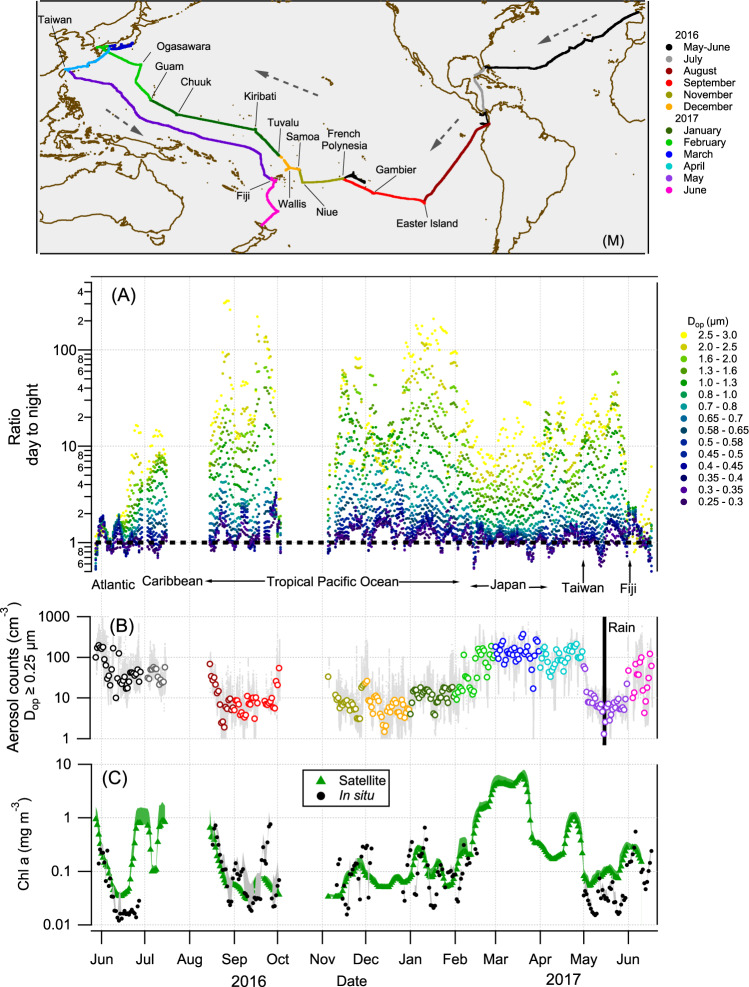
Sea spray aerosol (SSA) formation have a major role in the climate system, but measurements at a global-scale of this micro-scale process are highly challenging. We measured high-resolution temporal patterns of SSA number concentration over the Atlantic Ocean, Caribbean Sea, and the Pacific Ocean covering over 42,000 km. We discovered a ubiquitous 24-hour rhythm to the SSA number concentration, with concentrations increasing after sunrise, remaining higher during the day, and returning to predawn values after sunset. The presence of dominating continental aerosol transport can mask the SSA cycle. We did not find significant links between the diel cycle of SSA number concentration and diel variations of surface winds, atmospheric physical properties, radiation, pollution, nor oceanic physical properties. However, the daily mean sea surface temperature positively correlated with the magnitude of the day-to-nighttime increase in SSA concentration. Parallel diel patterns in particle sizes were also detected in near-surface waters attributed to variations in the size of particles smaller than ~1 µm. These variations may point to microbial day-to-night modulation of bubble-bursting dynamics as a possible cause of the SSA cycle.
海洋飞沫气溶胶(SSA)的形成在气候系统中起着重要作用,但在全球范围内对这一微观过程进行测量极具挑战性。我们测量了覆盖超过 42000 公里的大西洋、加勒比海和太平洋上空 SSA 数浓度的高分辨率时间变化模式。我们发现 SSA 数浓度存在普遍的 24 小时节律,日出后浓度增加,白天保持较高水平,日落后天亮前恢复到值。主导的大陆气溶胶输送的存在可能掩盖了 SSA 循环。我们没有发现 SSA 数浓度的日变化与表面风、大气物理特性、辐射、污染或海洋物理特性的日变化之间有显著联系。然而,每日平均海面温度与 SSA 浓度昼夜变化的幅度呈正相关。在近地表水中还检测到颗粒大小的平行日变化模式,这归因于小于约 1 µm 的颗粒大小的变化。这些变化可能表明微生物对气泡破裂动力学的昼夜调制是 SSA 循环的可能原因。