Abebe Abnet, Belayneh Meseret, Asrat Habtamu, Kassa Wondwossen, Gashu Andargachew, Desale Adino, Hailu Getnet, Mekonnen Tesfaye, Girmachew Feven, Mulugeta Achamyeleh, Abose Ebise, Yenealem Dereje, Tsadik Abeba G, Kebede Adisu, Ayana Gonfa, Desta Kassu
Ethiopian Public Health Institute, Addis Ababa, Ethiopia.
Department of Medical Laboratory Sciences, College of Health Sciences, Addis Ababa University, Addis Ababa, Ethiopia.
Malariaworld J. 2017 Jun 1;8:6. eCollection 2017.
Microscopic diagnosis of Giemsa-stained thick and thin blood films has remained the standard laboratory method for diagnosing malaria. High quality performance of microscopists that examine blood slides in health facilities remains critically important.
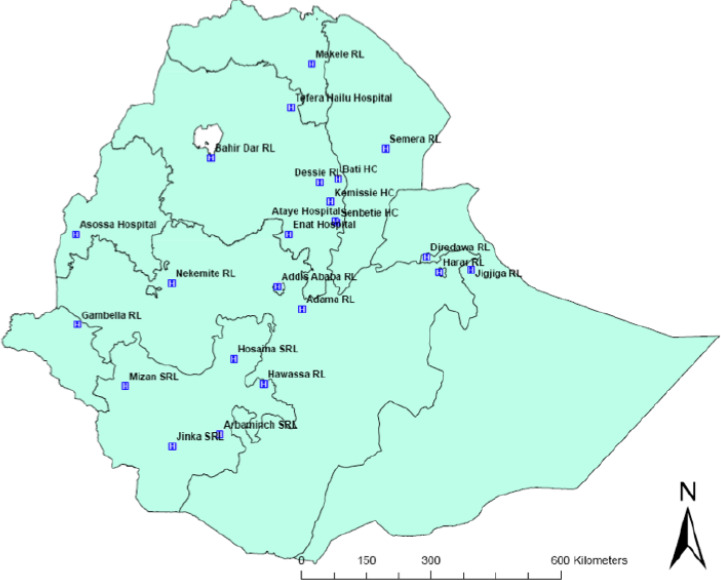
A cross-sectional study was conducted to assess the performance of 107 malaria microscopists working at 23 malaria rechecking laboratories in Ethiopia. A set of 12 blood film slides was distributed to each microscopist. Data was collected and exported to SPSS version 20 for analysis. Chi-square, sensitivity, specificity, percent agreement, and kappa scores were calculated to assess performance in detecting and identification of species.
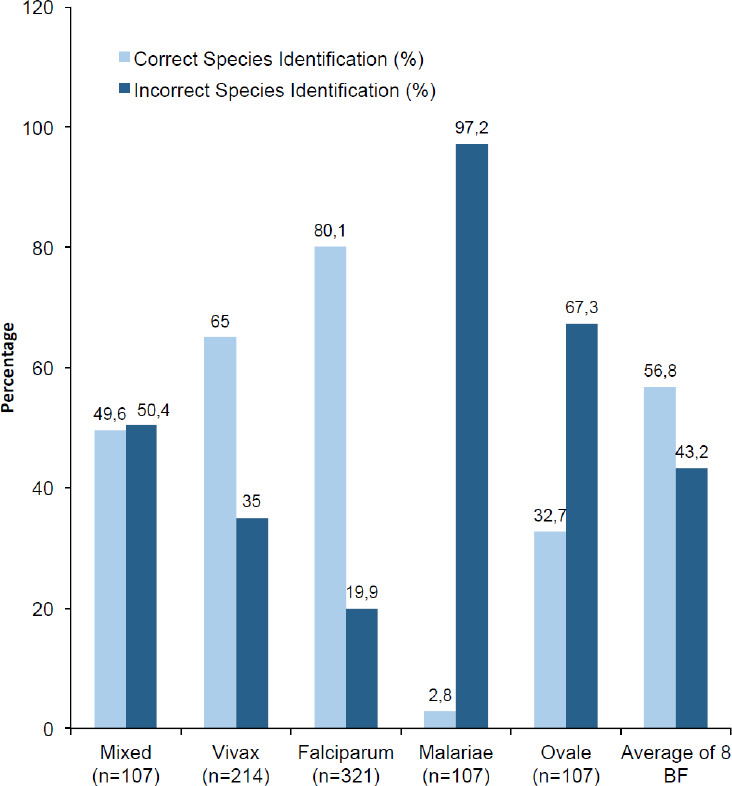
The mean age of the participants was 30 ± 5 yrs and most of them (54; 50.5%) were working at regional reference laboratories. Overall, the sensitivity of participants in detecting and identifying malaria parasite species was 96.8% and 56.7%, respectively. The overall agreement on detection and identification of malaria species was 96.8% (Kappa = 0.9) and 64.8% (Kappa = 0.33), respectively. The least accurately identified malaria parasite species was (3/107; 2.8%) followed by (35/107; 32.7%). Participants working at hospital laboratories had the highest percentage (72.3 %, Kappa=0.51) of accurate species identification. Study participants that had participated in malaria microscopy and quality assurance trainings were significantly better at quantifying parasite densities (P<0.001).
The accuracy of parasite identification and quantification differed strongly between participants and expert microscopists. Therefore, regular competency assessment and training for malaria microscopists should be mandatory to assure proper diagnosis and management of malaria in Ethiopia.
吉姆萨染色厚血膜和薄血膜的显微镜诊断一直是疟疾诊断的标准实验室方法。在卫生机构检查血涂片的显微镜检查人员的高质量表现仍然至关重要。
进行了一项横断面研究,以评估在埃塞俄比亚23个疟疾复查实验室工作的107名疟疾显微镜检查人员的表现。向每位显微镜检查人员分发了一组12张血涂片。收集数据并导出到SPSS 20版进行分析。计算卡方、敏感性、特异性、一致性百分比和kappa分数,以评估在检测和鉴定疟原虫种类方面的表现。
参与者的平均年龄为30±5岁,其中大多数(54人;50.5%)在区域参考实验室工作。总体而言,参与者检测和鉴定疟原虫种类的敏感性分别为96.8%和56.7%。对疟原虫种类检测和鉴定的总体一致性分别为96.8%(Kappa=0.9)和64.8%(Kappa=0.33)。鉴定最不准确的疟原虫种类是[具体种类1](3/107;2.8%),其次是[具体种类2](35/107;32.7%)。在医院实验室工作的参与者准确鉴定种类的百分比最高(72.3%,Kappa=0.51)。参加过疟疾显微镜检查和质量保证培训的研究参与者在定量寄生虫密度方面明显更好(P<0.001)。
参与者和专业显微镜检查人员在寄生虫鉴定和定量的准确性方面存在很大差异。因此,应为疟疾显微镜检查人员定期进行能力评估和培训,以确保埃塞俄比亚疟疾的正确诊断和管理。