Department of Family Medicine and Public Health, University of California San Diego, 9500 Gilman Dr, La Jolla, CA, USA; Herbert Wertheim School of Public Health and Human Longevity Science, University of California San Diego, 9500 Gilman Dr, La Jolla, CA, USA.
Herbert Wertheim School of Public Health and Human Longevity Science, University of California San Diego, 9500 Gilman Dr, La Jolla, CA, USA; Department of Radiology, University of California San Diego, 9500 Gilman Dr, La Jolla, CA, USA.
J Neurol Sci. 2021 Nov 15;430:118071. doi: 10.1016/j.jns.2021.118071. Epub 2021 Sep 14.
Estimated glomerular filtration rate (eGFR), albuminuria and serum uric acid (SUA) are markers of kidney function that have been associated with cognitive ability. However, whether these associations are causal is unclear.
We performed one-sample Mendelian randomization (MR) to estimate the effects of kidney function markers on cognitive performance using data from the UK Biobank. Polygenic scores for SUA, urine albumin to creatinine ratio (ACR), estimated glomerular filtration rate based on serum creatinine (eGFRcre) and serum cystatin C (eGFRcys) were used as instrumental variables, and cognitive function outcomes included tests of verbal-numeric reasoning, reaction time, visual memory, and numeric memory.
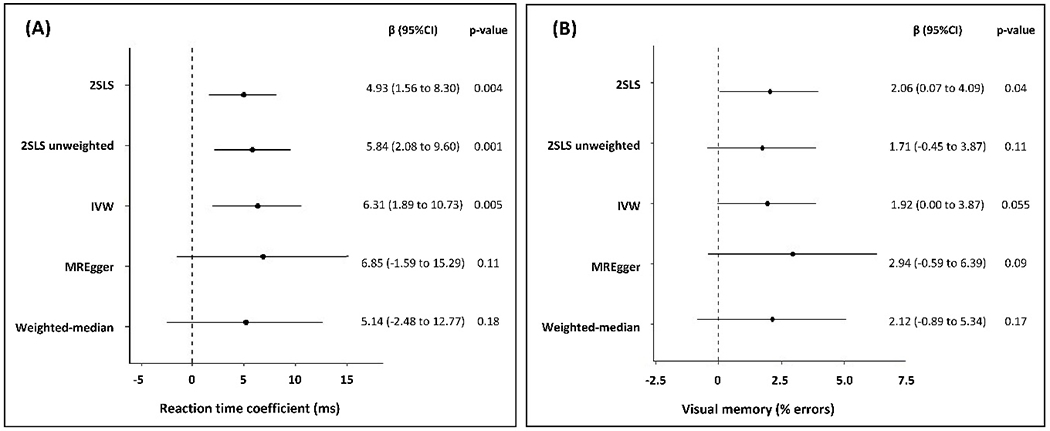
We found no evidence of a causal effect of genetically determined SUA, eGFRcre or eGFRcys on cognitive function outcomes. There was no association between a polygenic score for ACR and verbal-numeric reasoning or numeric memory. However, there was suggestive evidence of a relationship between genetically increased ACR and slower reaction time and worse visual memory. ACR was no longer significantly associated with visual memory in analyses using an unweighted polygenic score and in analyses stratified by sex and age category. Pleiotropy adjusted estimates were directionally consistent with those of the principal analysis but overlapped with the null.
This MR study does not support causal effects of SUA, eGFRcre or eGFRcys on cognitive performance. Genetically increased ACR was associated with slower processing speed and visual memory, but results need confirmation in independent samples.
估算肾小球滤过率(eGFR)、白蛋白尿和血清尿酸(SUA)是与认知能力相关的肾功能标志物。然而,这些关联是否具有因果关系尚不清楚。
我们使用 UK Biobank 的数据进行了单样本孟德尔随机化(MR)分析,以评估肾功能标志物对认知表现的影响。SUA、尿白蛋白与肌酐比值(ACR)、基于血清肌酐的估算肾小球滤过率(eGFRcre)和血清胱抑素 C 的估算肾小球滤过率(eGFRcys)的多基因评分被用作工具变量,认知功能结果包括言语数字推理、反应时间、视觉记忆和数字记忆测试。
我们没有发现遗传决定的 SUA、eGFRcre 或 eGFRcys 对认知功能结果有因果影响的证据。ACR 的多基因评分与言语数字推理或数字记忆之间没有关联。然而,遗传上增加的 ACR 与反应时间较慢和视觉记忆较差之间存在暗示性的关联。在使用非加权多基因评分和按性别和年龄类别分层的分析中,ACR 与视觉记忆之间不再存在显著关联。经多效性调整的估计值与主要分析的方向一致,但与零值重叠。
这项 MR 研究不支持 SUA、eGFRcre 或 eGFRcys 对认知表现的因果影响。遗传上增加的 ACR 与处理速度较慢和视觉记忆较差有关,但需要在独立样本中进行验证。