Department of Family Medicine and Public Health, University of California San Diego, 9500 Gilman Dr, La Jolla, San Diego, CA, USA.
Department of Family Medicine and Public Health, Herbert Wertheim School of Public Health and Human Longevity Science, University of California San Diego, School of Medicine, 9500 Gilman Dr, La Jolla, CA, 92093-0841, San Diego, USA.
BMC Nephrol. 2022 Apr 27;23(1):159. doi: 10.1186/s12882-022-02750-6.
Chronic kidney disease has been linked to worse cognition. However, this association may be dependent on the marker of kidney function used, and studies assessing modification by genetics are lacking. This study examined associations between multiple measures of kidney function and assessed effect modification by a polygenic score for general cognitive function.
In this cross-sectional study of up to 341,208 European ancestry participants from the UK Biobank study, we examined associations between albuminuria and estimated glomerular filtration rate based on creatinine (eGFRcre) or cystatin C (eGFRcys) with cognitive performance on tests of verbal-numeric reasoning, reaction time and visual memory. Adjustment for confounding factors was performed using multivariate regression and propensity-score matching. Interaction between kidney function markers and a polygenic risk score for general cognitive function was also assessed.
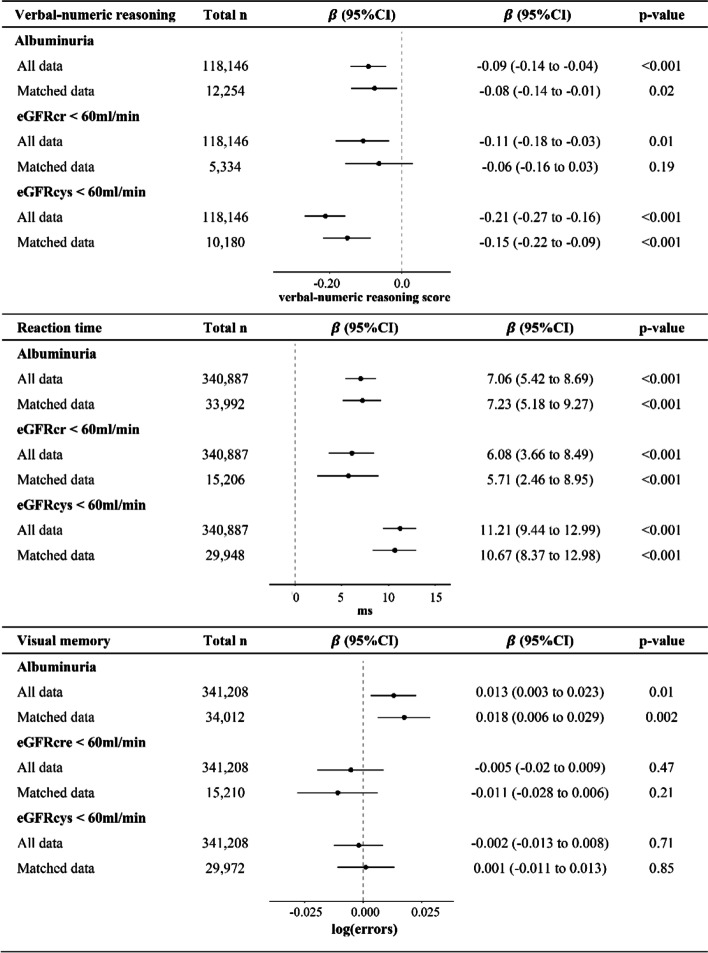
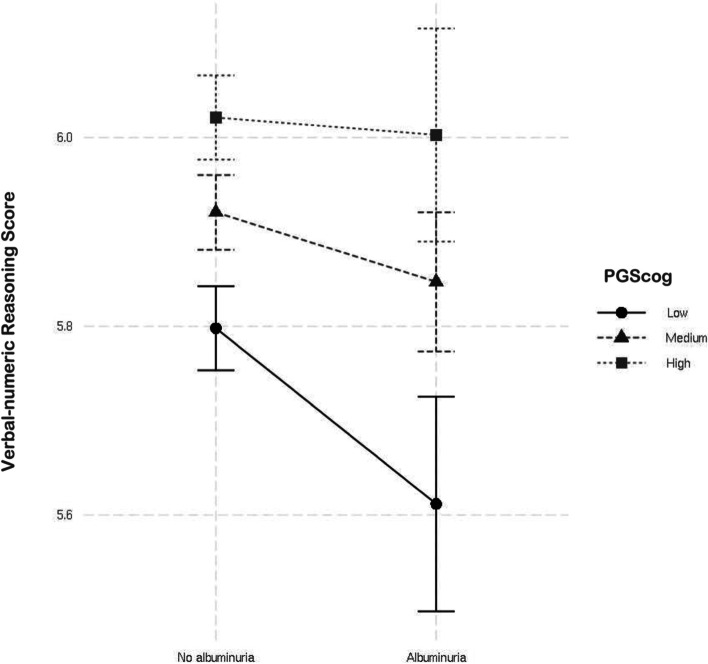
Albuminuria was associated with worse performance on tasks of verbal-numeric reasoning (β(points) = -0.09, p < 0.001), reaction time (β(milliseconds) = 7.06, p < 0.001) and visual memory (β(log errors) = 0.013, p = 0.01). A polygenic score for cognitive function modified the association between albuminuria and verbal-numeric reasoning with significantly lower scores in those with albuminuria and a lower polygenic score (p = 0.009). Compared to participants with eGFRcre ≥ 60 ml/min, those with eGFRcre < 60 ml/min had lower verbal-numeric reasoning scores and slower mean reaction times (verbal numeric reasoning β = -0.11, p < 0.001 and reaction time β = 6.08, p < 0.001 for eGFRcre < 60 vs eGFRcre ≥ 60). Associations were stronger using cystatin C-based eGFR than creatinine-based eGFR (verbal numeric reasoning β = -0.21, p < 0.001 and reaction time β = 11.21, p < 0.001 for eGFRcys < 60 vs eGFRcys ≥ 60).
Increased urine albumin is associated with worse cognition, but this may depend on genetic risk. Cystatin C-based eGFR may better predict cognitive performance than creatinine-based estimates.
慢性肾病与认知能力下降有关。然而,这种关联可能取决于所使用的肾功能标志物,并且缺乏评估遗传修饰的研究。本研究评估了多种肾功能指标与一般认知功能多基因评分之间的关联,并评估了其对认知表现的影响。
在这项 UK Biobank 研究中,对多达 341208 名欧洲血统的参与者进行了横断面研究,我们检查了白蛋白尿和基于肌酐的估计肾小球滤过率(eGFRcre)或胱抑素 C(eGFRcys)与言语数字推理、反应时间和视觉记忆测试的认知表现之间的关系。使用多元回归和倾向评分匹配来调整混杂因素。还评估了肾功能标志物与一般认知功能多基因风险评分之间的相互作用。
白蛋白尿与言语数字推理任务的表现较差有关(β(点)= -0.09,p < 0.001)、反应时间(β(毫秒)= 7.06,p < 0.001)和视觉记忆(β(对数错误)= 0.013,p = 0.01)。认知功能的多基因评分修饰了白蛋白尿与言语数字推理之间的关联,在白蛋白尿和较低多基因评分的患者中,评分明显较低(p = 0.009)。与 eGFRcre≥60 ml/min 的参与者相比,eGFRcre<60 ml/min 的参与者言语数字推理得分较低,平均反应时间较慢(言语数字推理β= -0.11,p < 0.001 和反应时间β= 6.08,p < 0.001 对于 eGFRcre<60 与 eGFRcre≥60)。与基于肌酐的 eGFR 相比,基于胱抑素 C 的 eGFR 的关联更强(言语数字推理β= -0.21,p < 0.001 和反应时间β= 11.21,p < 0.001 对于 eGFRcys<60 与 eGFRcys≥60)。
尿白蛋白升高与认知能力下降有关,但这可能取决于遗传风险。基于胱抑素 C 的 eGFR 可能比基于肌酐的估计更好地预测认知表现。