Ji Yoonjung, Lee Hyeonkyeong, Lee Taewha, Choi Mona, Lee Hyejung, Kim Sanghee, Do Hyunok Kim, Kim Sunah, Chu Sang Hui, Park Jeongok, Kim Young Man, Park Soyoon
Mo-Im Kim Nursing Research Institute, College of Nursing, Yonsei University, Seoul, Republic of Korea.
Joint Commission International, Illinois, United States.
BMC Nurs. 2021 Sep 17;20(1):172. doi: 10.1186/s12912-021-00694-0.
Nursing students' practical training should begin when students can apply core knowledge, skills, and attitudes related to patient safety. This necessitates an integrated curriculum in nursing education that links practice to the theory concerning patient safety to enhance patient safety competencies and quality in nursing care. This study aimed to develop an integrated curriculum that incorporates patient safety factors in the existing curriculum to increase patient safety competencies in nursing students.
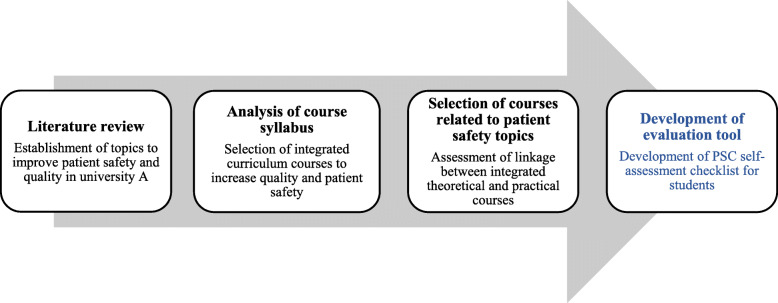
A case study approach was adopted to explain the development processes of a new curriculum integrating patient safety in the existing outcome-based curriculum of a nursing college. Based on the existing outcome-based curriculum of a nursing college, a four-step process was performed to integrate patient safety component, including quality improvement, into the curriculum: 1) literature review, 2) analysis of course syllabus, 3) selection of courses related to patient safety topics, and 4) development of evaluation tool.
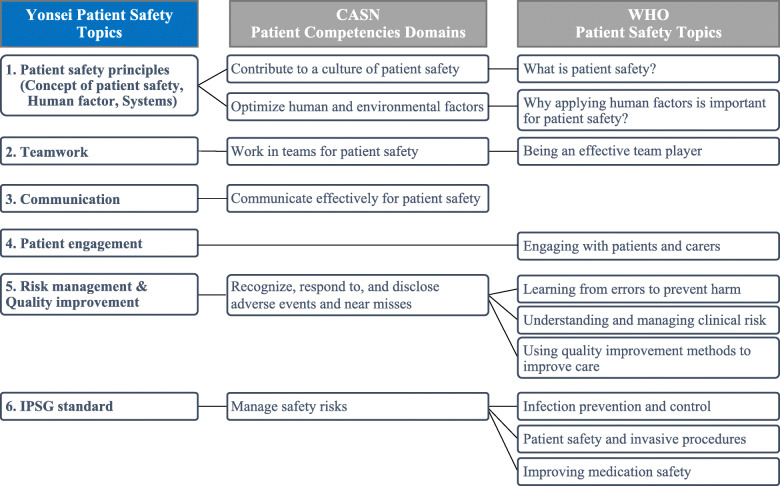
The integrated patient safety curriculum was based on six topics: patient safety principles, teamwork, communication, patient engagement, risk management and, quality improvement, and International Patient Safety Goals. Based on the characteristics of the course according to the level of students in each year, the curriculum was integrated to address patient safety topics in seven courses (four theoretical and three practical). A Patient safety Competency self-assessment checklist was developed for students to naturally acquire patient safety competencies in clinical settings.
This study demonstrated that patient safety topics should be addressed in both theoretical and practical settings across the entire nursing curriculum per the continuity and sequence of education principles.
护理专业学生的实践培训应在学生能够应用与患者安全相关的核心知识、技能和态度时开始。这就需要护理教育中有一个综合课程,将实践与关于患者安全的理论联系起来,以提高患者安全能力和护理质量。本研究旨在开发一个综合课程,将患者安全因素纳入现有课程,以提高护理专业学生的患者安全能力。
采用案例研究方法来解释在一所护理学院现有的基于结果的课程中整合患者安全的新课程的开发过程。基于一所护理学院现有的基于结果的课程,进行了四个步骤的过程,将包括质量改进在内的患者安全组成部分整合到课程中:1)文献综述,2)课程大纲分析,3)选择与患者安全主题相关的课程,4)开发评估工具。
综合患者安全课程基于六个主题:患者安全原则、团队合作、沟通、患者参与、风险管理和质量改进以及国际患者安全目标。根据每年学生水平的课程特点,该课程被整合到七门课程(四门理论课程和三门实践课程)中以涵盖患者安全主题。为学生开发了一份患者安全能力自我评估清单,以便他们在临床环境中自然地获得患者安全能力。
本研究表明,应根据教育原则的连续性和顺序,在整个护理课程的理论和实践环境中都纳入患者安全主题。