Banerjee Arna, Slagle Jason M, Mercaldo Nathaniel D, Booker Ray, Miller Anne, France Daniel J, Rawn Lisa, Weinger Matthew B
Department of Anesthesiology, Vanderbilt University Medical Center, 1211 21st Avenue S, 526 MAB, Nashville, TN, 37212, USA.
Department of Medical Education, Center for Experiential Learning and Assessment, Vanderbilt University Medical Center, Nashville, TN, USA.
BMC Med Educ. 2016 Nov 16;16(1):295. doi: 10.1186/s12909-016-0808-9.
Failures of teamwork and interpersonal communication have been cited as a major patient safety issue. Although healthcare is increasingly being provided in interdisciplinary teams, medical school curricula have traditionally not explicitly included the specific knowledge, skills, attitudes, and behaviors required to function effectively as part of such teams.
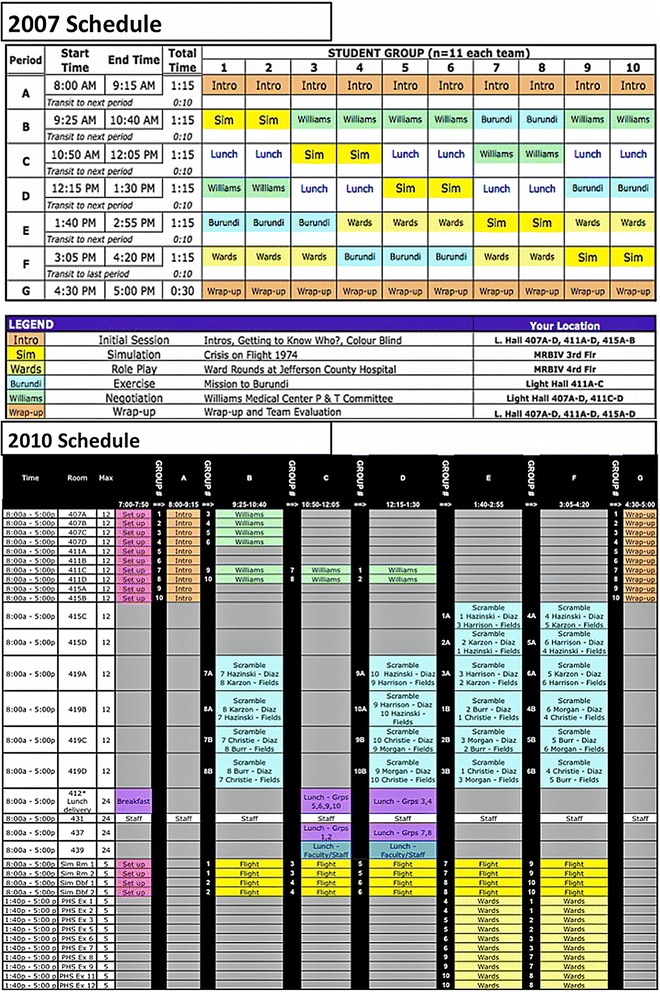
As part of a new "Foundations" core course for beginning medical students that provided a two-week introduction to the most important themes in modern healthcare, a multidisciplinary team, in collaboration with the Center for Experiential Learning and Assessment, was asked to create an experiential introduction to teamwork and interpersonal communication. We designed and implemented a novel, all-day course to teach second-week medical students basic teamwork and interpersonal principles and skills using immersive simulation methods. Students' anonymous comprehensive course evaluations were collected at the end of the day. Through four years of iterative refinement based on students' course evaluations, faculty reflection, and debriefing, the course changed and matured.
Four hundred twenty evaluations were collected. Course evaluations were positive with almost all questions having means and medians greater than 5 out of 7 across all 4 years. Sequential year comparisons were of greatest interest for examining the effects of year-to-year curricular improvements. Differences were not detected among any of the course evaluation questions between 2007 and 2008 except that more students in 2008 felt that the course further developed their "Decision Making Abilities" (OR 1.69, 95% CI 1.07-2.67). With extensive changes to the syllabus and debriefer selection/assignment, concomitant improvements were observed in these aspects between 2008 and 2009 (OR = 2.11, 95% CI: 1.28-3.50). Substantive improvements in specific exercises also yielded significant improvements in the evaluations of those exercises.
This curriculum could be valuable to other medical schools seeking to inculcate teamwork foundations in their medical school's preclinical curricula. Moreover, this curriculum can be used to facilitate teamwork principles important to inter-disciplinary, as well as uni-disciplinary, collaboration.
团队协作和人际沟通的失败被认为是一个主要的患者安全问题。尽管跨学科团队提供医疗服务的情况日益增多,但医学院课程传统上并未明确纳入作为此类团队一员有效发挥作用所需的特定知识、技能、态度和行为。
作为面向医学新生的一门新的“基础”核心课程的一部分,该课程对现代医疗保健中最重要的主题进行了为期两周的介绍,一个多学科团队与体验式学习与评估中心合作,被要求创建一个关于团队协作和人际沟通的体验式介绍。我们设计并实施了一门新颖的全天课程,使用沉浸式模拟方法向第二周的医学生教授基本的团队协作和人际原则与技能。在课程结束时收集了学生的匿名综合课程评价。通过基于学生课程评价、教师反思和总结汇报进行的四年迭代改进,该课程不断变化和成熟。
共收集到420份评价。课程评价呈积极态势,在所有4年中,几乎所有问题的均值和中位数都大于7分制中的5分。逐年比较对于检验逐年课程改进的效果最为重要。2007年和2008年之间,在任何课程评价问题中均未发现差异,只是2008年有更多学生认为该课程进一步提升了他们的“决策能力”(比值比1.69,95%置信区间1.07 - 2.67)。随着教学大纲以及总结汇报者选择/分配的广泛变化,2008年至2009年期间在这些方面出现了相应的改进(比值比 = 2.11,95%置信区间:1.28 - 3.50)。特定练习的实质性改进也在这些练习的评价中产生了显著提升。
该课程对于其他寻求在医学院临床前课程中灌输团队协作基础的医学院校可能具有价值。此外,该课程可用于促进对跨学科以及单学科协作都很重要的团队协作原则。