Escola de Medicina Tradicional Chinesa de Lisboa, Lisbon, Portugal.
Global Health and Tropical Medicine, Instituto de Higiene e Medicina Tropical, Universidade Nova de Lisboa, Rua da Junqueira, 100, 1359-008, Lisbon, Portugal.
Hum Resour Health. 2021 Sep 17;19(1):114. doi: 10.1186/s12960-021-00655-3.
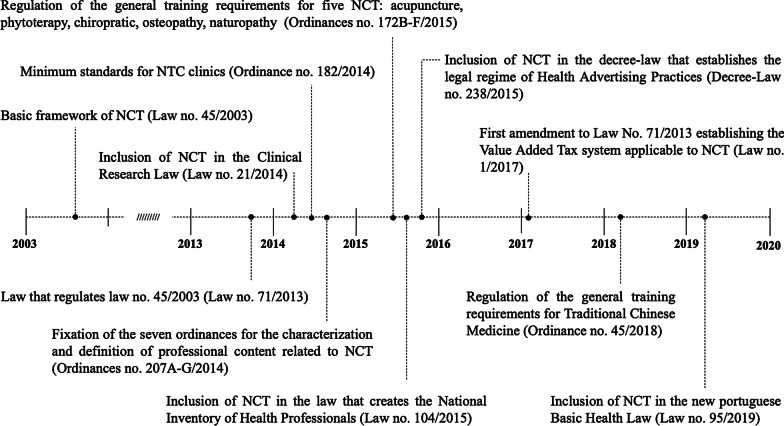
The integration of non-conventional therapies (NCT) into health policies and health services delivery is a worldwide trend and might have a role in achieving Universal Health Coverage. WHO has encouraged countries to integrate NCT into health service delivery and to increase the interest and utilization by consumers. Following two resolutions by the European Parliament and by the Council of Europe, in the late 1990s, recommending the recognition of NCT and calling for EU legislation on non-conventional forms of medicine, Portugal initiated, in 2003, its path towards regulation of NCT. We analyze this process and discuss its implications and impacts in terms of health policies, health services delivery and overall health workforce.
The need to regulate NCT in Portugal stemmed from a growing demand for NCT (and acceptability) among lay citizens and a positive attitude among conventional health professionals which also advocated for a regulatory framework. Political efforts undertaken since 2003 allowed for important advances in the regulation of NCT, beneficiating safe professional practices, and ensuring future academic training at the highest standards, with the defining moment of the social and legal model transition occurring in 2013, when acupuncture, chiropractic, homeopathy, naturopathy, osteopathy, phytotherapy and traditional Chinese Medicine were recognized and regulated. Nevertheless, and because the process knew important time gaps, significant deficiencies arose, mainly between regulation of the training and of the professional activities and the capacity to ensure the continuous production of NCT professionals at an acceptable rate and with minimum quality standards guaranteed.
The regulation of NCT in Portugal was lengthy but steady and was able to bring consumers a safer practice environment and NCT professionals a legal and deontological umbrella for their training, practice, and professional development. Nevertheless, and despite the growing acceptability and normative quality assurance of NCT and its workforce, the regulation process has highlighted some fragilities in terms of accessibility and availability that need attention and urgent action to achieve universal coverage.
将非传统疗法(NCT)纳入卫生政策和卫生服务提供是一种全球趋势,可能在实现全民健康覆盖方面发挥作用。世界卫生组织鼓励各国将 NCT 纳入卫生服务提供,并增加消费者的兴趣和利用。在欧洲议会和欧洲理事会的两项决议之后,在 20 世纪 90 年代末,建议承认 NCT,并呼吁欧盟对非传统形式的医学进行立法,葡萄牙于 2003 年开始其 NCT 监管之路。我们分析了这一过程,并讨论了其对卫生政策、卫生服务提供和整体卫生劳动力的影响和影响。
葡萄牙对 NCT 进行监管的必要性源于非传统疗法(和可接受性)在普通公民中的需求不断增长,以及传统卫生专业人员的积极态度,他们也倡导建立监管框架。自 2003 年以来,葡萄牙开展的政治努力使 NCT 的监管取得了重要进展,使安全的专业实践受益,并确保未来的学术培训达到最高标准,2013 年发生了社会和法律模式转变的决定性时刻,当时针灸、脊椎按摩疗法、顺势疗法、顺势疗法、整骨疗法、植物疗法和传统中医得到了承认和监管。然而,由于该过程存在重要的时间差距,出现了重大缺陷,主要是在培训和专业活动的监管以及确保以可接受的速度和最低质量标准持续生产 NCT 专业人员的能力之间存在缺陷。
葡萄牙的 NCT 监管漫长而稳定,为消费者提供了更安全的实践环境,为 NCT 专业人员提供了法律和职业道德保护伞,以支持他们的培训、实践和专业发展。然而,尽管 NCT 及其劳动力的可接受性和规范性质量保证不断提高,但监管过程凸显了在可及性和可用性方面的一些脆弱性,需要关注和紧急行动,以实现全民覆盖。