Li Kaicheng, Fu Zening, Qi Shile, Luo Xiao, Zeng Qingze, Xu Xiaopei, Huang Peiyu, Zhang Minming, Calhoun Vince D
Tri-Institutional Center for Translational Research in Neuroimaging and Data Science (TReNDS), Georgia Institute of Technology, Georgia State University, Emory University, Atlanta, GA, United States.
Department of Radiology, The Second Affiliated Hospital of Zhejiang University School of Medicine, Hangzhou, China.
Front Aging Neurosci. 2021 Sep 3;13:725246. doi: 10.3389/fnagi.2021.725246. eCollection 2021.
Late-onset Alzheimer's disease (AD) is a polygenic neurodegenerative disease. Identifying the neuroimaging phenotypes behind the genetic predisposition of AD is critical to the understanding of AD pathogenesis. Two major questions which previous studies have led to are: (1) should the general "polygenic hazard score" (PHS) be a good choice to identify the individual genetic risk for AD; and (2) should researchers also include inter-modality relationships in the analyses considering these may provide complementary information about the AD etiology.
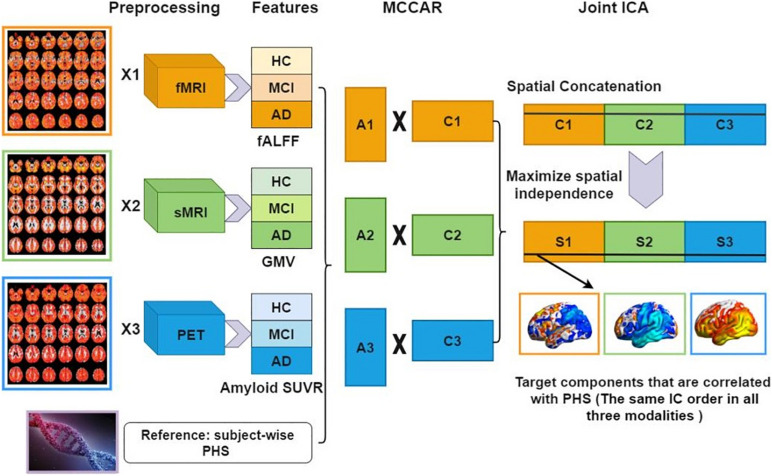
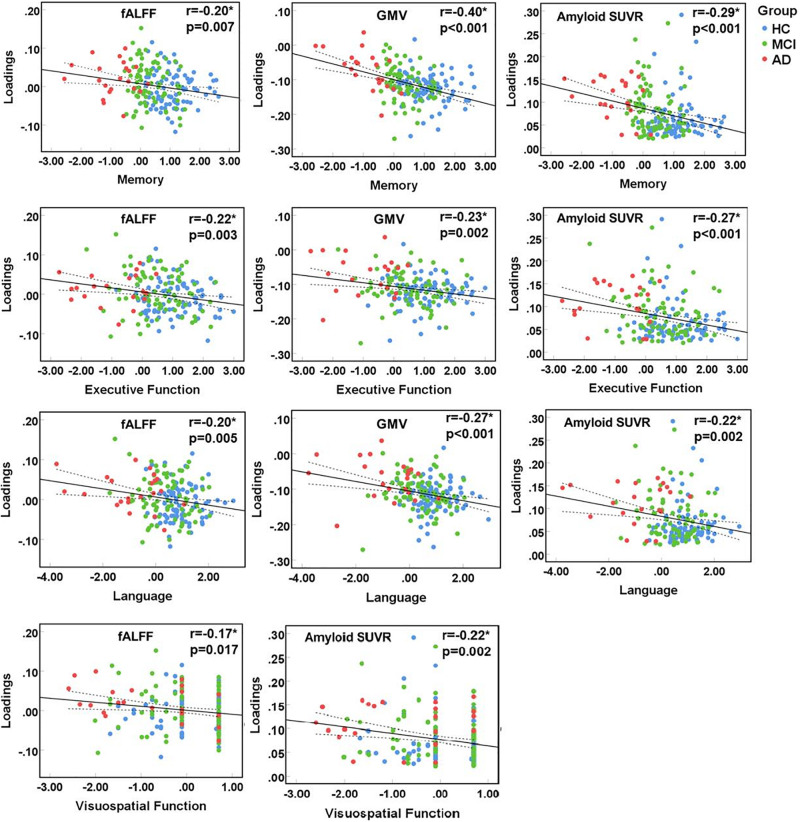
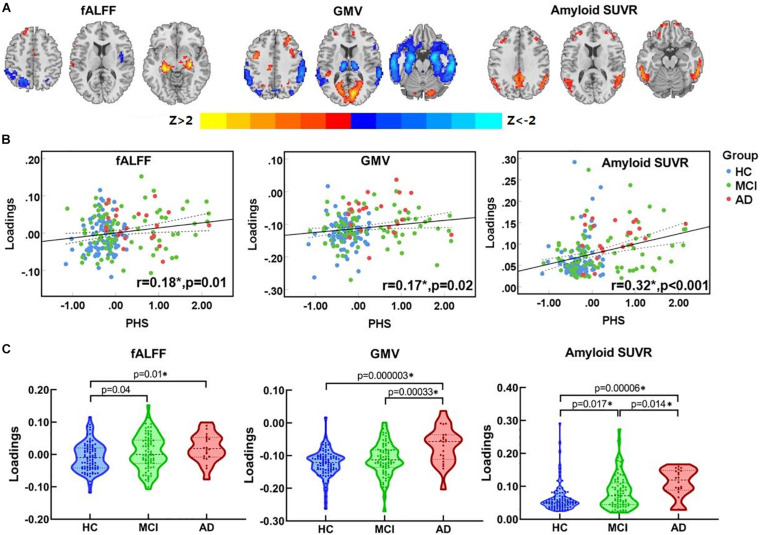
We collected 88 healthy controls, 77 patients with mild cognitive impairment (MCI), and 22 AD patients to simulate the AD continuum included from the ADNI database. PHS-guided multimodal fusion was used to investigate the impact of PHS on multimodal brain networks in AD-continuum by maximizing both inter-modality association and reference-modality correlation. Fractional amplitude of low frequency fluctuations, gray matter (GM) volume, and amyloid standard uptake value ratios were included as neuroimaging features. Eventually, the changes in neuroimaging features along AD continuum were investigated, and relationships between cognitive performance and identified PHS associated multimodal components were established.
We found that PHS was associated with multimodal brain networks, which showed different functional and structural impairments under increased amyloid deposits. Notably, along with AD progression, functional impairment occurred before GM atrophy, amyloid deposition started from the MCI stage and progressively increased throughout the disease continuum.
PHS is associated with multi-facets of brain impairments along the AD continuum, including cognitive dysfunction, pathological deposition, which might underpin the AD pathogenesis.
晚发性阿尔茨海默病(AD)是一种多基因神经退行性疾病。识别AD遗传易感性背后的神经影像表型对于理解AD发病机制至关重要。先前研究引发的两个主要问题是:(1)一般的“多基因风险评分”(PHS)是否是识别AD个体遗传风险的良好选择;(2)研究人员在分析中是否也应纳入不同模态之间的关系,因为这些关系可能提供有关AD病因的补充信息。
我们从阿尔茨海默病神经影像倡议(ADNI)数据库中收集了88名健康对照、77名轻度认知障碍(MCI)患者和22名AD患者,以模拟AD连续谱。通过最大化模态间关联和参考模态相关性,使用PHS引导的多模态融合来研究PHS对AD连续谱中多模态脑网络的影响。低频波动分数振幅、灰质(GM)体积和淀粉样蛋白标准摄取值比率被纳入作为神经影像特征。最终,研究了神经影像特征沿AD连续谱的变化,并建立了认知表现与识别出的与PHS相关的多模态成分之间的关系。
我们发现PHS与多模态脑网络相关,在淀粉样蛋白沉积增加的情况下,这些网络表现出不同的功能和结构损伤。值得注意的是,随着AD的进展,功能损伤发生在GM萎缩之前,淀粉样蛋白沉积从MCI阶段开始,并在整个疾病连续谱中逐渐增加。
PHS与AD连续谱中脑损伤的多个方面相关,包括认知功能障碍、病理沉积,这可能是AD发病机制的基础。