Chang Hong, An Ran, Li Xinying, Lang Xiaoling, Feng Jiannan, Lv Ming
Institute of Medical Technology, Suzhou Vocational Health College, Suzhou, Jiangsu 215009, P.R. China.
College of Basic Medicine, Hebei University of Chinese Medicine, Shijiazhuang, Hebei 050200, P.R. China.
Oncol Lett. 2021 Nov;22(5):749. doi: 10.3892/ol.2021.13010. Epub 2021 Aug 27.
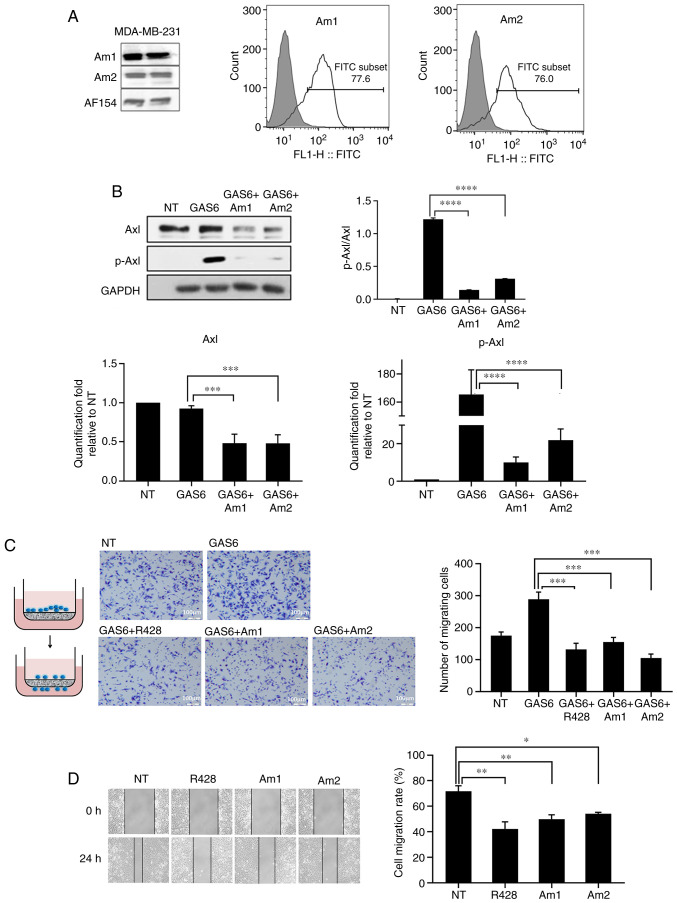
The receptor tyrosine kinase, anexelekto (Axl) is involved in tumor cell growth, migration and invasion, and has been associated with chemotherapy resistance, which makes it an attractive target for cancer therapy. In total, six Axl-targeted monoclonal antibodies (mAbs) and two antibody-drug conjugates have been reported in the last 10 years, which have been shown to have bioactivity in inhibiting tumor cell proliferation and migration. The Axl external cell domain (Axl), consisting of 426 amino acids, has always been used as an antigen in the screening process for all six of these Axl-targeted mAbs. However, the Axl functional domain, which interacts with its natural ligand, growth arrest-specific protein 6 (Gas6), is only a small part of the Axl. Antibodies targeting the Axl functional domain may efficiently block Gas6-Axl binding and attenuate its downstream signals and activities. To the best of our knowledge, no mAbs targeting the Axl functional domain have been reported. In the present study, a major Axl functional domain interacting with Gas6 was determined using bioinformatics and structural biology methods. In MDA-MB-231 breast cancer cell assays, anti-Axl mAbs targeting this relatively specific Axl functional domain almost completely neutralized the stimulation of Gas6 in both Axl phosphorylation and cell migration assays, and showed similar activity to the positive control drug R428 (a small molecular tyrosine kinase inhibitor of Axl currently in phase II clinical trials) in the cell migration assay. Given the important role of Axl in tumor development and chemotherapy resistance, Axl-targeted mAbs could be used to inhibit tumor cells directly, as well as reduce the development of chemotherapy resistance by blocking Axl activity. The application of Axl-targeted mAbs combined with chemotherapy provides a promising treatment strategy for patients with tumors, particularly those with triple-negative breast cancer, for whom no targeted therapy is currently available.
受体酪氨酸激酶Axl参与肿瘤细胞的生长、迁移和侵袭,并与化疗耐药性相关,这使其成为癌症治疗的一个有吸引力的靶点。在过去10年中,总共报道了6种靶向Axl的单克隆抗体(mAb)和2种抗体药物偶联物,它们已被证明具有抑制肿瘤细胞增殖和迁移的生物活性。由426个氨基酸组成的Axl胞外结构域(Axl)在所有这6种靶向Axl的mAb的筛选过程中一直被用作抗原。然而,与天然配体生长停滞特异性蛋白6(Gas6)相互作用的Axl功能结构域只是Axl的一小部分。靶向Axl功能结构域的抗体可能会有效阻断Gas6-Axl结合并减弱其下游信号和活性。据我们所知,尚未有靶向Axl功能结构域的mAb的报道。在本研究中,使用生物信息学和结构生物学方法确定了与Gas6相互作用的主要Axl功能结构域。在MDA-MB-231乳腺癌细胞试验中,靶向这个相对特异的Axl功能结构域的抗Axl mAb在Axl磷酸化和细胞迁移试验中几乎完全中和了Gas6的刺激,并且在细胞迁移试验中显示出与阳性对照药物R428(一种目前处于II期临床试验的Axl小分子酪氨酸激酶抑制剂)相似的活性。鉴于Axl在肿瘤发展和化疗耐药性中的重要作用,靶向Axl的mAb可用于直接抑制肿瘤细胞,以及通过阻断Axl活性来减少化疗耐药性的发展。靶向Axl的mAb与化疗联合应用为肿瘤患者,特别是三阴性乳腺癌患者(目前尚无靶向治疗方法)提供了一种有前景的治疗策略。