Makvandi Manoochehr, Teimoori Ali, Pirmoradi Roya, Karami Chiman, Shamsizadeh Ahmad, Shabani Abdolnabi, Angali Kambiz Ahmadi
Infectious and Tropical Diseases Research Center, Health Research Institute, Ahvaz Jundishapur University of Medical Sciences, Ahvaz, Iran.
Division of Pediatric Infectious Diseases, Aboozar Children's Medical Center, Ahvaz Jundishapur University of Medical Sciences, Ahvaz, Iran.
Iran J Microbiol. 2021 Jun;13(3):312-318. doi: 10.18502/ijm.v13i3.6393.
Human parechoviruses (HPeV) and Human enteroviruses (EV) frequently cause a sepsis-like illness in young infants (younger than three months). Therefore, this study was conducted to determine the frequency of HPeV and EV among the young infants with clinical signs and symptoms of sepsis in Ahvaz city, Iran.
The blood specimens were collected from 100 (younger than 90 days hospitalized infants) including 54 (56.25%) males and 46 (43.75%) females with clinical signs and symptoms of sepsis-like disease. The RNA was extracted and tested for detection of VP1 region of HPeV and 5 UTR (Untranslated Region) of EV by RT-PCR. The sequences of positive of HPeV were further analyzed to determine HPeV genotyping.
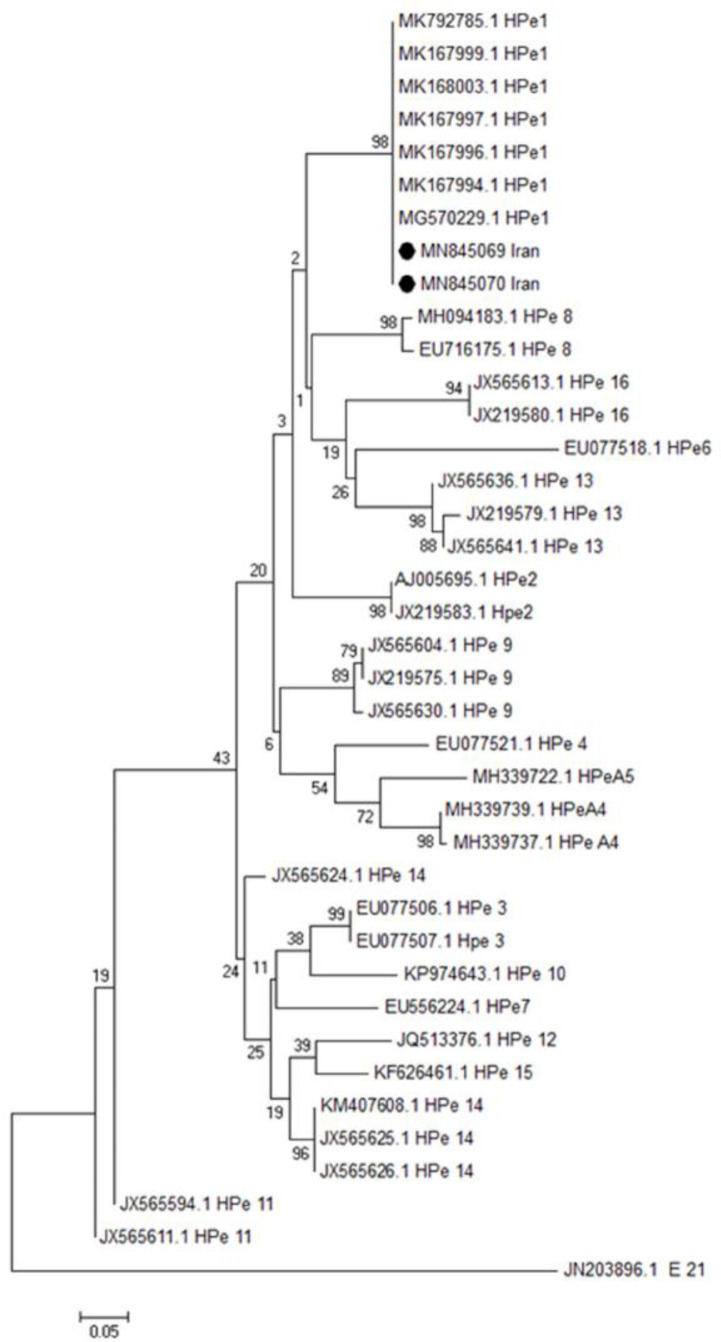
5/100 (5%) of patients including 2/46 (2%) females and 3/54 (3%) males tested positive for HPeV (P=0.85). The analysis of 5 positive VP1 region of HPeV revealed the genotype 1. The analysis of sequencing and phylogenetic tree revealed that the isolated HPeVs were genotype 1. While 38/100 (38%) specimens including 16 (16%) females and 22 (22%) males were tested positive for EV (P=0.68).
The frequency of HPeV genotype 1 was 5% among the young infants with sepsis. While frequency of EV was 38% among the young infants with sepsis. This study showed HPeV genotype 1 and EV are dominant in this region.
人细小病毒(HPeV)和人肠道病毒(EV)常导致3个月以下的小婴儿出现类似败血症的疾病。因此,本研究旨在确定伊朗阿瓦士市有败血症临床症状和体征的小婴儿中HPeV和EV的感染率。
采集了100名(90日龄以下住院婴儿)有类似败血症疾病临床症状和体征的婴儿的血液样本,其中包括54名(56.25%)男性和46名(43.75%)女性。提取RNA,通过逆转录聚合酶链反应(RT-PCR)检测HPeV的VP1区域和EV的5非翻译区(UTR)。对HPeV阳性序列进行进一步分析以确定HPeV基因分型。
100名患者中有5名(5%)检测出HPeV阳性,其中包括2名(2%)女性和3名(3%)男性(P = 0.85)。对5个HPeV阳性VP1区域的分析显示为1型基因型。测序和系统发育树分析表明分离出的HPeV为1型基因型。而100份样本中有38份(38%)检测出EV阳性,其中包括16名(16%)女性和22名(22%)男性(P = 0.68)。
败血症小婴儿中HPeV 1型基因型的感染率为5%。而败血症小婴儿中EV的感染率为38%。本研究表明HPeV 1型基因型和EV在该地区占主导地位。