Benech Nicolas, Vinet Olivier, Gaudin Jean-Louis, Benamouzig Robert, Dray Xavier, Ponchon Thierry, Galmiche Jean-Paul, Sacher-Huvelin Sylvie, Samaha Elia, Saurin Jean-Christophe
Service d'Hépato-Gastroentérologie, Hôpital Edouard Herriot, Hospices Civils de Lyon, Lyon, France.
Service de Gastro-entérologie, Hôpital d'Avicenne, Assistance Publique- Hôpitaux de Paris, Bobigny, France.
Endosc Int Open. 2021 Sep 16;9(10):E1542-E1548. doi: 10.1055/a-1526-0923. eCollection 2021 Oct.
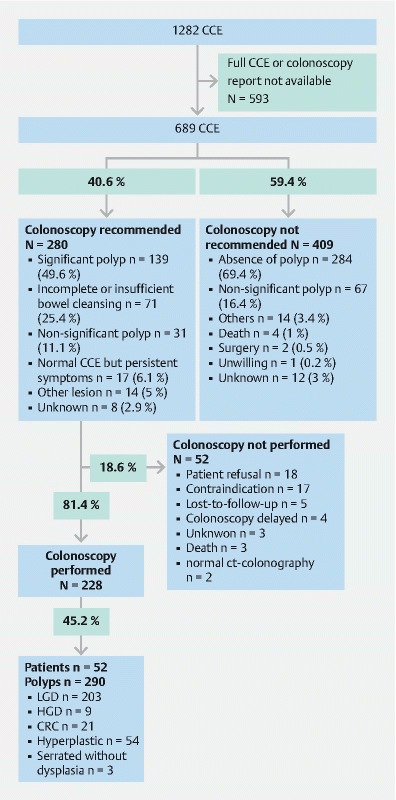
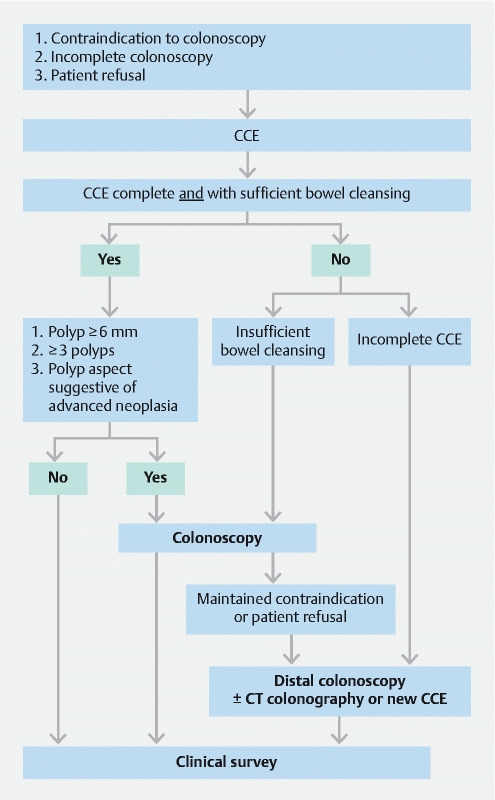
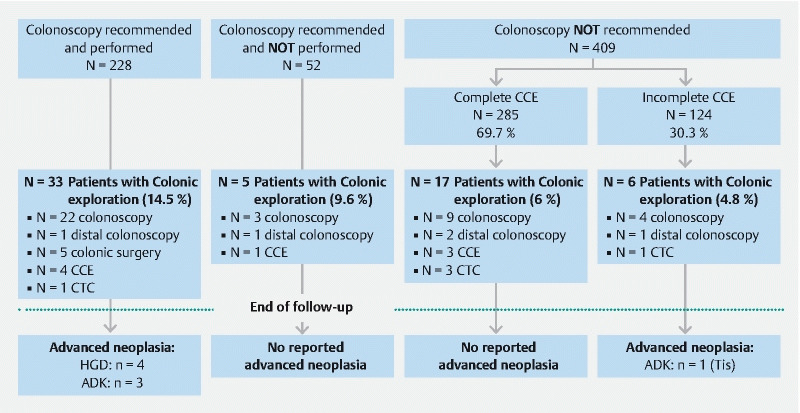
Colon capsule endoscopy (CCE) has been proposed as an alternative to colonoscopy for screening patients at average risk of colorectal cancer (CRC). A prospective national cohort was developed to assess relevance of CCE in real-life practice and its short- and long-term impacts on clinical management. All patients who underwent a CCE in France were prospectively enrolled from January 2011 to May 2016 and reached annually by phone until May 2017. All CCE and colonoscopy reports were systematically collected. During the study period, 689 CCEs were analyzed from 14 medical centers. Median follow-up time was 35 months [IQR: 12-50]. Indication for CCE was mainly for elderly patients (median age: 70 years, IQR: [61-79]) due to anesthetic or colonoscopy contraindication (n = 307; 44.6 %). Only 337 CCEs (48.9 %) were both complete and with adequate bowel preparation. Advanced neoplasia (adenoma with high-grade dysplasia or CRC) was diagnosed following 32 CCEs (4.6 %). Among patients who underwent colonoscopy or therapeutic surgery following CCE, 18.8 % of all advanced neoplasias (6/32) had not been diagnosed by CCE mainly due to technical issues. Performing a colonoscopy in the case of significant polyps or insufficient bowel cleansing or after an incomplete CCE allowed the diagnosis of 96.9 % of all identified advanced neoplasias (31/32). Outside the scope of academic trials, improvement is needed to increase the reliability of CCE as less than half were considered optimal i. e. complete with adequate bowel cleansing. Most of missed colonic advanced neoplasia were due to incomplete CCE with distal neoplasia location.
结肠胶囊内镜检查(CCE)已被提议作为结肠镜检查的替代方法,用于筛查患结直肠癌(CRC)平均风险的患者。一项前瞻性全国队列研究旨在评估CCE在实际临床中的相关性及其对临床管理的短期和长期影响。2011年1月至2016年5月,法国所有接受CCE的患者均被前瞻性纳入研究,并在2017年5月前每年通过电话随访。所有CCE和结肠镜检查报告均被系统收集。在研究期间,从14个医疗中心分析了689例CCE。中位随访时间为35个月[四分位间距:12 - 50]。CCE的适应证主要为老年患者(中位年龄:70岁,四分位间距:[61 - 79]),原因是存在麻醉或结肠镜检查禁忌证(n = 307;44.6%)。只有337例CCE(48.9%)完整且肠道准备充分。32例CCE(4.6%)后诊断为高级别瘤变(高级别异型增生腺瘤或CRC)。在CCE后接受结肠镜检查或治疗性手术的患者中,所有高级别瘤变中有18.8%(6/32)未被CCE诊断出来,主要是由于技术问题。对于有显著息肉、肠道清洁不足或CCE不完全的情况进行结肠镜检查,可诊断出所有已识别的高级别瘤变中的96.9%(31/32)。在学术试验范围之外,仍需改进以提高CCE的可靠性,因为不到一半的检查被认为是最佳的,即完整且肠道清洁充分。大多数漏诊的结肠高级别瘤变是由于CCE不完全且瘤变位于远端。