Lipiński Patryk, Tylki-Szymańska Anna
Department of Pediatrics, Nutrition and Metabolic Diseases, The Children's Memorial Health Institute, Warsaw, Poland.
Front Pediatr. 2021 Sep 3;9:715151. doi: 10.3389/fped.2021.715151. eCollection 2021.
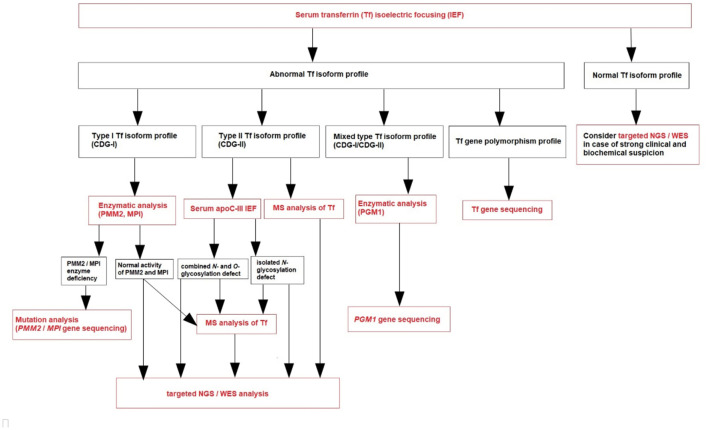
Congenital disorders of glycosylation (CDG) are a group of clinically heterogeneous disorders characterized by defects in the synthesis of glycans and their attachment to proteins and lipids. This manuscript aims to provide a classification of the clinical presentation, diagnostic methods, and treatment of CDG based on the literature review and our own experience (referral center in Poland). A diagnostic algorithm for CDG was also proposed. Isoelectric focusing (IEF) of serum transferrin (Tf) is still the method of choice for diagnosing N-glycosylation disorders associated with sialic acid deficiency. Nowadays, high-performance liquid chromatography, capillary zone electrophoresis, and mass spectrometry techniques are used, although they are not routinely available. Since next-generation sequencing became more widely available, an improvement in diagnostics has been observed, with more patients and novel CDG subtypes being reported. Early and accurate diagnosis of CDG is crucial for timely implementation of appropriate therapies and improving clinical outcomes. However, causative treatment is available only for few CDG types.
先天性糖基化障碍(CDG)是一组临床异质性疾病,其特征在于聚糖合成及其与蛋白质和脂质连接的缺陷。本手稿旨在基于文献综述和我们自己的经验(波兰的转诊中心),对CDG的临床表现、诊断方法和治疗进行分类。还提出了一种CDG的诊断算法。血清转铁蛋白(Tf)的等电聚焦(IEF)仍然是诊断与唾液酸缺乏相关的N-糖基化障碍的首选方法。如今,虽然高效液相色谱、毛细管区带电泳和质谱技术并非常规可用,但也已被使用。自从下一代测序更广泛可用以来,诊断有了改进,报告了更多患者和新的CDG亚型。CDG的早期准确诊断对于及时实施适当治疗和改善临床结果至关重要。然而,仅对少数类型的CDG有病因治疗方法。