Dickinson David L, Garbuio Caleb
Department of Economics and CERPA Appalachian State University Boone North Carolina USA.
Institute of Labor Economics (IZA) Bonn Germany.
Health Sci Rep. 2021 Sep 14;4(3):e369. doi: 10.1002/hsr2.369. eCollection 2021 Sep.
Previous research has investigated the impact of diet on cognition, but the focus has often been on general cognition. This paper reports on a preregistered cross-sectional study aimed at testing for specific executive function differences across individuals who self-reported one of four distinct dietary patterns: , , , or pattern. Our hypotheses were aimed at testing whether adherence to a specialty diet improved decision making relative to those who reported following .
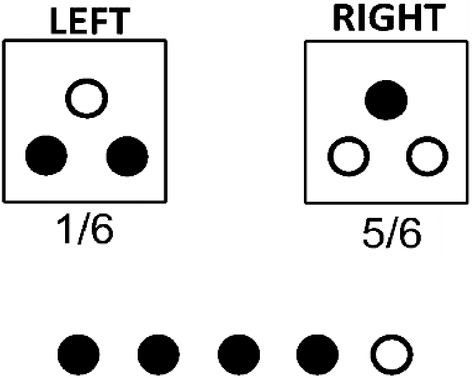
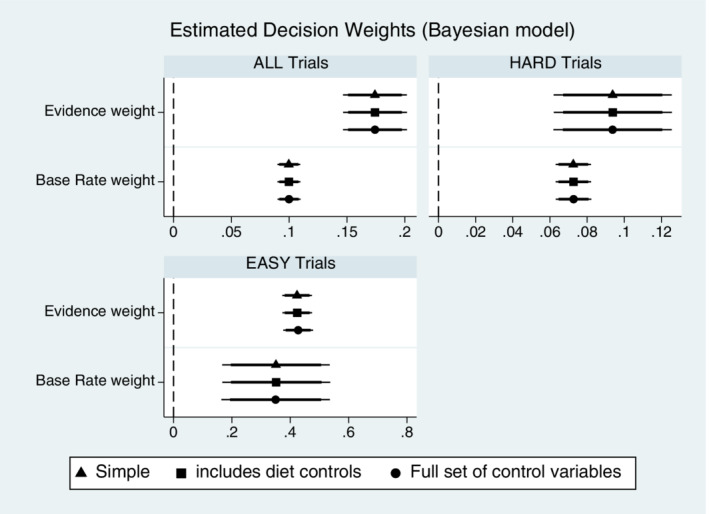
We administered an incentivized Bayesian choice task to all participants. The task involved multiple components of information-existing information (base rate odds) as well as new information (sample draw evidence)-to allow a test of how these information components were used in making probability assessments, and how this may differ by self-reported dietary pattern. Sample size, hypotheses, and analysis plans were all determined ex ante and registered on the Open Science Framework. Multi-variate linear and non-linear estimation methods were used to analyze the data.
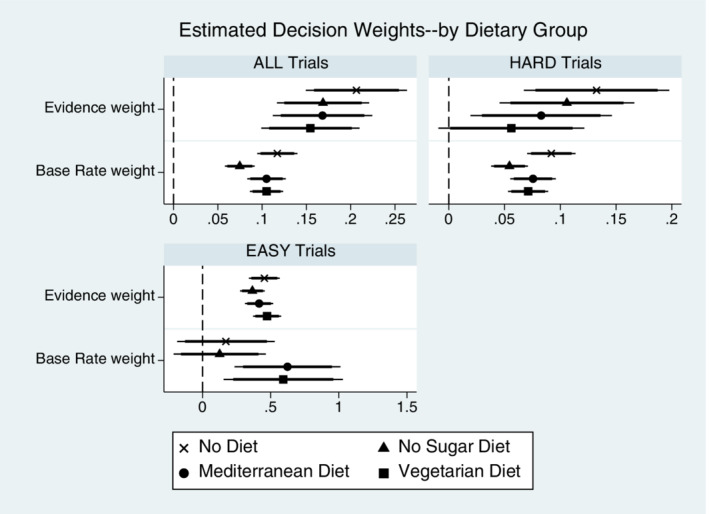
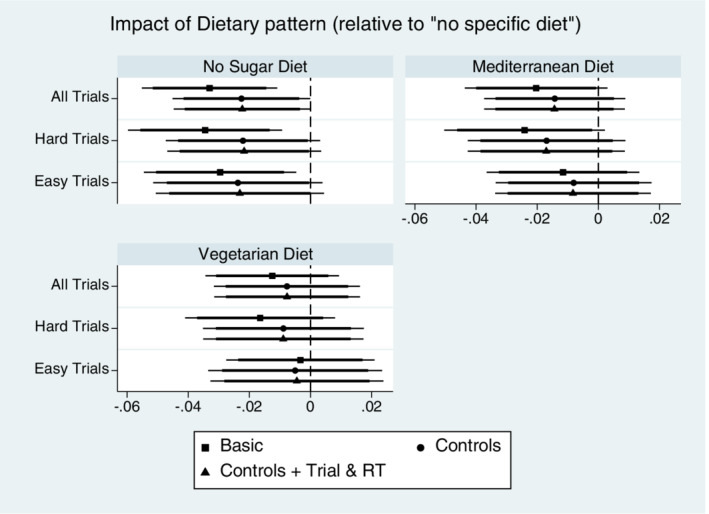
Our data failed to support our pre-registered hypotheses. In fact, we found some evidence that self-reported adherence to a specialty was associated with a reduced decision accuracy and was connected to an increased imbalance in how the participant weighted the two available sources of information when making choices.
Our results suggest that decision making is nuanced among dietary groups, but that short-term incentivized decisions in an ecologically valid field setting are likely not improved solely by following promoted dietary patterns such as the or diets.
先前的研究调查了饮食对认知的影响,但重点往往在于一般认知。本文报告了一项预先注册的横断面研究,旨在测试自我报告四种不同饮食模式之一(即[具体饮食模式 1]、[具体饮食模式 2]、[具体饮食模式 3]或[具体饮食模式 4])的个体之间特定执行功能的差异。我们的假设旨在检验相对于那些报告遵循[参照饮食模式]的人,坚持特定饮食模式是否能改善决策。
我们对所有参与者进行了一项有激励措施的贝叶斯选择任务。该任务涉及信息的多个组成部分——现有信息(基础概率)以及新信息(样本抽取证据)——以测试这些信息组成部分在进行概率评估时是如何被使用的,以及这可能因自我报告的饮食模式而有何不同。样本量、假设和分析计划均事先确定并在开放科学框架上进行了注册。使用多元线性和非线性估计方法分析数据。
我们的数据未能支持我们预先注册的假设。事实上,我们发现一些证据表明,自我报告坚持特定的[饮食模式名称]与决策准确性降低有关,并且与参与者在做出选择时权衡两种可用信息来源的方式失衡增加有关。
我们的结果表明,不同饮食群体的决策存在细微差别,但在生态有效场景下的短期激励决策可能不会仅通过遵循如[具体饮食模式 1]或[具体饮食模式 2]等推广的饮食模式而得到改善。