Bai Tao, Zhu Xue, Zhou Xiang, Grathwohl Denise, Yang Pengshuo, Zha Yuguo, Jin Yu, Chong Hui, Yu Qingyang, Isberner Nora, Wang Dongke, Zhang Lei, Kortüm K Martin, Song Jun, Rasche Leo, Einsele Hermann, Ning Kang, Hou Xiaohua
Division of Gastroenterology, Union Hospital, Tongji Medical College, Huazhong University of Science and Technology, Wuhan, China.
Key Laboratory of Molecular Biophysics of the Ministry of Education, Hubei Key Laboratory of Bioinformatics and Molecular-imaging, Department of Bioinformatics and Systems Biology, College of Life Science and Technology, Huazhong University of Science and Technology, Wuhan, China.
Front Artif Intell. 2021 Sep 3;4:672050. doi: 10.3389/frai.2021.672050. eCollection 2021.
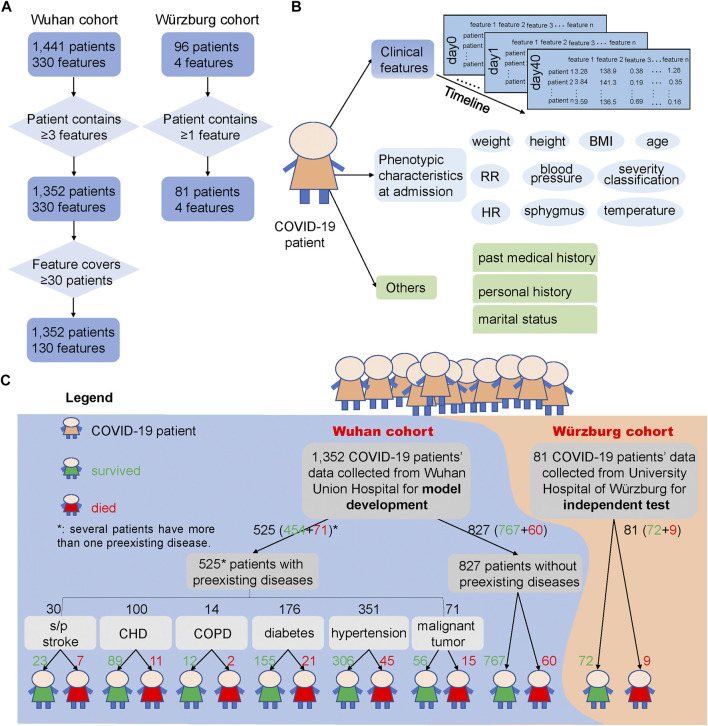
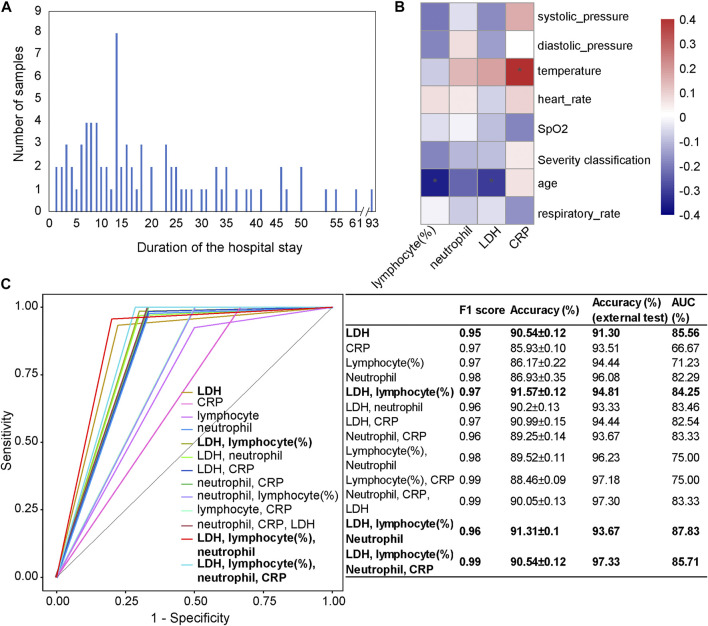
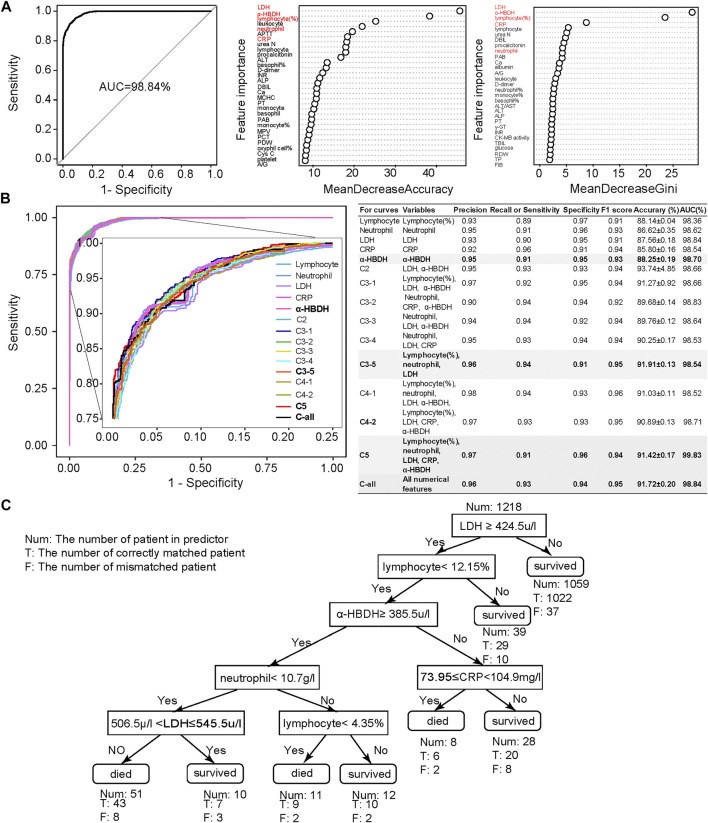
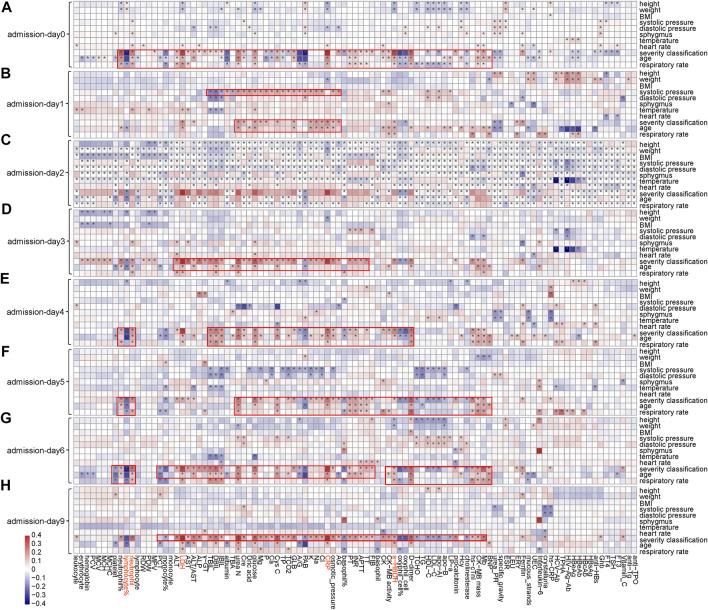
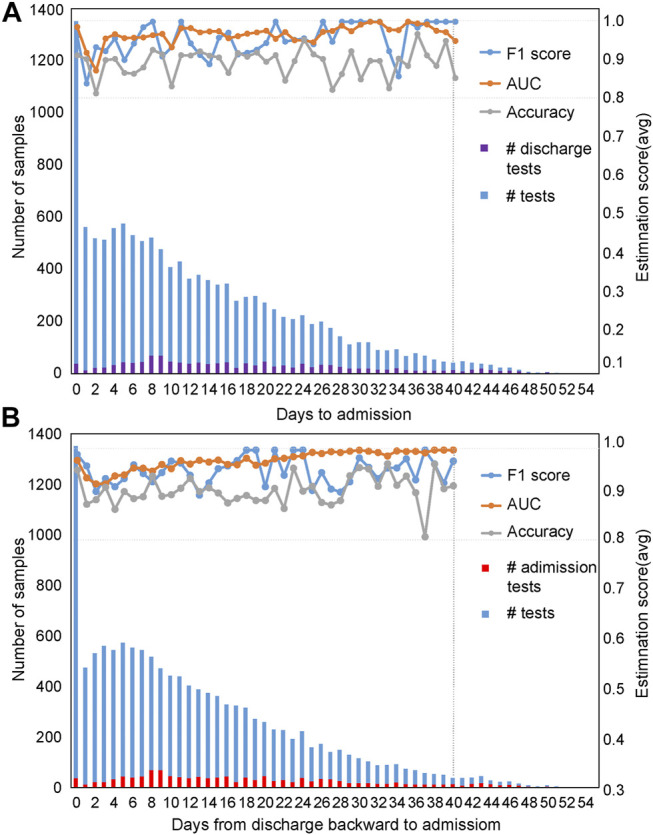
Cohort-independent robust mortality prediction model in patients with COVID-19 infection is not yet established. To build up a reliable, interpretable mortality prediction model with strong foresight, we have performed an international, bi-institutional study from China (Wuhan cohort, collected from January to March) and Germany (Würzburg cohort, collected from March to September). A Random Forest-based machine learning approach was applied to 1,352 patients from the Wuhan cohort, generating a mortality prediction model based on their clinical features. The results showed that five clinical features at admission, including lymphocyte (%), neutrophil count, C-reactive protein, lactate dehydrogenase, and α-hydroxybutyrate dehydrogenase, could be used for mortality prediction of COVID-19 patients with more than 91% accuracy and 99% AUC. Additionally, the time-series analysis revealed that the predictive model based on these clinical features is very robust over time when patients are in the hospital, indicating the strong association of these five clinical features with the progression of treatment as well. Moreover, for different preexisting diseases, this model also demonstrated high predictive power. Finally, the mortality prediction model has been applied to the independent Würzburg cohort, resulting in high prediction accuracy (with above 90% accuracy and 85% AUC) as well, indicating the robustness of the model in different cohorts. In summary, this study has established the mortality prediction model that allowed early classification of COVID-19 patients, not only at admission but also along the treatment timeline, not only cohort-independent but also highly interpretable. This model represents a valuable tool for triaging and optimizing the resources in COVID-19 patients.
目前尚未建立针对新型冠状病毒肺炎(COVID-19)感染患者的独立于队列的稳健死亡率预测模型。为构建一个具有可靠预测性、可解释性且有强大前瞻性的死亡率预测模型,我们开展了一项国际双机构研究,研究对象来自中国(武汉队列,收集时间为1月至3月)和德国(维尔茨堡队列,收集时间为3月至9月)。我们将基于随机森林的机器学习方法应用于武汉队列的1352例患者,根据他们的临床特征生成了一个死亡率预测模型。结果显示,入院时的五个临床特征,包括淋巴细胞(%)、中性粒细胞计数、C反应蛋白、乳酸脱氢酶和α-羟丁酸脱氢酶,可用于预测COVID-19患者的死亡率,准确率超过91%,曲线下面积(AUC)为99%。此外,时间序列分析表明,基于这些临床特征的预测模型在患者住院期间随时间推移非常稳健,这也表明这五个临床特征与治疗进展密切相关。而且,对于不同的基础疾病,该模型也显示出较高的预测能力。最后,该死亡率预测模型已应用于独立的维尔茨堡队列,同样获得了较高的预测准确率(准确率高于90%,AUC为85%以上),这表明该模型在不同队列中具有稳健性。总之,本研究建立的死亡率预测模型能够对COVID-19患者进行早期分类,不仅在入院时,而且在整个治疗过程中均可进行分类,该模型不仅独立于队列,而且具有高度可解释性。该模型是对COVID-19患者进行分诊和优化资源分配的宝贵工具。