Department of Pharmaceutical Sciences, Skaggs School of Pharmacy and Pharmaceutical Sciences, University of Colorado Anschutz Medical Campus, Aurora, Colorado, USA.
Department of Pharmaceutical Sciences, Skaggs School of Pharmacy and Pharmaceutical Sciences, University of Colorado Anschutz Medical Campus, Aurora, Colorado, USA.
J Biol Chem. 2021 Oct;297(4):101208. doi: 10.1016/j.jbc.2021.101208. Epub 2021 Sep 17.
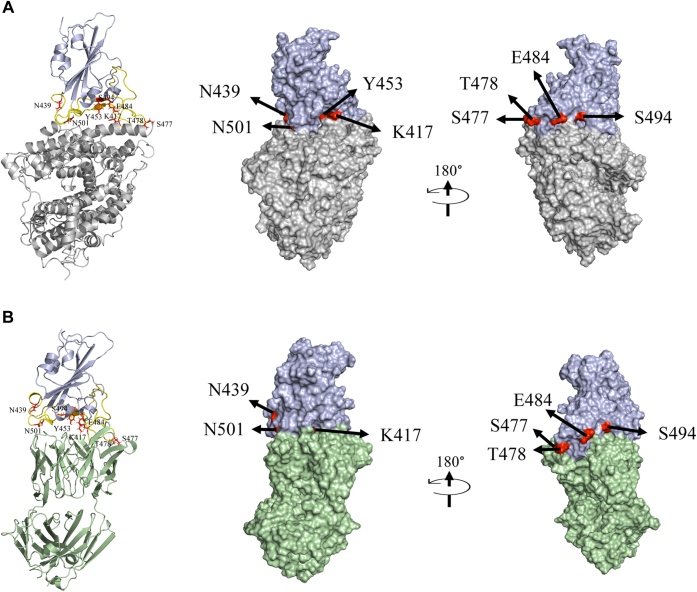
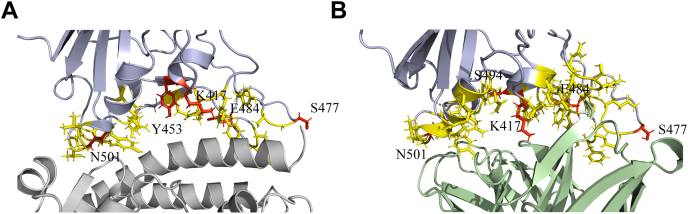
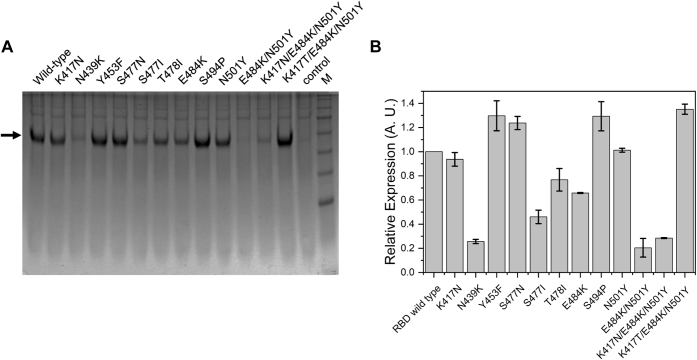
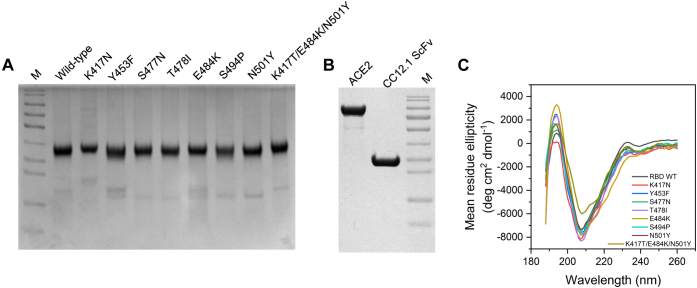
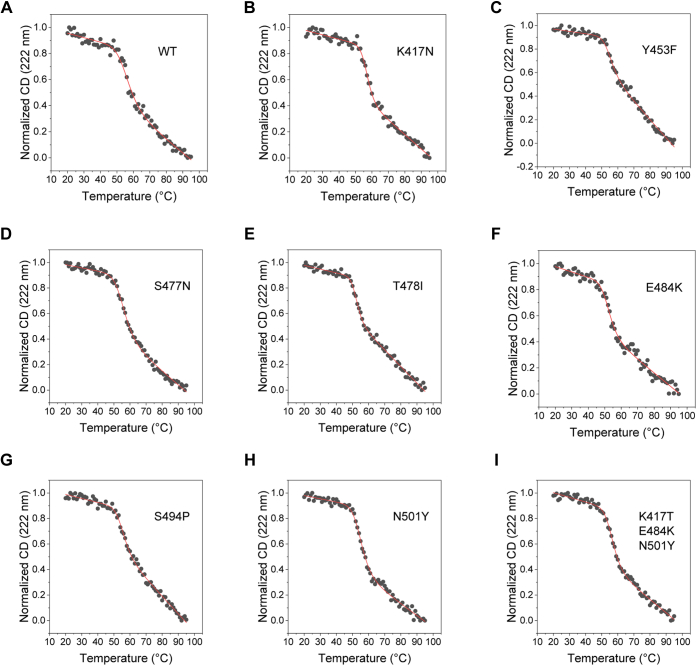
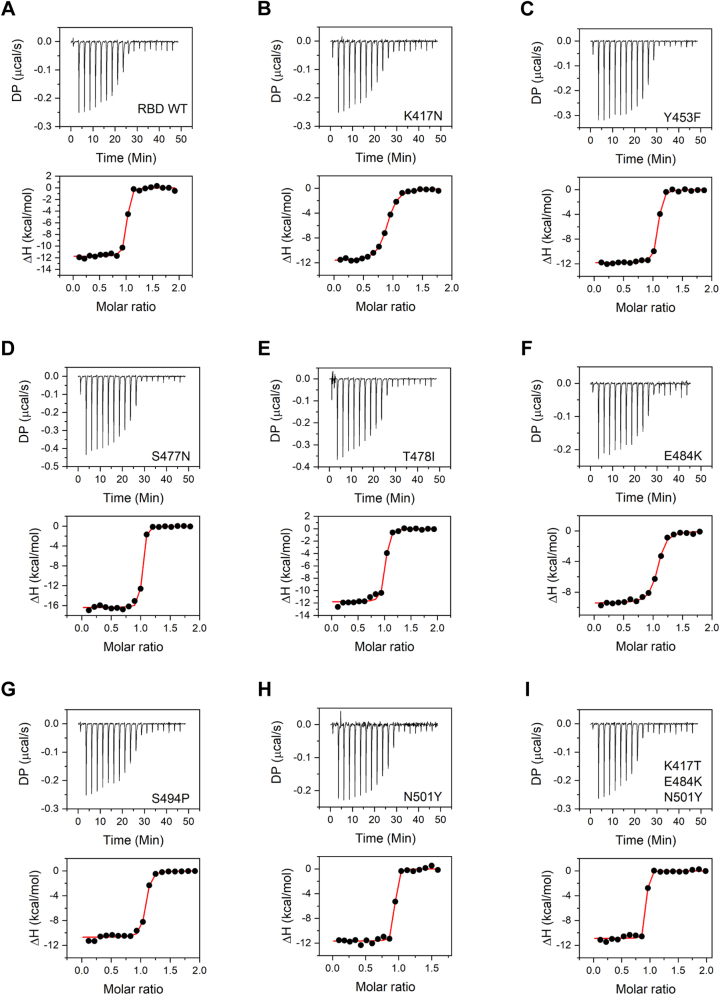
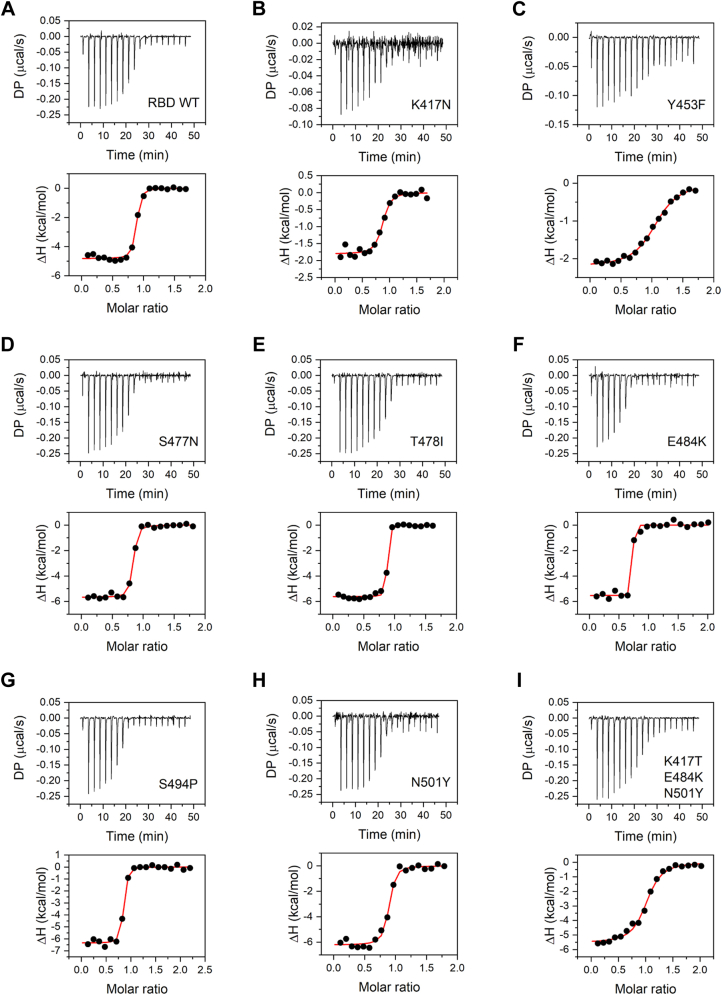
Emergence of new severe acute respiratory syndrome coronavirus 2 variants has raised concerns related to the effectiveness of vaccines and antibody therapeutics developed against the unmutated wildtype virus. Here, we examined the effect of the 12 most commonly occurring mutations in the receptor-binding domain of the spike protein on its expression, stability, activity, and antibody escape potential. Stability was measured using thermal denaturation, and the activity and antibody escape potential were measured using isothermal titration calorimetry in terms of binding to the human angiotensin-converting enzyme 2 and to neutralizing human antibody CC12.1, respectively. Our results show that mutants differ in their expression levels. Of the eight best-expressed mutants, two (N501Y and K417T/E484K/N501Y) showed stronger affinity to angiotensin-converting enzyme 2 compared with the wildtype, whereas four (Y453F, S477N, T478I, and S494P) had similar affinity and two (K417N and E484K) had weaker affinity than the wildtype. Compared with the wildtype, four mutants (K417N, Y453F, N501Y, and K417T/E484K/N501Y) had weaker affinity for the CC12.1 antibody, whereas two (S477N and S494P) had similar affinity, and two (T478I and E484K) had stronger affinity than the wildtype. Mutants also differ in their thermal stability, with the two least stable mutants showing reduced expression. Taken together, these results indicate that multiple factors contribute toward the natural selection of variants, and all these factors need to be considered to understand the evolution of the virus. In addition, since not all variants can escape a given neutralizing antibody, antibodies to treat new variants can be chosen based on the specific mutations in that variant.
新出现的严重急性呼吸系统综合征冠状病毒 2 变种引起了人们对针对未突变野生型病毒开发的疫苗和抗体治疗药物有效性的关注。在这里,我们研究了刺突蛋白受体结合域中 12 种最常见突变对其表达、稳定性、活性和抗体逃逸潜力的影响。稳定性通过热变性测量,活性和抗体逃逸潜力分别通过等温滴定量热法测量,以评估其与人类血管紧张素转化酶 2 的结合能力和中和人类抗体 CC12.1 的能力。我们的结果表明,突变体在表达水平上存在差异。在表达水平最高的 8 种突变体中,有两种(N501Y 和 K417T/E484K/N501Y)与野生型相比对血管紧张素转化酶 2 的亲和力更强,而有四种(Y453F、S477N、T478I 和 S494P)的亲和力与野生型相似,另外两种(K417N 和 E484K)的亲和力则比野生型弱。与野生型相比,有四种突变体(K417N、Y453F、N501Y 和 K417T/E484K/N501Y)对 CC12.1 抗体的亲和力较弱,而有两种(S477N 和 S494P)的亲和力相似,另外两种(T478I 和 E484K)的亲和力则比野生型强。突变体在热稳定性方面也存在差异,其中两种最不稳定的突变体的表达水平降低。综上所述,这些结果表明,多种因素共同促成了变体的自然选择,需要综合考虑所有这些因素才能了解病毒的进化。此外,由于并非所有变体都能逃避特定的中和抗体,因此可以根据变体中的特定突变来选择用于治疗新变体的抗体。