MRI unit, The Royal Marsden NHS Foundation Trust and The Institute of Cancer Research, London, UK.
Radiology department, The Royal Marsden NHS Foundation Trust, London, UK.
Br J Radiol. 2021 Oct 1;94(1126):20210310. doi: 10.1259/bjr.20210310.
Myxoid liposarcomas (MLS) show enhanced response to radiotherapy due to their distinctive vascular pattern and therefore could be effectively treated with lower radiation doses. This is a descriptive study to explore the use of functional MRI to identify response in a uniform cohort of MLS patients treated with reduced dose radiotherapy.
10 patients with MLS were imaged pre-, during, and post-radiotherapy receiving reduced dose radiotherapy and the response to treatment was histopathologically assessed post-radiotherapy. Apparent diffusion coefficient (ADC), T2* relaxation time, volume transfer constant (Ktrans), initial area under the gadolinium curve over 60 s (IAUGC60) and (Gd) were estimated for a central tumour volume.
All parameters showed large inter- and intrasubject variabilities. Pre-treatment (Gd), IAUGC60 and Ktrans were significantly different between responders and non-responders. Post-radiotherapy reductions from baseline were demonstrated for T2*, (Gd), IAUGC60 and Ktrans for responders. No statistically significant ADC differences were demonstrated between the two response groups. Significantly greater early tumour volume reductions were observed for responders.
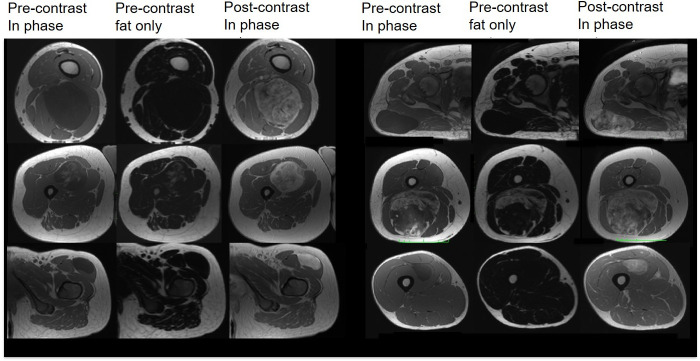
MLS are heterogenous lesions, characterised by a slow gradual contrast-agent uptake. Pre-treatment vascular parameters, early changes to tumour volume, vascular parameters and T2* have potential in identifying response to treatment. The delayed (Gd) is a suitable descriptive parameter, relying simply on T1 measurements. Volume changes precede changes in MLS functionality and could be used to identify early response.
MLS are are characterised by slow gradual contrast-agent uptake. Measurement of the delayed contrast-agent uptake (Gd) is simple to implement and able to discriminate response.
黏液样脂肪肉瘤(MLS)因其独特的血管模式而对放疗有明显的反应,因此可以用较低的辐射剂量进行有效治疗。本研究旨在探讨功能磁共振成像(fMRI)在接受低剂量放疗的统一 MLS 患者队列中识别疗效的应用。
对 10 例 MLS 患者进行影像学检查,在接受低剂量放疗期间和放疗后进行,并在放疗后进行组织病理学评估。对中心肿瘤体积进行表观扩散系数(ADC)、T2*弛豫时间、容积转移常数(Ktrans)、60 秒内钆增强曲线下初始面积(IAUGC60)和(Gd)的测量。
所有参数均表现出较大的个体间和个体内变异性。在反应者和无反应者之间,治疗前(Gd)、IAUGC60 和 Ktrans 存在显著差异。反应者在放疗后 T2*、(Gd)、IAUGC60 和 Ktrans 均较基线水平降低。两组间 ADC 差异无统计学意义。反应者的肿瘤体积早期缩小更为明显。
MLS 是异质性病变,其特点是造影剂摄取缓慢而逐渐。治疗前的血管参数、肿瘤体积、血管参数和 T2*的早期变化有潜力识别治疗反应。延迟(Gd)是一个合适的描述性参数,仅依赖于 T1 测量。体积变化先于 MLS 功能变化,可用于早期识别反应。
MLS 的特点是造影剂摄取缓慢而逐渐。延迟对比剂摄取(Gd)的测量简单易行,能够区分疗效。