Dirección de Investigación, Hospital Juárez de México, Ciudad de México, Mexico.
División de Investigación, Hospital Juárez de México, Ciudad de México, Mexico.
Am J Infect Control. 2021 Dec;49(12):1474-1480. doi: 10.1016/j.ajic.2021.09.012. Epub 2021 Sep 20.
Mechanical ventilators are essential biomedical devices for the respiratory support of patients with SARS-CoV-2 infection. These devices can be transmitters of bacterial pathogens. Therefore, it is necessary to implement effective disinfection procedures. The aim of this work was to show the impact of the modification of a cleaning and disinfection method of mechanical ventilators of patients with SARS-CoV-2 and ventilator-associated pneumonia.
A total of 338 mechanical ventilators of patients infected with SARS-CoV-2 and ESKAPE bacteria were divided in two groups. Group A and B were subjected to cleaning and disinfection with superoxidation solution-Cl/enzymatic detergent and isopropyl alcohol, respectively. Both groups were cultured for the detection of ESKAPE bacteria. The isolates were subjected to tests for identification, resistance, adherence, and genomic typing.
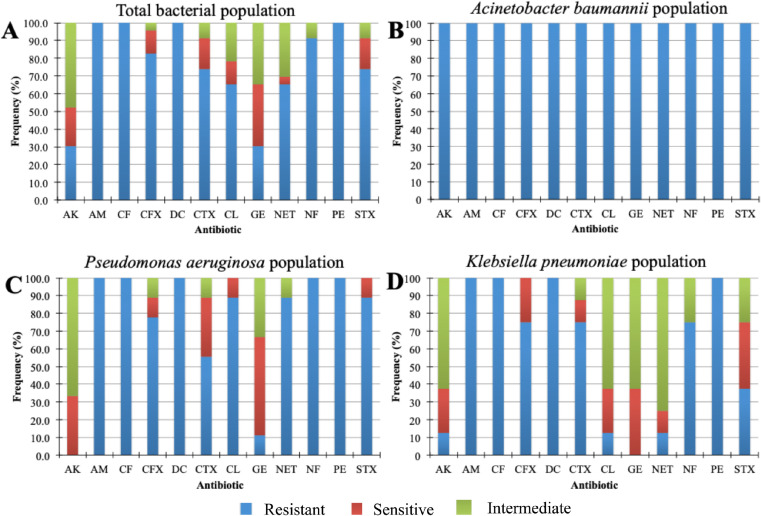
Contamination rates of 21.6% (n = 36) were identified in group A. The inspiratory limb was the circuit involved in most cases of postdisinfection contamination. Acinetobacter baumanni, Pseudomonas aeruginosa, and multi-resistant Klebsiella pneumoniae were the pathogens involved in the contamination cases. The pathogens were highly adherent and in the case of A. baumanni, clonal dispersion was detected in 14 ventilators. Disinfection with enzymatic detergents allows a 100% reduction in contamination rates.
The implementation of cleaning and disinfection with enzymatic detergents/isopropyl alcohol of mechanical ventilators of patients with SARS-CoV-2 and ESKAPE bacteria had a positive impact on postdisinfection microbial contamination rates.
机械呼吸机是 SARS-CoV-2 感染患者呼吸支持的重要生物医学设备。这些设备可能成为细菌病原体的传播媒介。因此,有必要实施有效的消毒程序。本研究旨在展示对 SARS-CoV-2 和呼吸机相关性肺炎患者机械呼吸机清洗消毒方法改良的影响。
将 338 例 SARS-CoV-2 感染患者的机械呼吸机分为两组。A 组和 B 组分别采用超氧化溶液-Cl/酶清洁剂和异丙醇进行清洗消毒。两组均进行 ESKAPE 细菌培养。对分离株进行鉴定、耐药性、黏附性和基因组分型检测。
A 组 21.6%(n=36)的污染率。在大多数情况下,污染发生在经过消毒后的吸气肢。与污染病例相关的病原体为鲍曼不动杆菌、铜绿假单胞菌和多耐药肺炎克雷伯菌。病原体具有高度的黏附性,在鲍曼不动杆菌的情况下,14 个呼吸机中检测到克隆分散。使用酶清洁剂进行消毒可将污染率降低 100%。
对 SARS-CoV-2 和 ESKAPE 细菌感染患者的机械呼吸机采用酶清洁剂/异丙醇清洗消毒,对降低消毒后微生物污染率有积极影响。