Lin Gaoting, Jeong Jaehong, Kim Chaebin, Wang Yao, Huang Qing, Masuda Takatsugu, Asai Shinichiro, Itoh Shinichi, Günther Gerrit, Russina Margarita, Lu Zhilun, Sheng Jieming, Wang Le, Wang Jiucai, Wang Guohua, Ren Qingyong, Xi Chuanying, Tong Wei, Ling Langsheng, Liu Zhengxin, Wu Liusuo, Mei Jiawei, Qu Zhe, Zhou Haidong, Wang Xiaoqun, Park Je-Geun, Wan Yuan, Ma Jie
Key Laboratory of Artificial Structures and Quantum Control, Shenyang National Laboratory for Materials Science, School of Physics and Astronomy, Shanghai Jiao Tong University, Shanghai, 200240, China.
Department of Physics and Astronomy, Seoul National University, Seoul, 08826, Republic of Korea.
Nat Commun. 2021 Sep 21;12(1):5559. doi: 10.1038/s41467-021-25567-7.
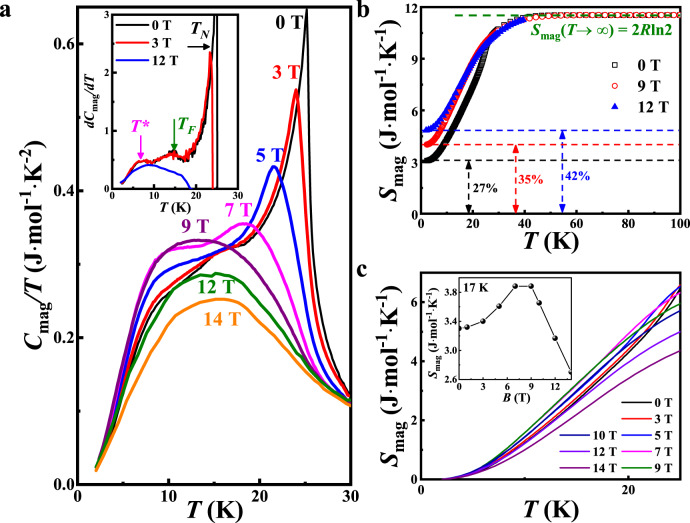
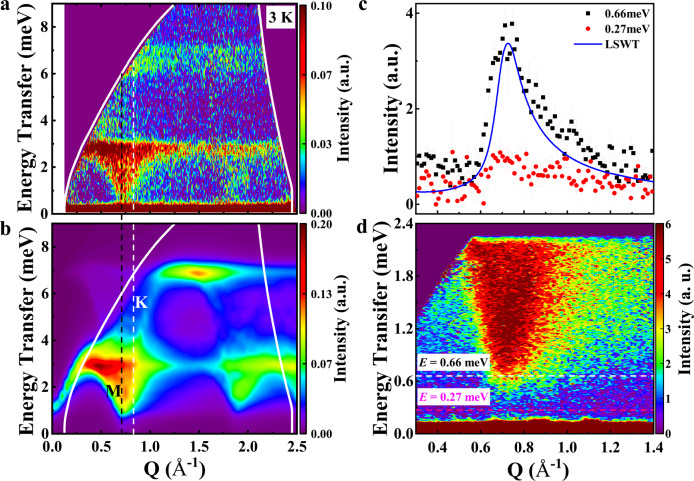
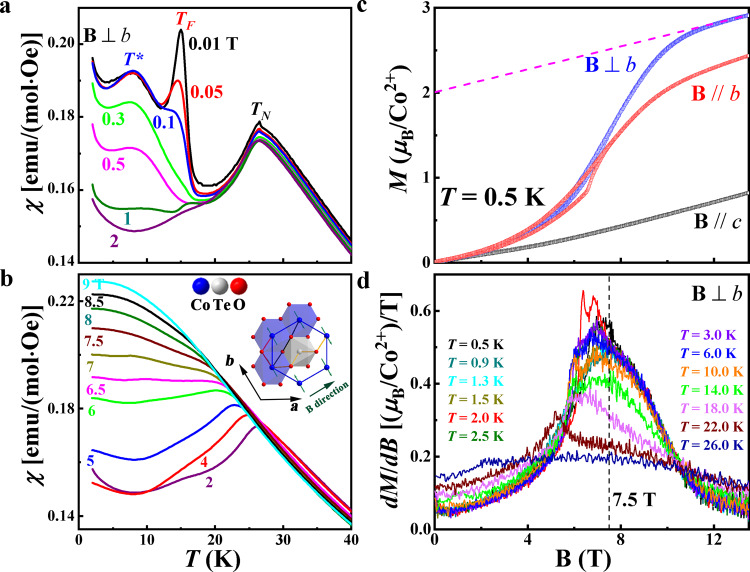
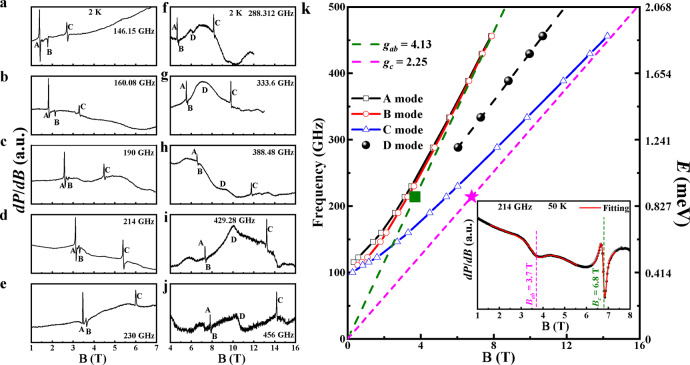
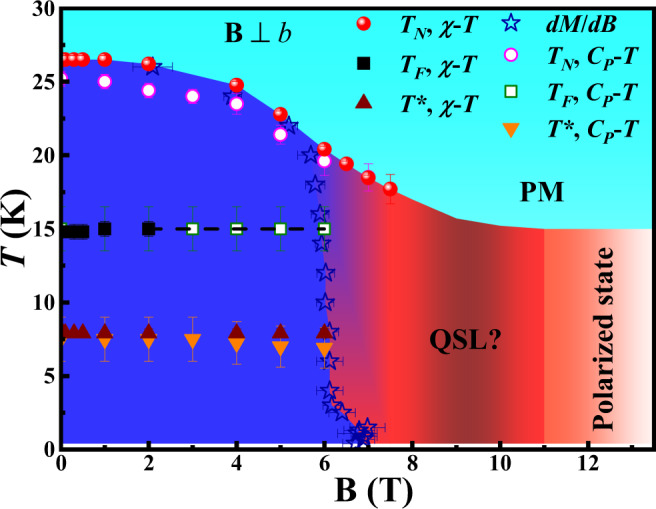
Spin-orbit coupled honeycomb magnets with the Kitaev interaction have received a lot of attention due to their potential of hosting exotic quantum states including quantum spin liquids. Thus far, the most studied Kitaev systems are 4d/5d-based honeycomb magnets. Recent theoretical studies predicted that 3d-based honeycomb magnets, including NaCoTeO (NCTO), could also be a potential Kitaev system. Here, we have used a combination of heat capacity, magnetization, electron spin resonance measurements alongside inelastic neutron scattering (INS) to study NCTO's quantum magnetism, and we have found a field-induced spin disordered state in an applied magnetic field range of 7.5 T < B (⊥ b-axis) < 10.5 T. The INS spectra were also simulated to tentatively extract the exchange interactions. As a 3d-magnet with a field-induced disordered state on an effective spin-1/2 honeycomb lattice, NCTO expands the Kitaev model to 3d compounds, promoting further interests on the spin-orbital effect in quantum magnets.
具有基塔耶夫相互作用的自旋轨道耦合蜂窝状磁体因其承载包括量子自旋液体在内的奇异量子态的潜力而备受关注。到目前为止,研究最多的基塔耶夫体系是基于4d/5d的蜂窝状磁体。最近的理论研究预测,包括NaCoTeO(NCTO)在内的基于3d的蜂窝状磁体也可能是一个潜在的基塔耶夫体系。在此,我们结合热容量、磁化强度、电子自旋共振测量以及非弹性中子散射(INS)来研究NCTO的量子磁性,并且我们在7.5 T < B(垂直于b轴)< 10.5 T的外加磁场范围内发现了一个场致自旋无序态。还对INS光谱进行了模拟,以初步提取交换相互作用。作为一种在有效自旋-1/2蜂窝晶格上具有场致无序态的3d磁体,NCTO将基塔耶夫模型扩展到了3d化合物,激发了人们对量子磁体中自旋轨道效应的进一步兴趣。