Nagoya City University School of Nursing, Nagoya, Japan.
Nagoya City University School of Humanities and Social Sciences, Nagoya, Japan.
Nagoya J Med Sci. 2021 Aug;83(3):551-565. doi: 10.18999/nagjms.83.3.551.
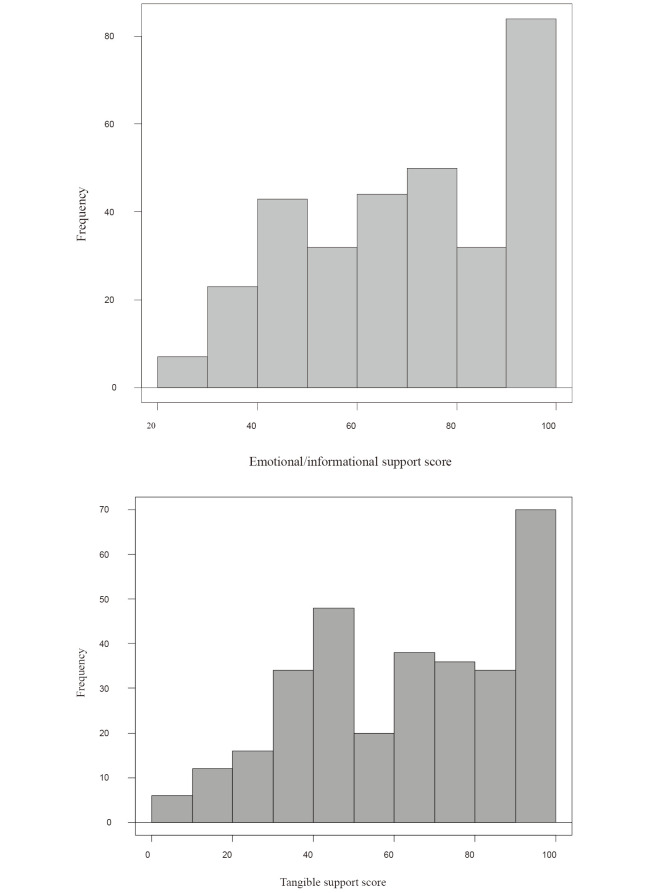
This study investigated associations between social support and access to healthcare among Filipino women living in Aichi Prefecture, Japan. A cross-sectional design was used. Self-administered questionnaires were distributed to Filipino women and collected 342 valid responses. Each participant was asked about her access to healthcare for her own health and for her youngest child's health, and social support, as well as her socio-demographic characteristics. Of these respondents, 114 women (33%) did not have a usual source of care for themselves. Participants in our study had higher Medical Outcome Study Social Support Survey scores than people living in other Southeast Asian countries. However, distribution of the score showed that there were outliers with low scores which were very different from the others. Women with the highest emotional/informational and tangible support score showed better access to healthcare (adjusted odds ratio=0.22, 95% confidence interval 0.10-0.50, and adjusted odds ratio=0.38, 95% confidence interval 0.17-0.85 respectively). Women with a Japanese husband also showed lower odds of no usual source of care (adjusted odds ratio=0.44, 95% confidence interval 0.20-0.95). On the other hand, there was no factors significantly associated with access to healthcare for their youngest child including social support. Emotional/informational and tangible support were crucial factors associated with access to healthcare among Filipino women in Aichi Prefecture.
本研究调查了在日本爱知县居住的菲律宾女性的社会支持与获得医疗保健之间的关联。采用了横断面设计。向菲律宾女性分发了自我管理问卷,并收集了 342 份有效回复。每位参与者都被问及她自己和她最小孩子的医疗保健获取情况以及社会支持,以及她的社会人口统计学特征。在这些受访者中,有 114 名女性(33%)没有为自己提供常规医疗服务的来源。与生活在其他东南亚国家的人相比,我们研究中的参与者在医疗结局研究社会支持调查评分中得分更高。然而,得分分布表明,有一些得分较低的异常值,与其他人非常不同。获得情感/信息和有形支持得分最高的女性表现出更好的医疗保健获取(调整后的优势比=0.22,95%置信区间 0.10-0.50,和调整后的优势比=0.38,95%置信区间 0.17-0.85)。有日本丈夫的女性也表现出较低的没有常规医疗服务来源的可能性(调整后的优势比=0.44,95%置信区间 0.20-0.95)。另一方面,没有任何因素与她们最小孩子的医疗保健获取显著相关,包括社会支持。情感/信息和有形支持是爱知县菲律宾女性获得医疗保健的关键因素。