School of Medicine, University of Tsukuba, 1-1-1 Tenno-dai, Tsukuba, Ibaraki, 305-8575, Japan.
Department of Health Services Research, Faculty of Medicine, University of Tsukuba, 1-1-1 Tenno-dai, Tsukuba, Ibaraki, 305-8575, Japan.
BMC Health Serv Res. 2020 Apr 26;20(1):359. doi: 10.1186/s12913-020-05205-6.
Under the Japanese free access healthcare system, patients are allowed to consult multiple medical institutions (including clinics and hospitals for general or specialist consultation) without primary care referral. This potentially increases the risk of polypharmacy. We examined the association between the number of consulting medical institutions and polypharmacy under a healthcare system with free access.
Via a self-administered questionnaire, we identified people aged ≥65 years with ≥1 disease and ≥1 consulting medical institution in a Japanese city in 2016. The exposure of interest was the number of consulting medical institutions (1, 2, or ≥3) and the outcome was polypharmacy (use of ≥6 types of drugs). We performed a multivariate logistic regression analysis, adjusting for age, sex, household economy, and the number and type of comorbidities. To minimize confounding effects, we also performed propensity-score-matched analysis, categorizing patients into two groups: 1 and ≥2 consulting medical institutions.
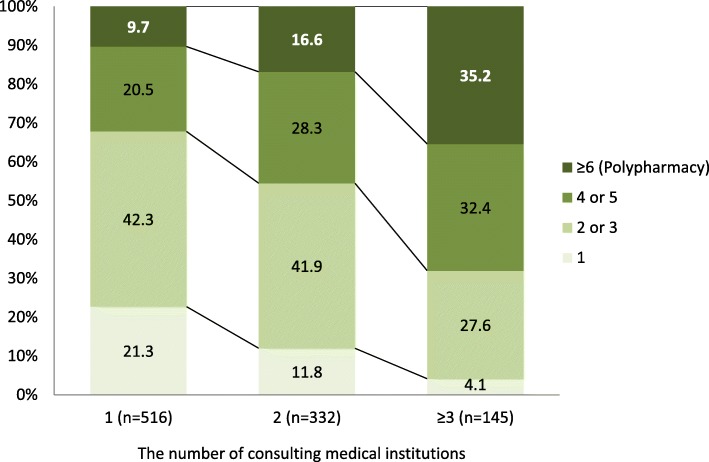
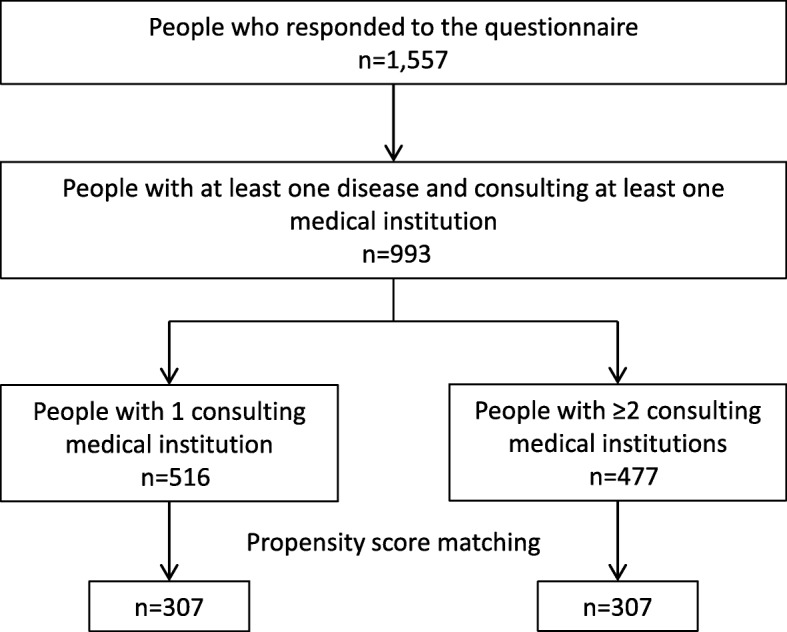
Of 993 eligible individuals (mean (standard deviation) age: 75.1 (6.5) years, men: 52.6%), 15.7% (156/993) showed polypharmacy. Proportions of polypharmacy were 9.7% (50/516), 16.6% (55/332), and 35.2% (51/145) for people who consulted 1, 2, and ≥3 medical institutions, respectively. Relative to people who consulted 1 medical institution, adjusted odds ratios (95% confidence intervals) for polypharmacy were 1.50 (0.94-2.37) and 3.34 (1.98-5.65) for those who consulted 2 and ≥3 medical institutions, respectively. In propensity score matching, of 516 and 477 patients who consulted 1 and ≥2 medical institutions, 307 pairs were generated. The proportion of polypharmacy was 10.8% (33/307) and 17.3% (53/307), respectively (P = 0.020). The odds ratio for polypharmacy (≥2 vs. 1 consulting medical institution) was 1.73 (95% confidence interval 1.09-2.76).
Patients who consulted more medical institutions were more likely to show polypharmacy. The results could encourage physicians and pharmacists to collect medication information more actively and conduct appropriate medication reviews. Strengthening primary care is needed to address the polypharmacy issue, especially in countries with healthcare systems with free access.
在日本的免费医疗保健系统下,患者可以在没有初级保健转诊的情况下咨询多家医疗机构(包括诊所和综合或专科咨询医院)。这可能会增加多药治疗的风险。我们研究了在免费医疗保健系统下,与咨询医疗机构数量相关的多药治疗情况。
通过自填问卷,我们确定了 2016 年日本某城市年龄≥65 岁、≥1 种疾病和≥1 家咨询医疗机构的人群。感兴趣的暴露因素是咨询医疗机构的数量(1、2 或≥3 家),结果是多药治疗(使用≥6 种药物)。我们进行了多变量逻辑回归分析,调整了年龄、性别、家庭经济状况以及合并症的数量和类型。为了最大限度地减少混杂效应,我们还进行了倾向评分匹配分析,将患者分为两组:1 家和≥2 家咨询医疗机构。
在 993 名符合条件的个体中(平均(标准差)年龄:75.1(6.5)岁,男性:52.6%),15.7%(156/993)表现出多药治疗。1、2 和≥3 家医疗机构就诊者的多药治疗比例分别为 9.7%(50/516)、16.6%(55/332)和 35.2%(51/145)。与咨询 1 家医疗机构的患者相比,咨询 2 家和≥3 家医疗机构的患者多药治疗的调整比值比(95%置信区间)分别为 1.50(0.94-2.37)和 3.34(1.98-5.65)。在倾向评分匹配中,在咨询 1 家和≥2 家医疗机构的 516 名和 477 名患者中,生成了 307 对。多药治疗的比例分别为 10.8%(33/307)和 17.3%(53/307)(P=0.020)。多药治疗(≥2 家 vs. 1 家医疗机构)的比值比为 1.73(95%置信区间 1.09-2.76)。
咨询更多医疗机构的患者更有可能出现多药治疗。研究结果可能鼓励医生和药剂师更积极地收集药物信息并进行适当的药物审查。需要加强初级保健以解决多药治疗问题,特别是在有免费医疗保健系统的国家。