Infectious Diseases Research Collaboration, Kampala, Uganda.
Department of Medicine, University of California, San Francisco, CA, USA.
Lancet Microbe. 2021 Sep;2(9):e441-e449. doi: 10.1016/s2666-5247(21)00085-9. Epub 2021 Jun 18.
Treatment and control of malaria depends on artemisinin-based combination therapies (ACTs) and is challenged by drug resistance, but thus far resistance to artemisinins and partner drugs has primarily occurred in southeast Asia. The aim of this study was to characterise antimalarial drug susceptibility of isolates from Tororo and Busia districts in Uganda.
In this prospective longitudinal study, isolates were collected from patients aged 6 months or older presenting at the Tororo District Hospital (Tororo district, a site with relatively low malaria incidence) or Masafu General Hospital (Busia district, a high-incidence site) in eastern Uganda with clinical symptoms of malaria, a positive Giemsa-stained blood film for , and no signs of severe disease. Ex-vivo susceptibilities to ten antimalarial drugs were measured using a 72-h microplate growth inhibition assay with SYBR Green detection. Relevant genetic polymorphisms were characterised by molecular methods. We compared results with those from earlier studies in this region and searched for associations between drug susceptibility and parasite genotypes.
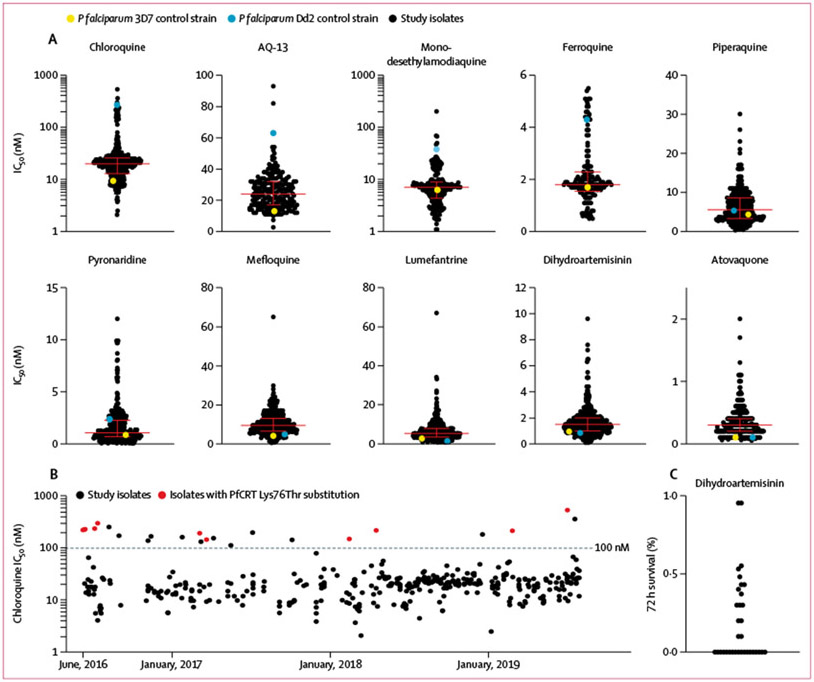
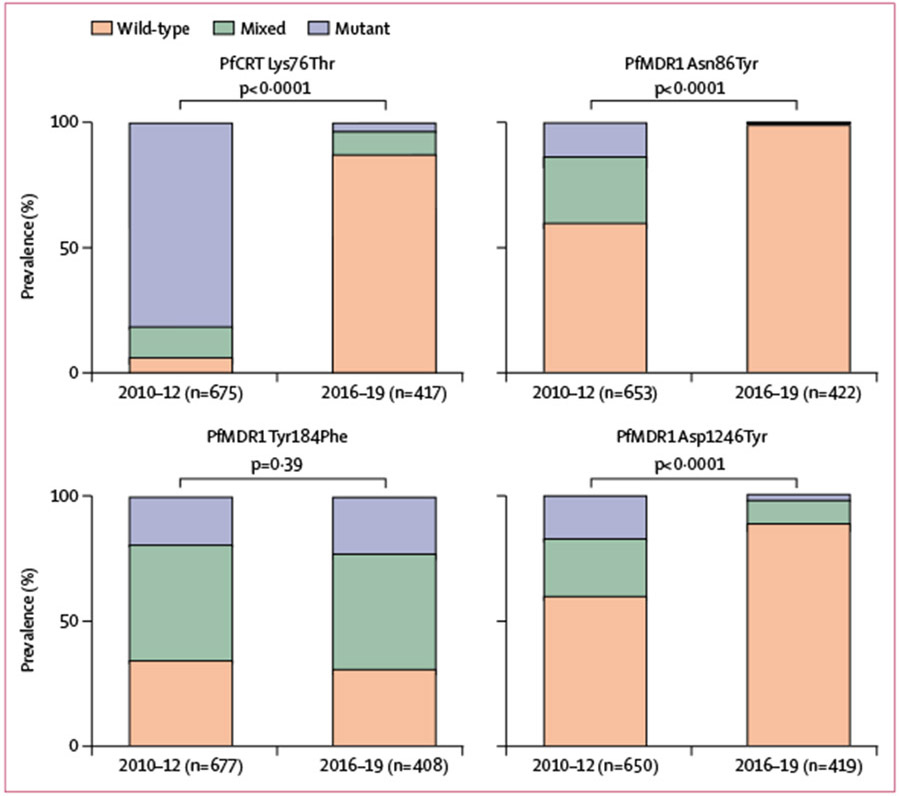
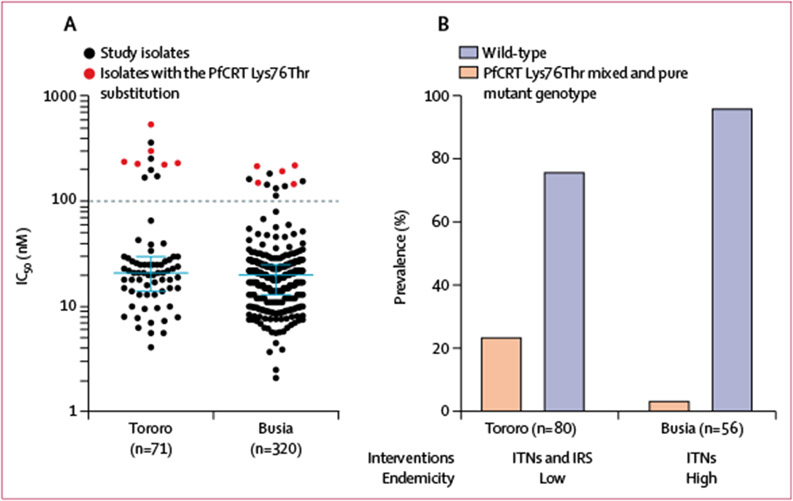
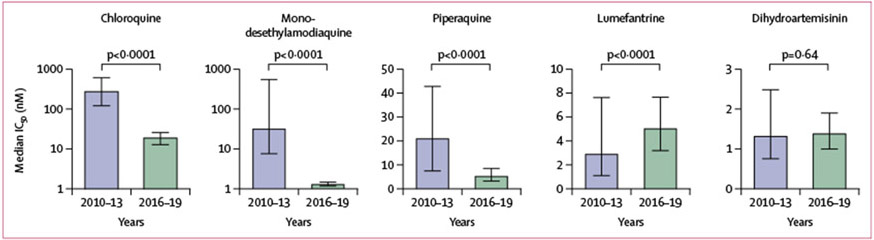
From June 10, 2016, to July 29, 2019, 361 isolates were collected in the Busia district and 79 in the Tororo district from 440 participants. Of 440 total isolates, 392 (89%) successfully grew in culture and showed excellent drug susceptibility for chloroquine (median half-maximal inhibitory concentration [IC] 20·0 nM [IQR 12·0-26·0]), monodesethylamodiaquine (7·1 nM [4·3-8·9]), pyronaridine (1·1 nM [0·7-2·3]), piperaquine (5·6 nM [3·3-8·6]), ferroquine (1·8 nM [1·5-3·3]), AQ-13 (24·0 nM [17·0-32·0]), lumefantrine (5·1 nM [3·2-7·7]), mefloquine (9·5 nM [6·6-13·0]), dihydroartemisinin (1·5 nM [1·0-2·0]), and atovaquone (0·3 nM [0·2-0·4]). Compared with results from our study in 2010-13, significant improvements in susceptibility were seen for chloroquine (median IC 288·0 nM [IQR 122·0-607·0]; p<0·0001), monodesethylamodiaquine (76·0 nM [44·0-137]; p<0·0001), and piperaquine (21·0 nM [7·6-43·0]; p<0·0001), a small but significant decrease in susceptibility was seen for lumefantrine (3·0 nM [1·1-7·6]; p<0·0001), and no change in susceptibility was seen with dihydroartemisinin (1·3 nM [0·8-2·5]; p=0·64). Chloroquine resistance (IC>100 nM) was more common in isolates from the Tororo district (11 [15%] of 71), compared with those from the Busia district (12 [4%] of 320; p=0·0017). We showed significant increases between 2010-12 and 2016-19 in the prevalences of wild-type multidrug resistance protein 1 (PfMDR1) Asn86Tyr from 60% (391 of 653) to 99% (418 of 422; p<0·0001), PfMDR1 Asp1246Tyr from 60% (390 of 650) to 90% (371 of 419; p<0·0001), and chloroquine resistance transporter (PfCRT) Lys76Thr from 7% (44 of 675) to 87% (364 of 417; p<0·0001).
Our results show marked changes in drug susceptibility phenotypes and genotypes in Uganda during the past decade. These results suggest that additional changes will be seen over time and continued surveillance of susceptibility to key ACT components is warranted.
National Institutes of Health and Medicines for Malaria Venture.
疟疾的治疗和控制依赖于青蒿素类复方疗法(ACTs),但受到药物耐药性的挑战,然而到目前为止,青蒿素类药物和联合用药的耐药性主要发生在东南亚。本研究的目的是描述乌干达托罗罗和布西亚地区疟原虫的抗疟药物敏感性。
在这项前瞻性纵向研究中,从乌干达东部托罗罗区医院(托罗罗区,疟疾发病率相对较低的地点)或布西亚区马萨富综合医院(疟疾发病率较高的地点)就诊、具有疟疾临床症状、吉姆萨染色血涂片阳性且无严重疾病迹象的 6 个月或以上的患者中采集 。使用含有 SYBR Green 检测的 72 小时微孔板生长抑制试验来测量对十种抗疟药物的体外敏感性。通过分子方法描述相关的 遗传多态性。我们将结果与该地区早期的研究结果进行了比较,并搜索了药物敏感性与寄生虫基因型之间的关联。
从 2016 年 6 月 10 日至 2019 年 7 月 29 日,从 440 名参与者中在布西亚区采集了 361 株 ,在托罗罗区采集了 79 株 。在总共 440 株中,392 株(89%)成功培养并表现出良好的药物敏感性,氯喹(中位数半最大抑制浓度 [IC]20·0 nM [12·0-26·0])、单去乙基阿莫地喹(7·1 nM [4·3-8·9])、哌喹(1·1 nM [0·7-2·3])、哌喹(5·6 nM [3·3-8·6])、铁氟喹(1·8 nM [1·5-3·3])、AQ-13(24·0 nM [17·0-32·0])、青蒿琥酯(5·1 nM [3·2-7·7])、甲氟喹(9·5 nM [6·6-13·0])、二氢青蒿素(1·5 nM [1·0-2·0])和阿托喹酮(0·3 nM [0·2-0·4])。与我们在 2010-13 年进行的研究结果相比,氯喹(中位数 IC 288·0 nM [122·0-607·0];p<0·0001)、单去乙基阿莫地喹(76·0 nM [44·0-137];p<0·0001)和哌喹(21·0 nM [7·6-43·0];p<0·0001)的敏感性显著改善,青蒿琥酯(3·0 nM [1·1-7·6];p<0·0001)的敏感性略有下降,二氢青蒿素(1·3 nM [0·8-2·5];p=0·64)的敏感性没有变化。托罗罗区(11 [15%],71 株)中氯喹耐药(IC>100 nM)的比例明显高于布西亚区(12 [4%],320 株;p=0·0017)。我们显示出 2010-12 年和 2016-19 年之间 PfMDR1 天冬氨酸 86 酪氨酸(野生型)的流行率显著增加,从 60%(391 株/653 株)增加到 99%(418 株/422 株;p<0·0001),PfMDR1 天门冬氨酸 1246 酪氨酸(野生型)从 60%(390 株/650 株)增加到 90%(371 株/419 株;p<0·0001),以及 氯喹耐药转运蛋白(PfCRT)赖氨酸 76 苏氨酸从 7%(44 株/675 株)增加到 87%(364 株/417 株;p<0·0001)。
我们的结果表明,乌干达在过去十年中疟原虫药物敏感性表型和基因型发生了显著变化。这些结果表明,随着时间的推移还会出现更多的变化,因此有必要继续监测关键 ACT 成分的敏感性。
美国国立卫生研究院和抗疟疾药物基金会。