Department of Microbiology and Molecular Genetics, University of Pittsburgh School of Medicine, Pittsburgh, Pennsylvania, United States of America.
PLoS Genet. 2021 Sep 23;17(9):e1009800. doi: 10.1371/journal.pgen.1009800. eCollection 2021 Sep.
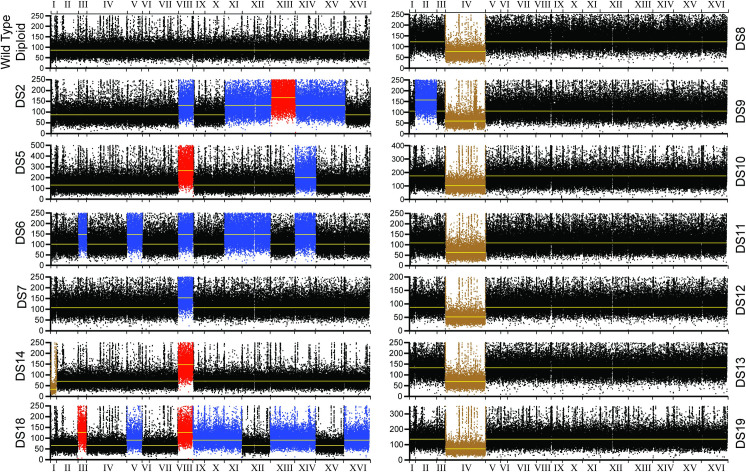
Previous studies of adaptation to the glucose analog, 2-deoxyglucose, by Saccharomyces cerevisiae have utilized haploid cells. In this study, diploid cells were used in the hope of identifying the distinct genetic mechanisms used by diploid cells to acquire drug resistance. While haploid cells acquire resistance to 2-deoxyglucose primarily through recessive alleles in specific genes, diploid cells acquire resistance through dominant alleles, haploinsufficiency, gene duplication and aneuploidy. Dominant-acting, missense alleles in all three subunits of yeast AMP-activated protein kinase confer resistance to 2-deoxyglucose. Dominant-acting, nonsense alleles in the REG1 gene, which encodes a negative regulator of AMP-activated protein kinase, confer 2-deoxyglucose resistance through haploinsufficiency. Most of the resistant strains isolated in this study achieved resistance through aneuploidy. Cells with a monosomy of chromosome 4 are resistant to 2-deoxyglucose. While this genetic strategy comes with a severe fitness cost, it has the advantage of being readily reversible when 2-deoxyglucose selection is lifted. Increased expression of the two DOG phosphatase genes on chromosome 8 confers resistance and was achieved through trisomies and tetrasomies of that chromosome. Finally, resistance was also mediated by increased expression of hexose transporters, achieved by duplication of a 117 kb region of chromosome 4 that included the HXT3, HXT6 and HXT7 genes. The frequent use of aneuploidy as a genetic strategy for drug resistance in diploid yeast and human tumors may be in part due to its potential for reversibility when selection pressure shifts.
先前对酵母细胞适应葡萄糖类似物 2-脱氧葡萄糖的研究利用了单倍体细胞。在本研究中,使用了二倍体细胞,希望能确定二倍体细胞获得耐药性所使用的独特遗传机制。虽然单倍体细胞主要通过特定基因中的隐性等位基因获得对 2-脱氧葡萄糖的抗性,但二倍体细胞通过显性等位基因、杂合不足、基因复制和非整倍性获得抗性。酵母 AMP 激活蛋白激酶的所有三个亚基中的显性作用、错义等位基因赋予对 2-脱氧葡萄糖的抗性。编码 AMP 激活蛋白激酶负调节剂的 REG1 基因中的显性作用、无义等位基因通过杂合不足赋予对 2-脱氧葡萄糖的抗性。本研究中分离的大多数耐药株通过非整倍性获得抗性。染色体 4 单体的细胞对 2-脱氧葡萄糖具有抗性。虽然这种遗传策略伴随着严重的适应性成本,但当去除 2-脱氧葡萄糖选择时,它具有易于逆转的优势。染色体 8 上两个 DOG 磷酸酶基因的表达增加赋予了抗性,这是通过该染色体的三体和四体实现的。最后,通过复制包括 HXT3、HXT6 和 HXT7 基因的染色体 4 的 117kb 区域,增加了己糖转运蛋白的表达,从而介导了抗性。二倍体酵母和人类肿瘤中耐药性的非整倍性作为一种遗传策略的频繁使用,部分原因可能是由于其在选择压力改变时具有潜在的可逆性。