Pei Caixia, Wang Fei, Huang Demei, Shi Shihua, Wang Xiaomin, Wang Yilan, Li Shuiqin, Wu Yongcan, Wang Zhenxing
Hospital of Chengdu University of Traditional Chinese Medicine, Chengdu, Sichuan Province, People's Republic of China.
J Inflamm Res. 2021 Sep 16;14:4707-4721. doi: 10.2147/JIR.S312167. eCollection 2021.
Prolonged exposure to air polluted with airborne fine particulate matter (PM2.5) can increase respiratory disease risk. Astragaloside IV (AS-IV) is one of the main bioactive substances in the traditional Chinese medicinal herb, Bunge. AS-IV has numerous pharmacological properties; whereas there are few reports on the prevention of PM2.5-induced lung injury by AS-IV through modulation of the autophagic pathway. This study aimed to investigate the protective effects and the underlying mechanisms of AS-IV in PM2.5-induced lung injury rats and rat alveolar macrophages (NR8383 cells).
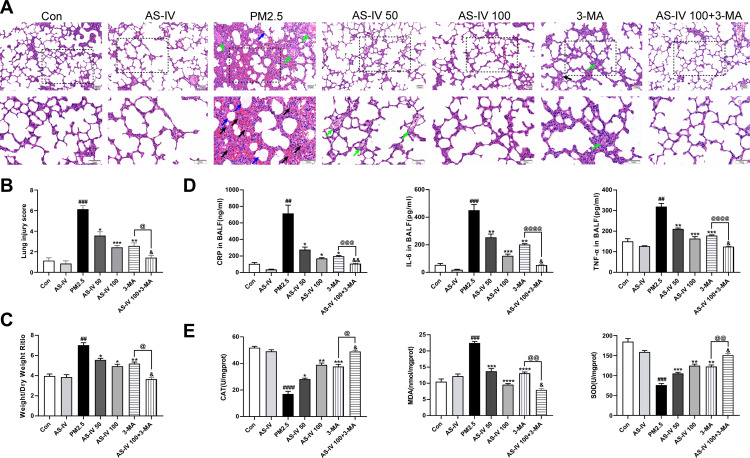
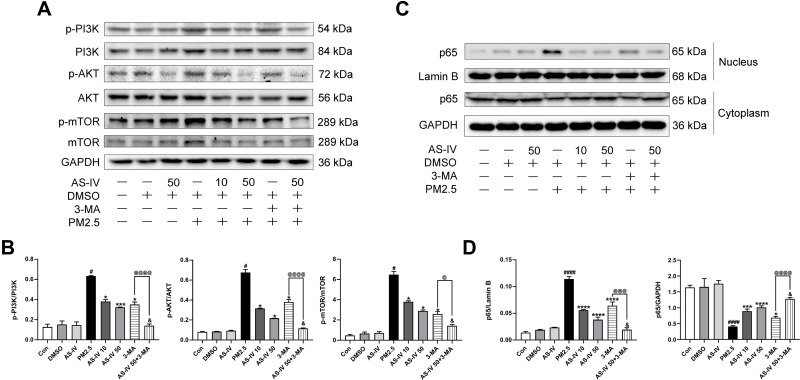
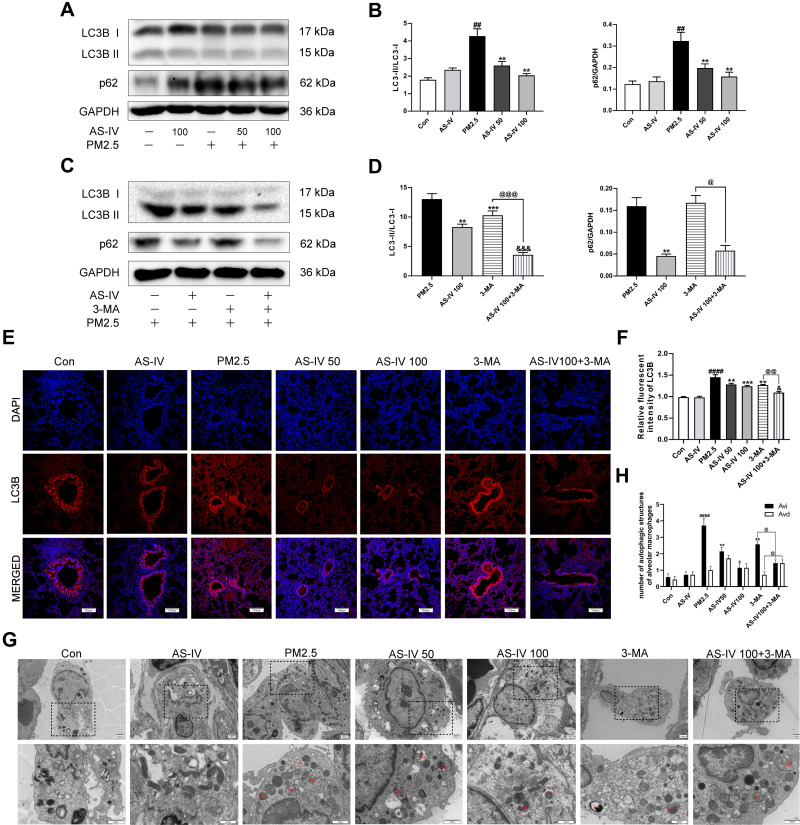
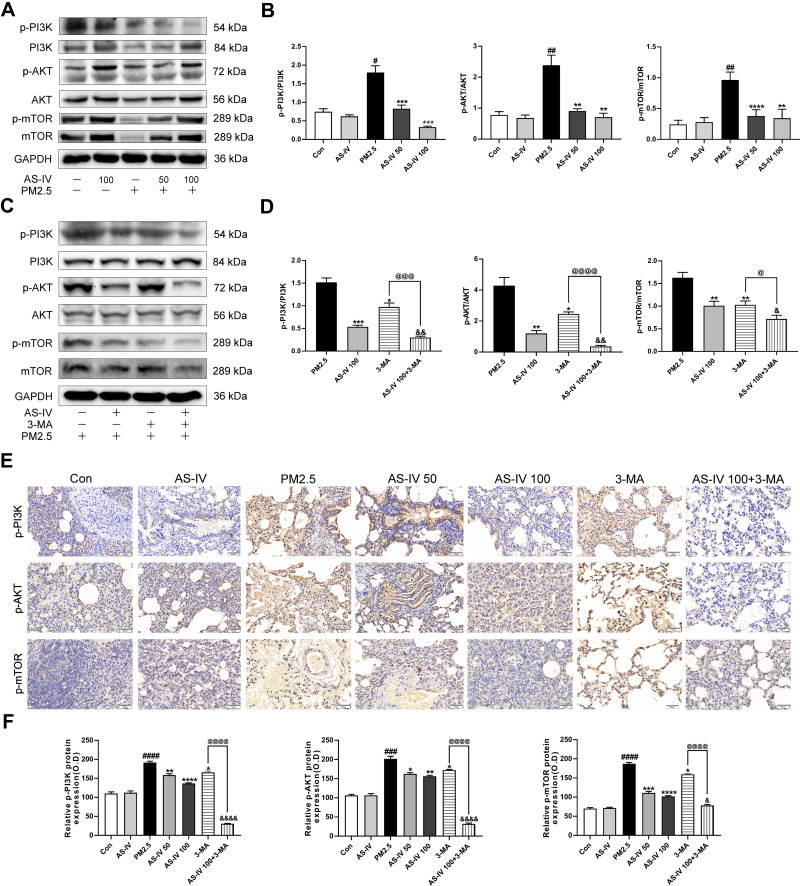
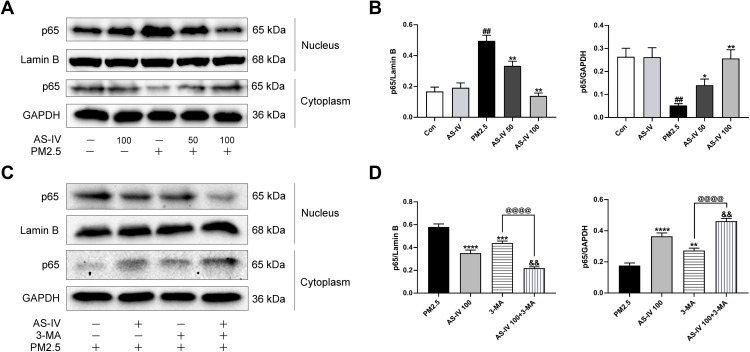
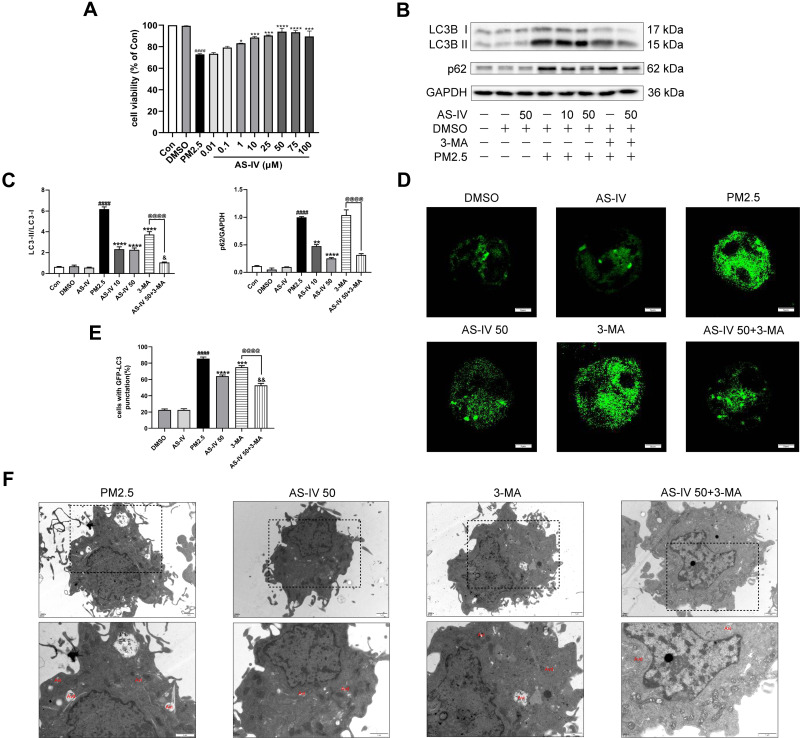
The pneumotoxicity model was established by intratracheal injection of PM2.5 in rats, and PM2.5 challenge in NR8383 cells. The severity of lung injury was evaluated by wet weight to dry weight ratio and McGuigan pathology scoring. Inflammatory factors and oxidative stress were detected through ELISA. The expressions of p-PI3K, p-Akt, and p-mTOR proteins were analyzed by immunohistochemistry. Immunofluorescence and transmission electron microscopy were used to detect autophagosomes. The expressions of autophagy marker protein (LC3B and p62), PI3K/Akt/mTOR signaling and NF-κB translocation were detected by Western blot in lung tissue and NR8383 cells.
After PM2.5 stimulation, rats showed severe inflammation and oxidative stress, along with inhibition of autophagy in lung tissue. AS-IV not only decreased pulmonary inflammation and oxidative stress by inhibiting nuclear factor kappa B translocation, but also regulated autophagy by inhibiting PI3K/Akt/mTOR signaling. After treatment with 3-methyladenine (a classic PI3K inhibitor, blocking the formation of autophagosomes), the protective effect of AS-IV on PM2.5-induced lung injury was further strengthened. In parallel, using Western blot, immunohistochemistry, and transmission electron microscopy, we demonstrated that AS-IV restore autophagic flux mainly through regulating the degradation of autophagosomes rather than suppressing the formation in vivo and in vitro.
Our data indicated that AS-IV protects from PM2.5-induced lung injury in vivo and in vitro by inhibiting the PI3K/Akt/mTOR pathway to regulate autophagy and inflammation.
长期暴露于含有空气细颗粒物(PM2.5)的污染空气中会增加患呼吸道疾病的风险。黄芪甲苷(AS-IV)是传统中药黄芪中的主要生物活性物质之一。AS-IV具有多种药理特性;然而,关于AS-IV通过调节自噬途径预防PM2.5诱导的肺损伤的报道较少。本研究旨在探讨AS-IV对PM2.5诱导的肺损伤大鼠和大鼠肺泡巨噬细胞(NR8383细胞)的保护作用及其潜在机制。
通过气管内注射PM2.5建立大鼠肺毒性模型,并对NR8383细胞进行PM2.5刺激。通过湿重与干重比和麦奎根病理评分评估肺损伤的严重程度。通过酶联免疫吸附测定法检测炎症因子和氧化应激。通过免疫组织化学分析p-PI3K、p-Akt和p-mTOR蛋白的表达。采用免疫荧光和透射电子显微镜检测自噬体。通过蛋白质免疫印迹法检测肺组织和NR8383细胞中自噬标记蛋白(LC3B和p62)、PI3K/Akt/mTOR信号传导和NF-κB易位的表达。
PM2.5刺激后,大鼠表现出严重的炎症和氧化应激,同时肺组织中的自噬受到抑制。AS-IV不仅通过抑制核因子κB易位降低肺部炎症和氧化应激,还通过抑制PI3K/Akt/mTOR信号传导调节自噬。用3-甲基腺嘌呤(一种经典的PI3K抑制剂,可阻断自噬体的形成)处理后,AS-IV对PM2.5诱导的肺损伤的保护作用进一步增强。同时,通过蛋白质免疫印迹法、免疫组织化学和透射电子显微镜,我们证明AS-IV主要通过调节自噬体的降解而非抑制体内和体外的形成来恢复自噬流。
我们的数据表明,AS-IV通过抑制PI3K/Akt/mTOR途径调节自噬和炎症,在体内和体外保护免受PM2.5诱导的肺损伤。