Deng Renjian, Chen Yilin, Deng Xinpin, Huang Zhongjie, Zhou Saijun, Ren Bozhi, Jin Guizhong, Hursthouse Andrew
School of Civil Engineering, Hunan University of Science and Technology, Xiangtan, China.
Hunan 402 Geological Prospecting Part, Changsha, China.
Front Microbiol. 2021 Sep 7;12:738596. doi: 10.3389/fmicb.2021.738596. eCollection 2021.
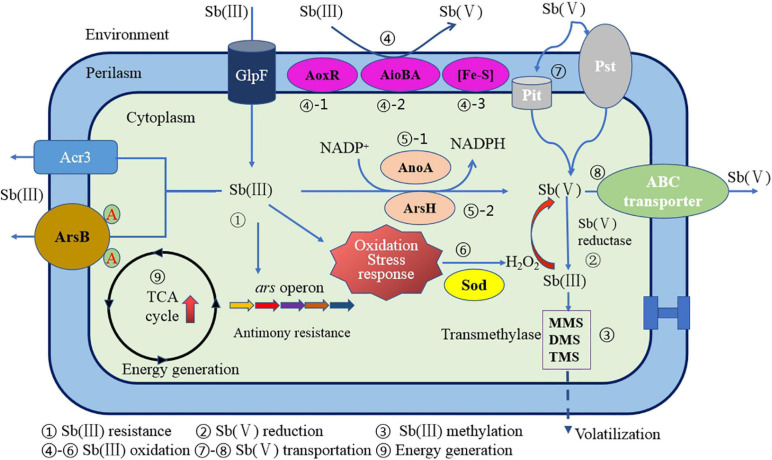
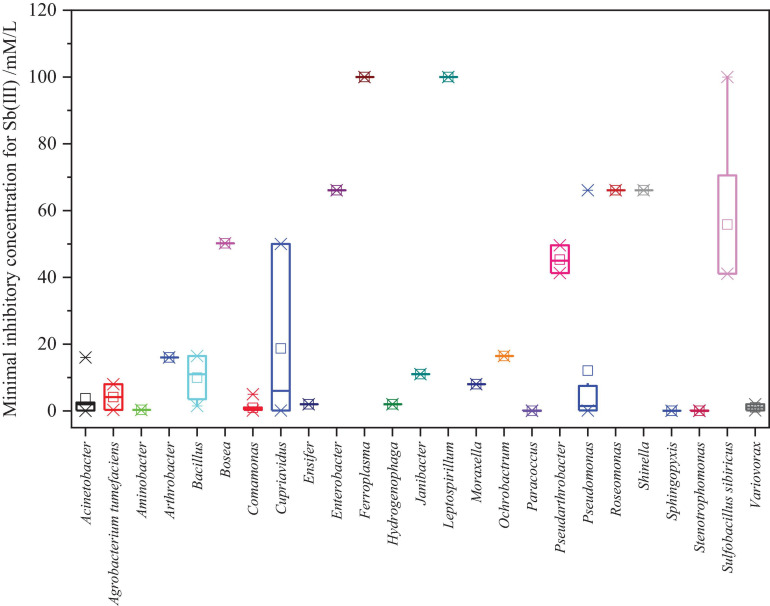
Antimony (Sb) is a priority pollutant in many countries and regions due to its chronic toxicity and potential carcinogenicity. Elevated concentrations of Sb in the environmental originating from mining and other anthropogenic sources are of particular global concern, so the prevention and control of the source of pollution and environment remediation are urgent. It is widely accepted that indigenous microbes play an important role in Sb speciation, mobility, bioavailability, and fate in the natural environment. Especially, antimony-oxidizing bacteria can promote the release of antimony from ore deposits to the wider environment. However, it can also oxidize the more toxic antimonite [Sb(III)] to the less-toxic antimonate [Sb(V)], which is considered as a potentially environmentally friendly and efficient remediation technology for Sb pollution. Therefore, understanding its biological oxidation mechanism has great practical significance to protect environment and human health. This paper reviews studies of the isolation, identification, diversity, Sb(III) resistance mechanisms, Sb(III) oxidation characteristics and mechanism and potential application of Sb-oxidizing bacteria. The aim is to provide a theoretical basis and reference for the diversity and metabolic mechanism of Sb-oxidizing bacteria, the prevention and control of Sb pollution sources, and the application of environment treatment for Sb pollution.
锑(Sb)在许多国家和地区都是优先污染物,因其具有慢性毒性和潜在致癌性。源于采矿和其他人为来源的环境中锑浓度升高尤其受到全球关注,因此污染源头的预防控制和环境修复迫在眉睫。人们普遍认为,本地微生物在锑的形态、迁移性、生物可利用性以及在自然环境中的归宿方面发挥着重要作用。特别是,锑氧化细菌可促进锑从矿床释放到更广泛的环境中。然而,它也能将毒性更强的亚锑酸盐[Sb(III)]氧化为毒性较小的锑酸盐[Sb(V)],这被认为是一种潜在的环境友好且高效的锑污染修复技术。因此,了解其生物氧化机制对保护环境和人类健康具有重大现实意义。本文综述了锑氧化细菌的分离、鉴定、多样性、Sb(III)抗性机制、Sb(III)氧化特性及机制以及潜在应用等方面的研究。目的是为锑氧化细菌的多样性和代谢机制、锑污染源的防控以及锑污染环境治理的应用提供理论依据和参考。