State Key Laboratory of Agricultural Microbiology, College of Life Science and Technology, Huazhong Agricultural University, Wuhan, P.R. China.
PLoS One. 2013 Oct 29;8(10):e78533. doi: 10.1371/journal.pone.0078533. eCollection 2013.
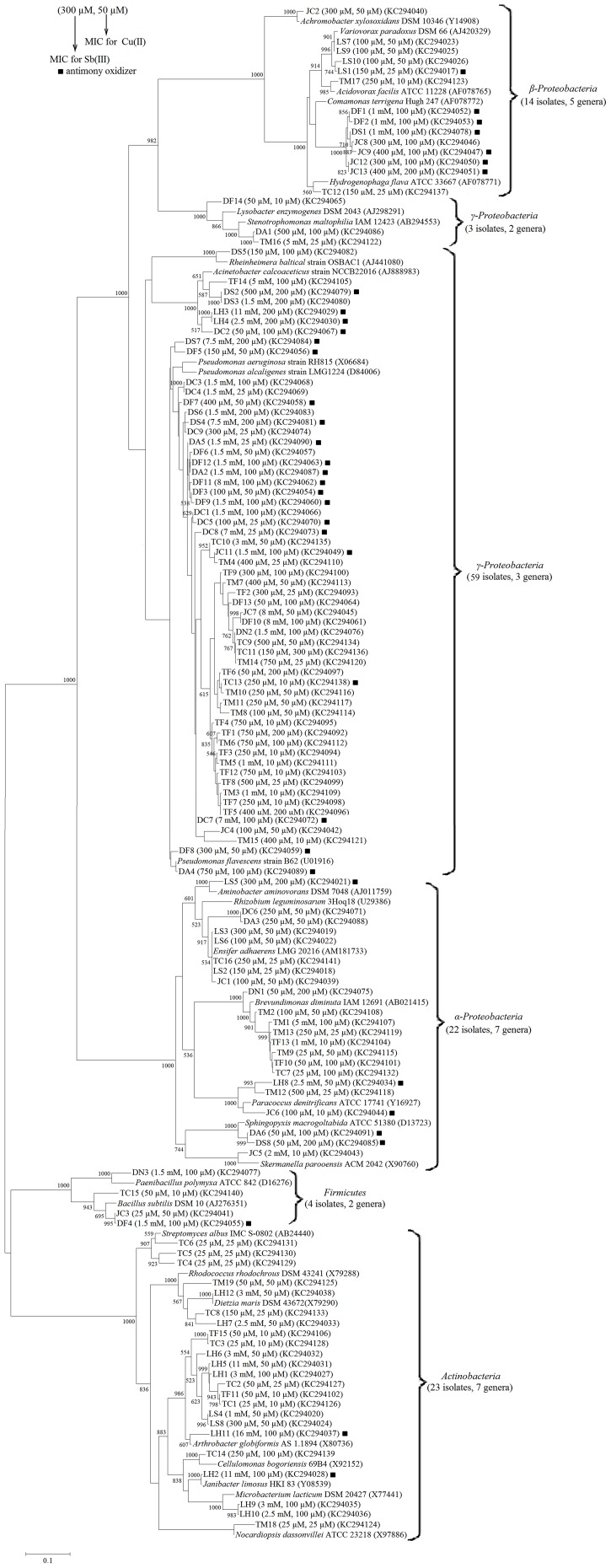
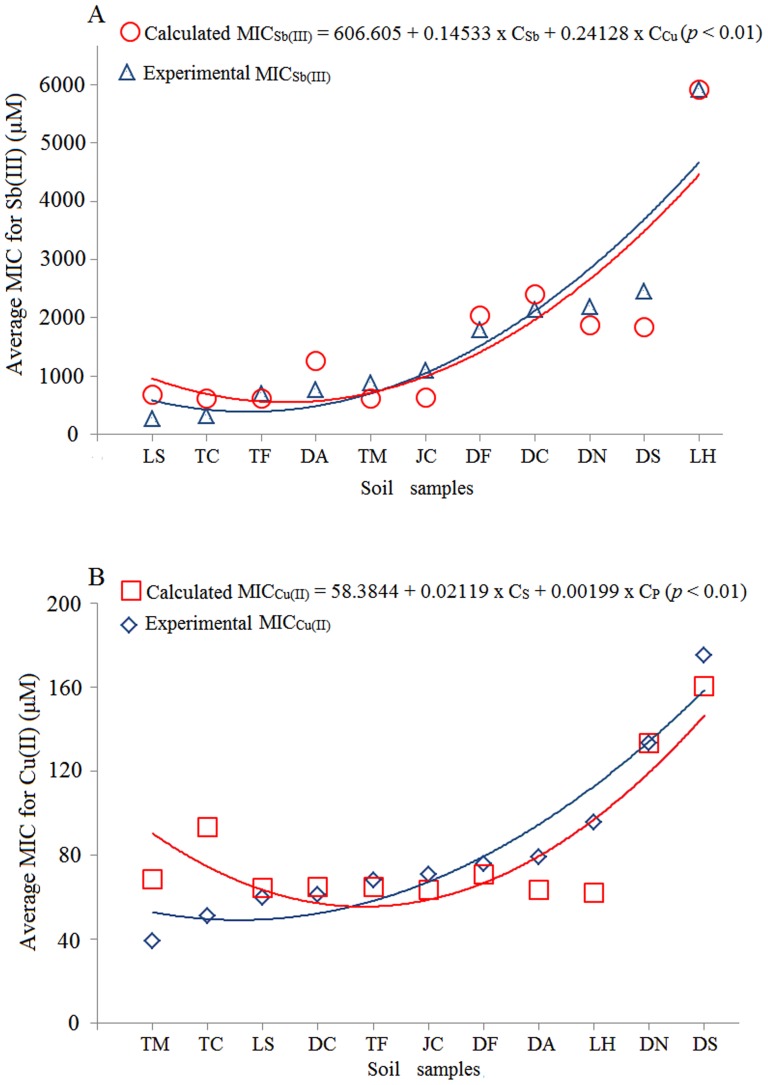
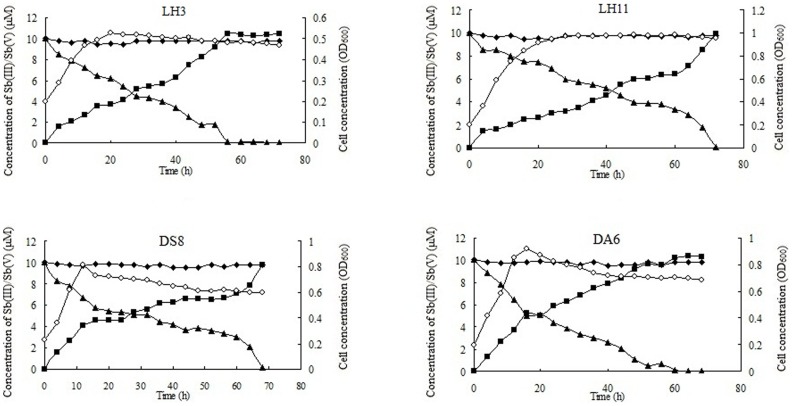
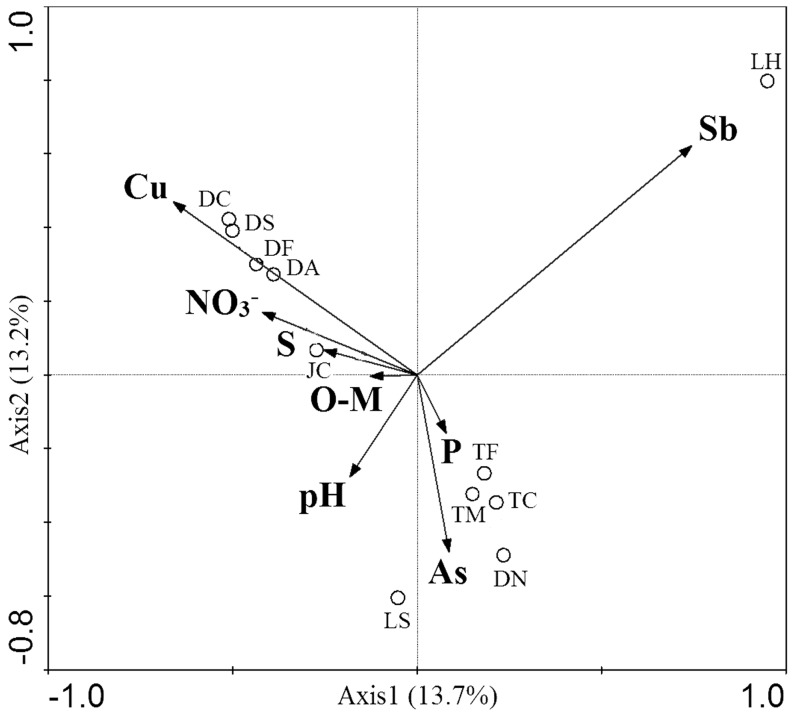
Antimony (Sb) and copper (Cu) are toxic heavy metals that are associated with a wide variety of minerals. Sb(III)-oxidizing bacteria that convert the toxic Sb(III) to the less toxic Sb(V) are potentially useful for environmental Sb bioremediation. A total of 125 culturable Sb(III)/Cu(II)-resistant bacteria from 11 different types of mining soils were isolated. Four strains identified as Arthrobacter, Acinetobacter and Janibacter exhibited notably high minimum inhibitory concentrations (MICs) for Sb(III) (>10 mM),making them the most highly Sb(III)-resistant bacteria to date. Thirty-six strains were able to oxidize Sb(III), including Pseudomonas-, Comamonas-, Acinetobacter-, Sphingopyxis-, Paracoccus- Aminobacter-, Arthrobacter-, Bacillus-, Janibacter- and Variovorax-like isolates. Canonical correspondence analysis (CCA) revealed that the soil concentrations of Sb and Cu were the most obvious environmental factors affecting the culturable bacterial population structures. Stepwise linear regression was used to create two predictive models for the correlation between soil characteristics and the bacterial Sb(III) or Cu(II) resistance. The concentrations of Sb and Cu in the soil was the significant factors affecting the bacterial Sb(III) resistance, whereas the concentrations of S and P in the soil greatly affected the bacterial Cu(II) resistance. The two stepwise linear regression models that we derived are as follows: MIC(Sb(III))=606.605+0.14533 x C(Sb)+0.4128 x C(Cu) and MIC((Cu)(II))=58.3844+0.02119 x C(S)+0.00199 x CP [where the MIC(Sb(III)) and MIC(Cu(II)) represent the average bacterial MIC for the metal of each soil (μM), and the C(Sb), C(Cu), C(S) and C(P) represent concentrations for Sb, Cu, S and P (mg/kg) in soil, respectively, p<0.01]. The stepwise linear regression models we developed suggest that metals as well as other soil physicochemical parameters can contribute to bacterial resistance to metals.
锑(Sb)和铜(Cu)是与各种矿物质相关的有毒重金属。能够将有毒的 Sb(III) 转化为毒性较低的 Sb(V) 的 Sb(III) 氧化细菌,对于环境 Sb 的生物修复具有潜在的用途。从 11 种不同类型的采矿土壤中分离出了总共 125 株可培养的 Sb(III)/Cu(II) 抗性细菌。鉴定为节杆菌属、不动杆菌属和詹氏菌属的 4 株细菌对 Sb(III) 的最小抑菌浓度(MIC)明显较高(>10 mM),是迄今为止对 Sb(III) 抗性最高的细菌。36 株细菌能够氧化 Sb(III),包括假单胞菌属、食酸菌属、不动杆菌属、鞘氨醇单胞菌属、副球菌属、气单胞菌属、节杆菌属、芽孢杆菌属、詹氏菌属和交替单胞菌属的分离株。典范对应分析(CCA)显示,土壤中 Sb 和 Cu 的浓度是影响可培养细菌种群结构的最明显的环境因素。逐步线性回归用于创建土壤特性与细菌 Sb(III)或 Cu(II)抗性之间相关性的两个预测模型。土壤中 Sb 和 Cu 的浓度是影响细菌 Sb(III)抗性的重要因素,而土壤中 S 和 P 的浓度则极大地影响了细菌对 Cu(II)的抗性。我们推导的两个逐步线性回归模型如下:MIC(Sb(III))=606.605+0.14533 x C(Sb)+0.4128 x C(Cu) 和 MIC(Cu(II))=58.3844+0.02119 x C(S)+0.00199 x CP [其中 MIC(Sb(III)) 和 MIC(Cu(II)) 分别代表每种土壤中金属的平均细菌 MIC(μM),C(Sb)、C(Cu)、C(S) 和 C(P) 分别代表土壤中 Sb、Cu、S 和 P 的浓度(mg/kg),p<0.01]。我们建立的逐步线性回归模型表明,金属以及其他土壤理化参数可能有助于细菌对金属的抗性。