Linares Raquel, Francés Rubén, Gutiérrez Ana, Juanola Oriol
Hepatic and Intestinal Immunobiology Group, Department of Clinical Medicine, Miguel Hernández University, San Juan de Alicante, Spain.
CIBERehd, Instituto de Salud Carlos III, Madrid, Spain.
Front Cell Dev Biol. 2021 Sep 7;9:703310. doi: 10.3389/fcell.2021.703310. eCollection 2021.
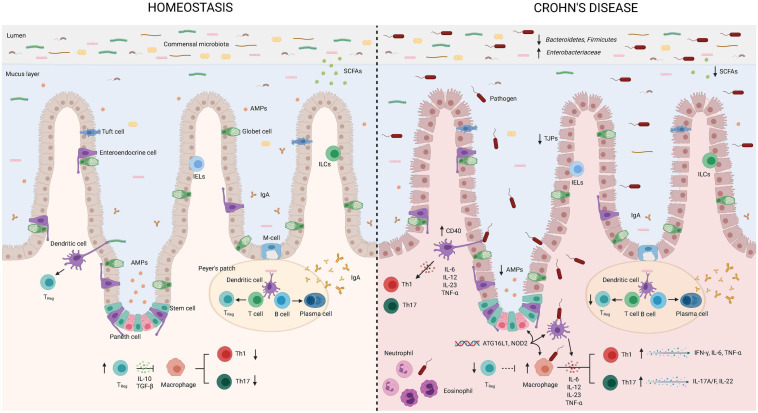
Crohn's disease (CD) is a chronic inflammatory disorder of the gastrointestinal tract responsible for intestinal lesions. The multifactorial etiology attributed to CD includes a combination of environmental and host susceptibility factors, which result in an impaired host-microbe gut interaction. Bacterial overgrowth and dysbiosis, increased intestinal barrier permeability, and altered inflammatory responses in patients with CD have been described in the past. Those events explain the pathogenesis of luminal translocation of bacteria or its products into the blood, a frequent event in CD, which, in turn, favors a sustained inflammatory response in these patients. In this review, we navigate through the interaction between bacterial antigen translocation, permeability of the intestinal barrier, immunologic response of the host, and genetic predisposition as a combined effect on the inflammatory response observed in CD. Several lines of evidence support that translocation of bacterial products leads to uncontrolled inflammation in CD patients, and as a matter of fact, the presence of gut bacterial genomic fragments at a systemic level constitutes a marker for increased risk of relapse among CD patients. Also, the significant percentage of CD patients who lose response to biologic therapies may be influenced by the translocation of bacterial products, which are well-known drivers of proinflammatory cytokine production by host immune cells. Further mechanistic studies evaluating cellular and humoral immune responses, gut microbiota alterations, and genetic predisposition will help clinicians to better control and personalize the management of CD patients in the future.
克罗恩病(CD)是一种导致肠道病变的胃肠道慢性炎症性疾病。CD的多因素病因包括环境因素和宿主易感性因素的综合作用,这会导致宿主与肠道微生物的相互作用受损。过去曾描述过CD患者存在细菌过度生长和生态失调、肠道屏障通透性增加以及炎症反应改变。这些情况解释了细菌或其产物向血液中腔隙性移位的发病机制,这在CD中是常见现象,进而促使这些患者持续出现炎症反应。在本综述中,我们探讨细菌抗原移位、肠道屏障通透性、宿主免疫反应和遗传易感性之间的相互作用,它们共同影响CD中观察到的炎症反应。多项证据支持细菌产物的移位会导致CD患者出现不受控制的炎症,事实上,在系统水平检测到肠道细菌基因组片段是CD患者复发风险增加的一个标志物。此外,相当比例对生物治疗失去反应的CD患者可能受到细菌产物移位的影响,而细菌产物是宿主免疫细胞产生促炎细胞因子的已知驱动因素。进一步评估细胞和体液免疫反应、肠道微生物群改变以及遗传易感性的机制研究,将有助于临床医生在未来更好地控制和个性化管理CD患者。