Barbetta Arianna, Butler Chanté, Barhouma Sarah, Hogen Rachel, Rocque Brittany, Goldbeck Cameron, Schilperoort Hannah, Meeberg Glenda, Shapiro James, Kwon Yong K, Kohli Rohit, Emamaullee Juliet
Department of Surgery, University of Southern California, Los Angeles, CA.
Wilson Dental Library, USC Libraries, University of Southern California, Los Angeles, CA.
Transplant Direct. 2021 Sep 20;7(10):e767. doi: 10.1097/TXD.0000000000001219. eCollection 2021 Oct.
Reduced-size deceased donors and living donor liver transplantation (LDLT) can address the organ shortage for pediatric liver transplant candidates, but concerns regarding technical challenges and the risk of complications using these grafts have been raised. The aim of this study was to compare outcomes for pediatric LDLT and deceased donor liver transplantation (DDLT) via systematic review.
A systematic literature search was performed to identify studies reporting outcomes of pediatric (<18 y) LDLT and DDLT published between 2005 and 2019. A meta-analysis was conducted to examine peri- and postoperative outcomes using fixed- and random-effects models.
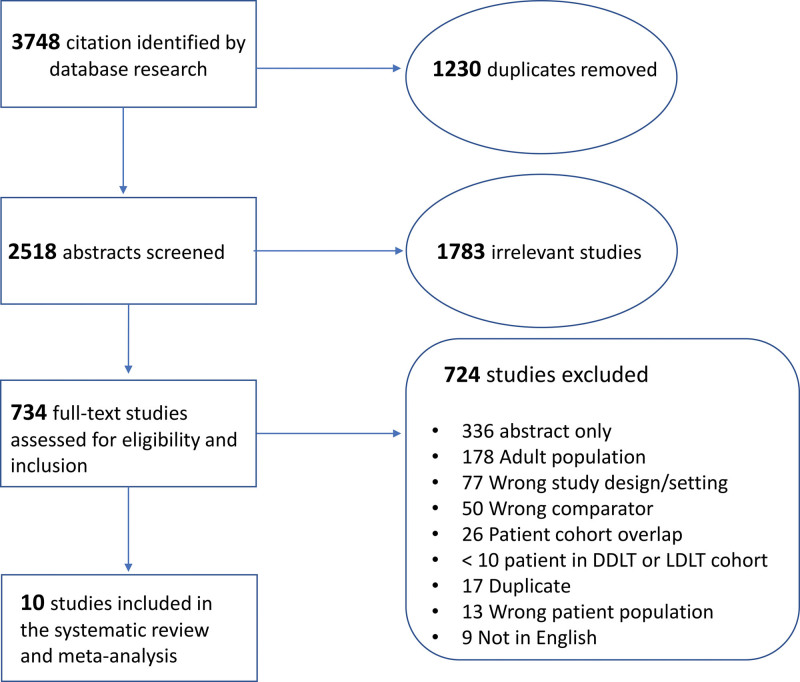
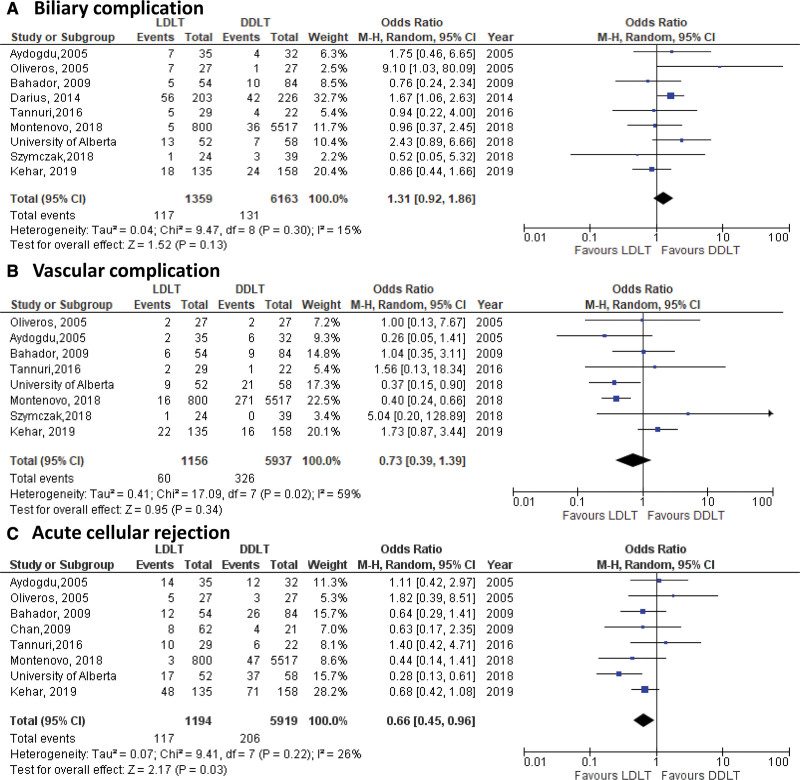
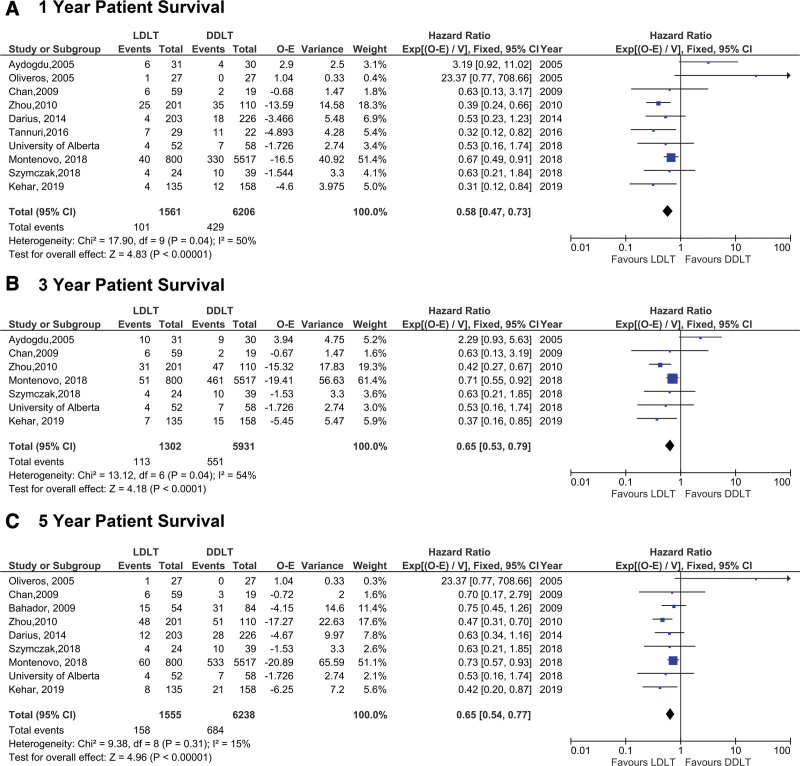
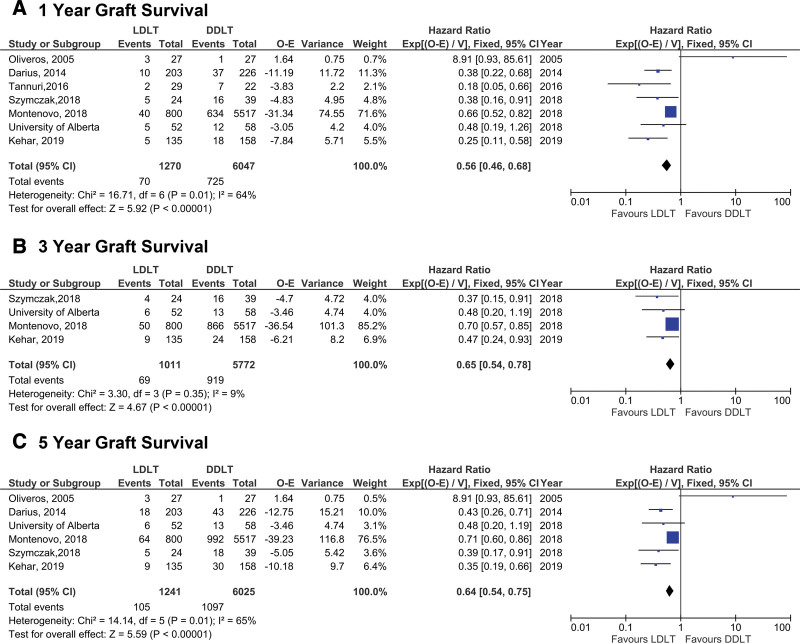
Overall, 2518 abstracts were screened, and 10 studies met criteria for inclusion. In total, 1622 LDLT and 6326 DDLT pediatric patients from 4 continents were examined. LDLT resulted in superior patient survival when compared with DDLT at 1, 3, and 5 y post-LT (1-y hazard ratio: 0.58, 95% confidence interval [CI] 0.47-0.73, < 0.0001). Similarly, LDLT resulted in superior graft survival at all time points post-LT when compared with DDLT (1-y hazard ratio: 0.56 [95% CI 0.46-0.68], < 0.0001]. The OR for vascular complications was 0.73 (95% CI 0.39-1.39) and 1.31 (95% CI 0.92-1.86) for biliary complications in LDLT compared with DDLT, whereas LDLT was associated with lower rates of rejection (OR: 0.66 [95% CI 0.45-0.96], = 0.03).
This meta-analysis demonstrates that LDLT may offer many advantages when compared with DDLT in children and suggests that LDLT should continue to be expanded to optimize outcomes for pediatric LT candidates.
减体积的脑死亡供体肝移植和活体供体肝移植(LDLT)可以解决儿童肝移植受者的器官短缺问题,但人们对使用这些移植物的技术挑战和并发症风险提出了担忧。本研究的目的是通过系统评价比较儿童LDLT和脑死亡供体肝移植(DDLT)的结果。
进行系统的文献检索,以确定报告2005年至2019年期间儿童(<18岁)LDLT和DDLT结果的研究。使用固定效应模型和随机效应模型进行荟萃分析,以检查围手术期和术后结果。
总体而言,筛选了2518篇摘要,10项研究符合纳入标准。总共检查了来自4个大洲的1622例LDLT和6326例DDLT儿童患者。与DDLT相比,LDLT在肝移植后1年、3年和5年时患者生存率更高(1年风险比:(0.58,95%置信区间[CI]0.47-0.73,P<0.0001)。同样,与DDLT相比,LDLT在肝移植后的所有时间点移植物生存率更高(1年风险比:0.56[95%CI0.46-0.68],P<0.0001)。与DDLT相比,LDLT血管并发症的比值比为0.73(95%CI0.39-1.39);胆道并发症的比值比为1.31(95%CI0.92-1.86),而LDLT与较低的排斥反应发生率相关(比值比:0.66[95%CI0.45-0.96],P=0.03)。
这项荟萃分析表明,与DDLT相比,LDLT在儿童中可能具有许多优势,并表明LDLT应继续扩大应用,以优化儿童肝移植受者的治疗结果。