Wang Haitao, Su Wentao, Tan Mingqian
School of Food Science and Technology, National Engineering Research Center of Seafood, Dalian Polytechnic University, Qinggongyuan 1, Ganjingzi District, Dalian, Liaoning 116034, China.
Collaborative Innovation Center of Seafood Deep Processing, Dalian Polytechnic University, Qinggongyuan 1, Ganjingzi District, Dalian, Liaoning 116034, China.
Innovation (Camb). 2020 Apr 22;1(1):100009. doi: 10.1016/j.xinn.2020.04.009. eCollection 2020 May 21.
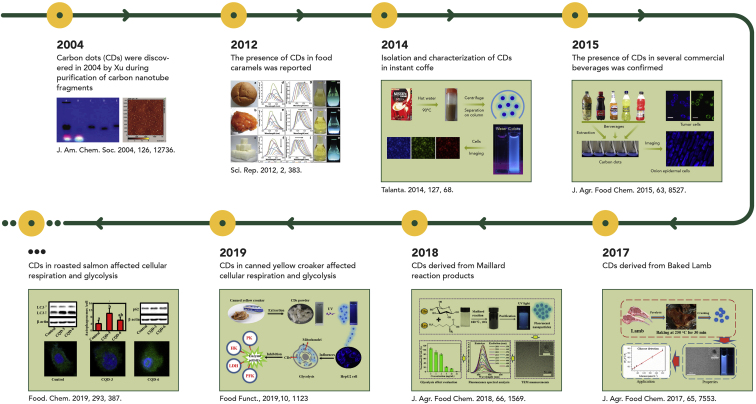
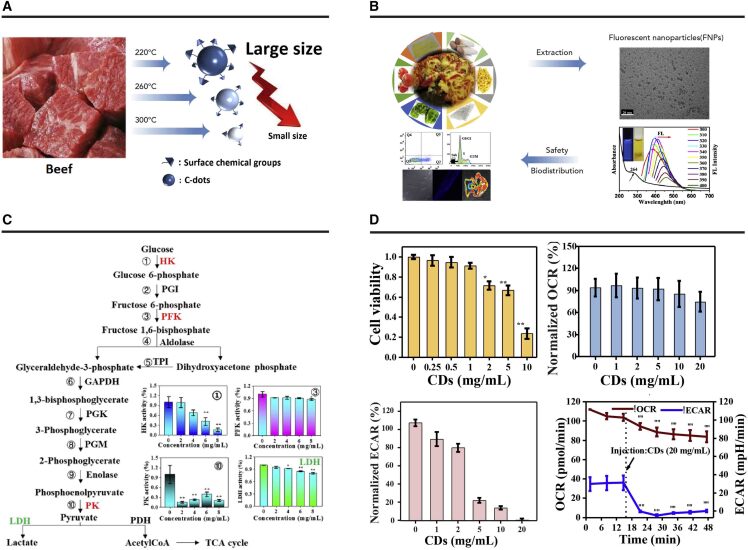
Fluorescent carbon dots (CDs) are a novel class of carbon-based nanomaterials that were discovered in 2004. However, nobody knew that CDs existed in food items naturally until 2012. Properties of nanosize materials are distinct from those of their bulk materials due to the particle size and accordingly alter their bioavailability and/or biocompatibility. Therefore, the potential health risk of nanoparticles in food has drawn massive attention. Currently, almost all studies regarding the biosafety of nanoparticles in food have mainly focused on engineered nanoparticles used as food additives and have excluded the endogenous nanoparticles in food. Therefore, investigation of the properties of food-borne fluorescent CDs and their potential health risk to humans is of great significance.
This review summarizes the existing literature on fluorescent carbon dots (CDs) in food, with particular attention to their properties, formation process, and the potential health risks posed to consumers. The knowledge gap between food-borne nanoparticles and their potential risks is identified, and future research is proposed.
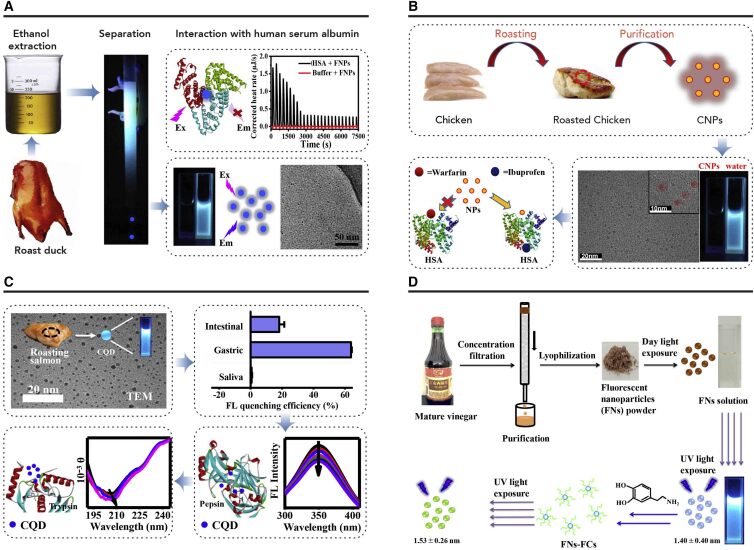
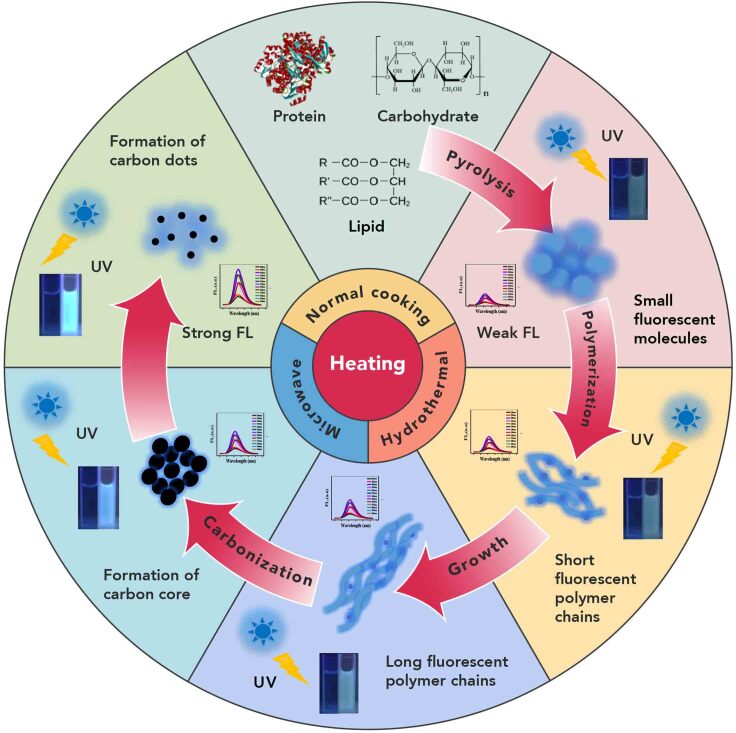
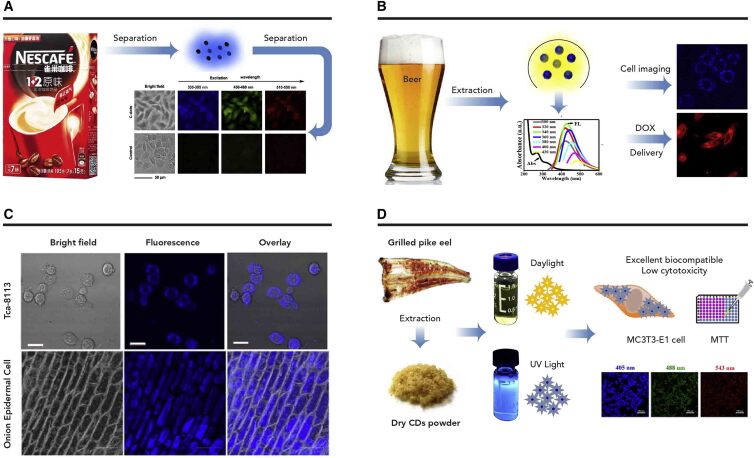
The presence of fluorescent CDs in food produced during food processing has been summarized. Fluorescent CDs less than 10 nm in size mainly contain carbon, oxygen, hydrogen, and/or nitrogen. The presence of CDs in food items was first demonstrated in 2012, and their formation was attributed to heating of the starting material. The properties of CDs in food are different from the engineered nanoparticles used as food as additives and represent a novel kind of nanostructure in food. Further studies should focus on the chronic effects of CDs, although their toxicity is low, because investigations both and are limited.
荧光碳点(CDs)是一类新型的碳基纳米材料,于2004年被发现。然而,直到2012年人们才知道食品中天然存在碳点。由于粒径的原因,纳米尺寸材料的性质与其块状材料不同,相应地改变了它们的生物利用度和/或生物相容性。因此,食品中纳米颗粒的潜在健康风险引起了广泛关注。目前,几乎所有关于食品中纳米颗粒生物安全性的研究主要集中在用作食品添加剂的工程纳米颗粒上,而排除了食品中的内源性纳米颗粒。因此,研究食品中荧光碳点的性质及其对人类的潜在健康风险具有重要意义。
本综述总结了食品中荧光碳点(CDs)的现有文献,特别关注其性质、形成过程以及对消费者构成的潜在健康风险。确定了食品中纳米颗粒与其潜在风险之间的知识差距,并提出了未来的研究方向。
总结了食品加工过程中产生的食品中荧光碳点的存在情况。尺寸小于10纳米的荧光碳点主要含有碳、氧、氢和/或氮。2012年首次证明了食品中存在碳点,其形成归因于原料的加热。食品中碳点的性质不同于用作食品添加剂的工程纳米颗粒,代表了食品中一种新型的纳米结构。尽管碳点的毒性较低,但进一步的研究应集中在其慢性影响上,因为目前的调查和研究都很有限。