Hematology Department, Hospital Universitario Infanta Leonor, Madrid, Spain.
Infectious Diseases Department, Hospital Universitario Puerta de Hierro-Majadahonda, Spain.
Cancer Med. 2021 Nov;10(21):7629-7640. doi: 10.1002/cam4.4293. Epub 2021 Sep 23.
Lymphoid neoplasms treatment has recently been renewed to increase antitumor efficacy and conventional chemotherapies toxicities. Limited data have been published about the infection risk associated with these new drugs, therefore this study analyzes the infectious complications in patients with lymphoproliferative diseases (LPD) treated with monoclonal antibodies (obinutuzumab, ofatumumab, brentuximab, nivolumab, or pembrolizumab), BTK inhibitors (ibrutinib and acalabrutinib), PI3K inhibitors (idelalisib) and BCL2 inhibitors (venetoclax).
Multicenter retrospective study of 458 LPD patients treated with targeted therapies in real-life setting, in 18 Spanish institutions, from the time of their commercial availability to August 2020.
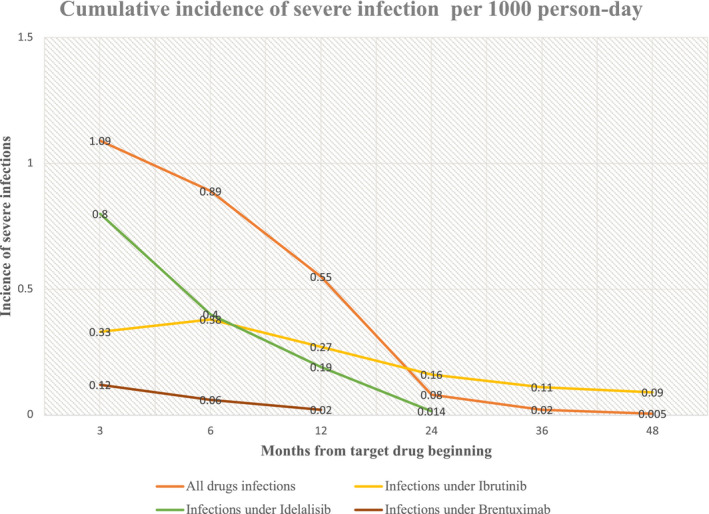
Severe infections incidence was 23% during 17-month median follow-up; cumulative incidence was higher in the first 3-6 months of targeted drug treatment and then decreased. The most frequent etiology was bacterial (54%). Nine (6%) Invasive fungal infections (IFI) were observed, in its majority in chronic lymphocytic leukemia (CLL) patients treated predominantly with ibrutinib. Significant risk factors for severe infection were: severe lymphopenia (p = 0.009, OR 4.7, range 1.3-1.7), combined targeted treatment vs single agent treatment (p = 0.014 OR 2.2 range 1.1-4.2) and previous rituximab (p = 0.03 OR 1.8, range 1.05-3.3). Infection-related mortality was 6%. In 22% of patients with severe infections, definitive discontinuation of the targeted drug was observed.
A high proportion of patients presented severe infections during follow-up, with non-negligible attributable mortality, but infection incidence is not superior to the one observed during the chemotherapy era. In selected cases with specific risk factors for infection, antimicrobial prophylaxis should be considered.
淋巴肿瘤的治疗最近已经更新,以提高抗肿瘤疗效和降低常规化疗的毒性。关于这些新药相关的感染风险,仅有有限的数据发表,因此本研究分析了在接受单克隆抗体(奥滨尤妥珠单抗、奥法妥珠单抗、本妥昔单抗、纳武利尤单抗或帕博利珠单抗)、BTK 抑制剂(依鲁替尼和阿卡替尼)、PI3K 抑制剂(idelalisib)和 BCL2 抑制剂(维奈托克)治疗的淋巴增殖性疾病(LPD)患者中出现的感染并发症。
这是一项在 18 家西班牙机构进行的多中心回顾性研究,纳入了 458 名在真实环境中接受靶向治疗的 LPD 患者,研究从靶向药物上市开始,一直持续到 2020 年 8 月。
在中位随访 17 个月期间,严重感染的发生率为 23%;在靶向药物治疗的前 3-6 个月内累积发生率较高,然后逐渐下降。最常见的病因是细菌(54%)。观察到 9 例(6%)侵袭性真菌感染(IFI),其中大多数发生在接受伊布替尼治疗的慢性淋巴细胞白血病(CLL)患者中。严重感染的显著危险因素包括:严重淋巴细胞减少(p=0.009,OR 4.7,范围 1.3-1.7)、联合靶向治疗与单药治疗(p=0.014,OR 2.2,范围 1.1-4.2)和先前使用利妥昔单抗(p=0.03,OR 1.8,范围 1.05-3.3)。与感染相关的死亡率为 6%。在 22%的严重感染患者中,观察到靶向药物的治疗被永久性停止。
在随访期间,相当比例的患者发生了严重感染,且具有不可忽视的感染相关死亡率,但感染发生率并不高于化疗时代。在具有特定感染风险因素的选定病例中,应考虑使用抗菌预防措施。