Department of Internal Medicine, Yanbian Hospital of Traditional Chinese Medicine, Yanbian, Jilin 133000, P.R. China.
Department of Hepatobiliary Surgery, Jiangxi Cancer Hospital, Nanchang, Jiangxi 330029, P.R. China.
Mol Med Rep. 2021 Nov;24(5). doi: 10.3892/mmr.2021.12459. Epub 2021 Sep 24.
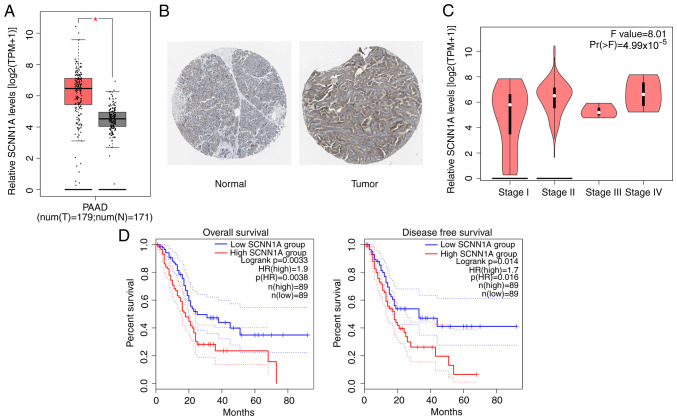
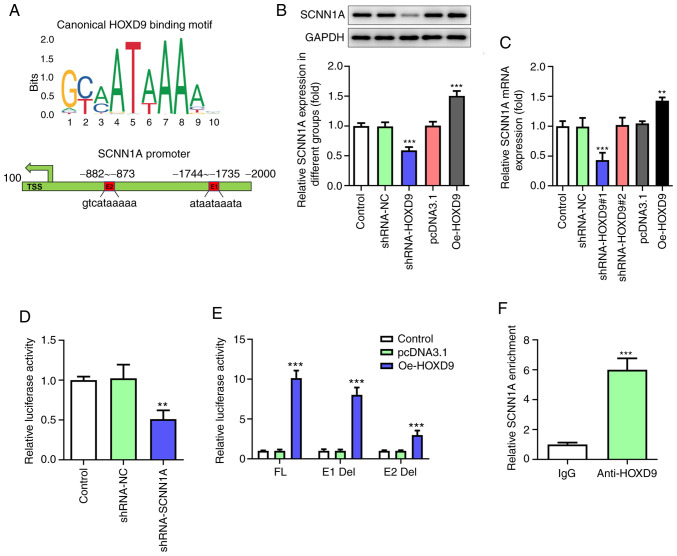
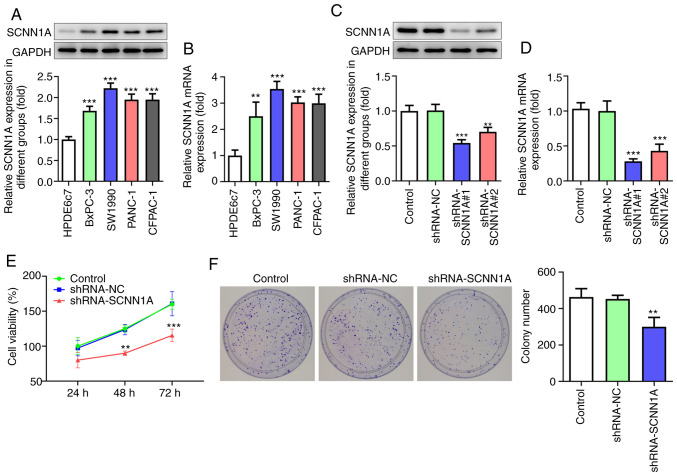
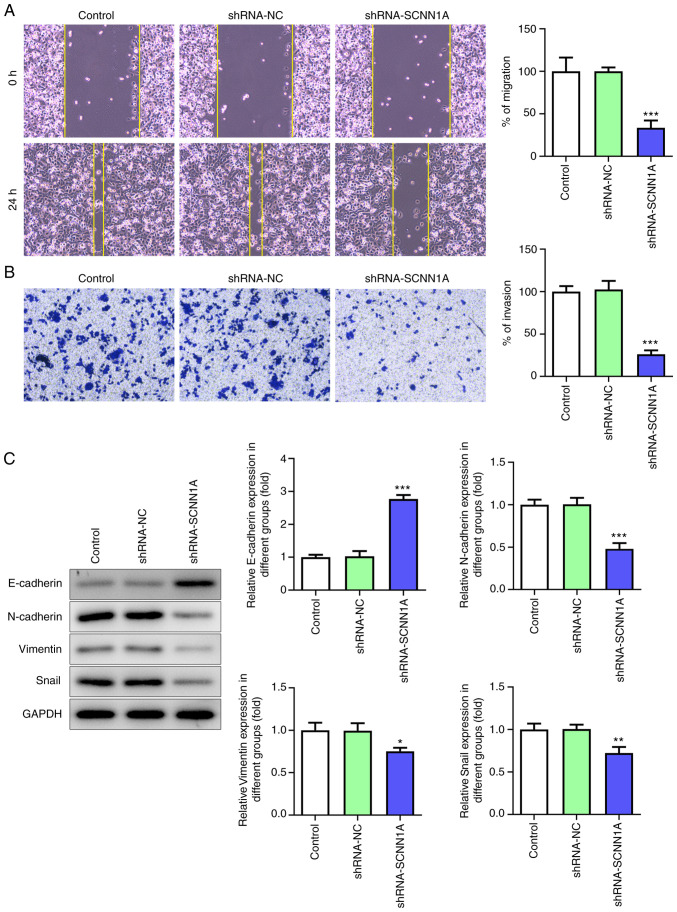
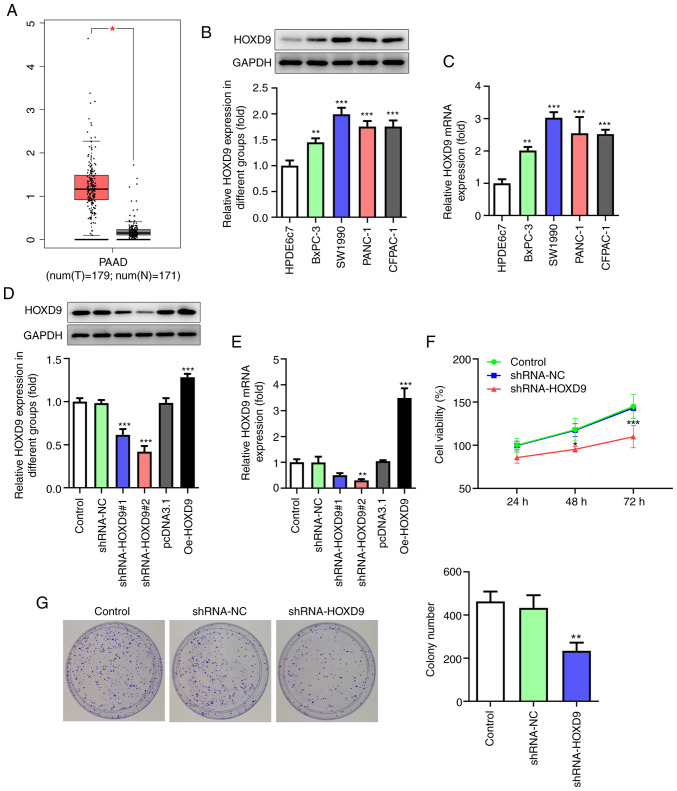
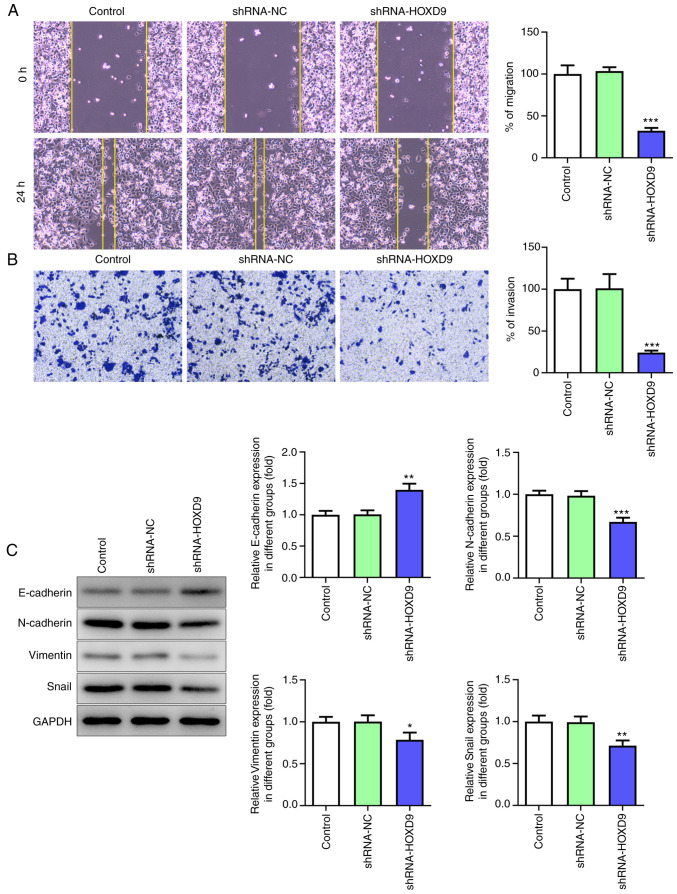
Pancreatic cancer (PC) is a malignant tumor disease, whose molecular mechanism is not fully understood. Sodium channel epithelial 1α subunit (SCNN1A) serves an important role in tumor progression. The current study explored the role of homeobox D9 (HOXD9) and SCNN1A in the progression of PC. The expression of SCNN1A and HOXD9 in PC samples was predicted on online databases and detected in PC cell lines. The association between SCNN1A expression and PC prognosis was examined by the Gene Expression Profiling Interactive Analysis, The Cancer Genome Atlas and Genotype‑Tissue Expression databases and by a Kaplan‑Meier plotter. Subsequently, the biological effects of SCNN1A on PC cell growth, colony formation, migration and invasion were investigated through RNA interference and cell transfection. Next, the expression of E‑cadherin, N‑cadherin, Vimentin and Snail was detected by western blotting to discover whether HOXD9 dysregulation mediated PC metastasis. Binding sites of HOXD9 and SCNN1A promoters were predicted on JASPAR. Reverse transcription‑quantitative PCR and western blotting were used to detect the expression level of SCNN1A following interference and overexpression of HOXD9. Luciferase assay detected luciferase activity following interference with HOXD9 and the transcriptional activity of SCNN1A following binding site deletion. High expression of SCNN1A and HOXD9 in PC was predicted by online databases, signifying poor prognosis. The present study confirmed the above predictions in PC cell lines. Knockdown of SCNN1A and HOXD9 could effectively inhibit the proliferation, migration, invasion and epithelial‑mesenchymal transition of PC cells. Furthermore, HOXD9 activated SCNN1A transcription, forming a feedback regulatory loop. HOXD9 was demonstrated to activate SCNN1A and promote the malignant biological process of PC.
胰腺癌(PC)是一种恶性肿瘤疾病,其分子机制尚未完全阐明。钠通道上皮 1α 亚基(SCNN1A)在肿瘤进展中起着重要作用。本研究探讨了同源盒 D9(HOXD9)和 SCNN1A 在 PC 进展中的作用。通过在线数据库预测 PC 样本中 SCNN1A 和 HOXD9 的表达,并在 PC 细胞系中检测。通过基因表达谱交互分析、癌症基因组图谱和基因型组织表达数据库以及 Kaplan-Meier 绘图器检查 SCNN1A 表达与 PC 预后的关系。随后,通过 RNA 干扰和细胞转染研究 SCNN1A 对 PC 细胞生长、集落形成、迁移和侵袭的生物学影响。接下来,通过 Western blot 检测 E-钙黏蛋白、N-钙黏蛋白、波形蛋白和 Slug 的表达,以发现 HOXD9 失调是否介导 PC 转移。在 JASPAR 上预测 HOXD9 和 SCNN1A 启动子的结合位点。逆转录定量 PCR 和 Western blot 用于检测干扰和过表达 HOXD9 后 SCNN1A 的表达水平。荧光素酶测定检测干扰 HOXD9 后荧光素酶活性和结合位点缺失后 SCNN1A 的转录活性。在线数据库预测 PC 中 SCNN1A 和 HOXD9 的高表达,提示预后不良。本研究在 PC 细胞系中证实了上述预测。敲低 SCNN1A 和 HOXD9 可有效抑制 PC 细胞的增殖、迁移、侵袭和上皮-间充质转化。此外,HOXD9 激活 SCNN1A 转录,形成反馈调节环。HOXD9 被证明可激活 SCNN1A 并促进 PC 的恶性生物学过程。